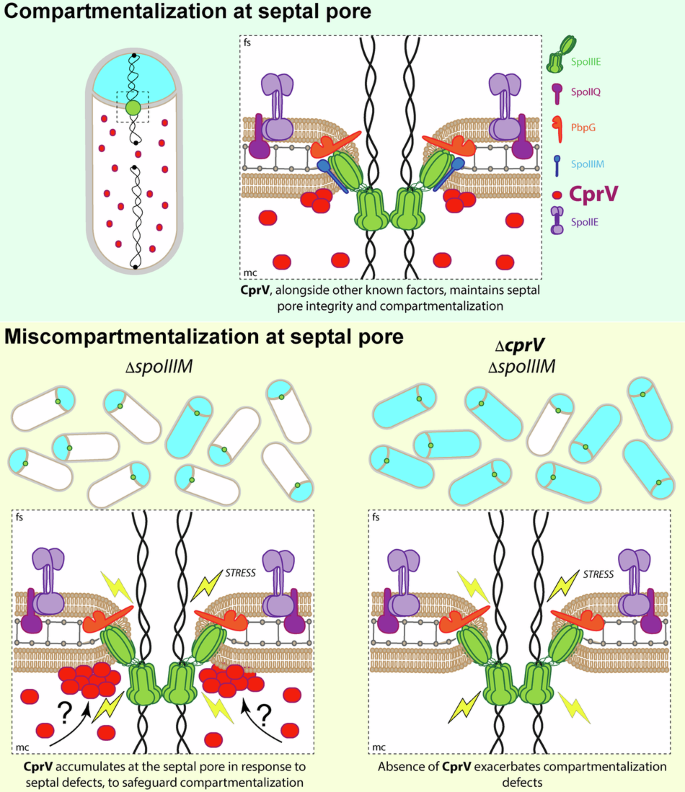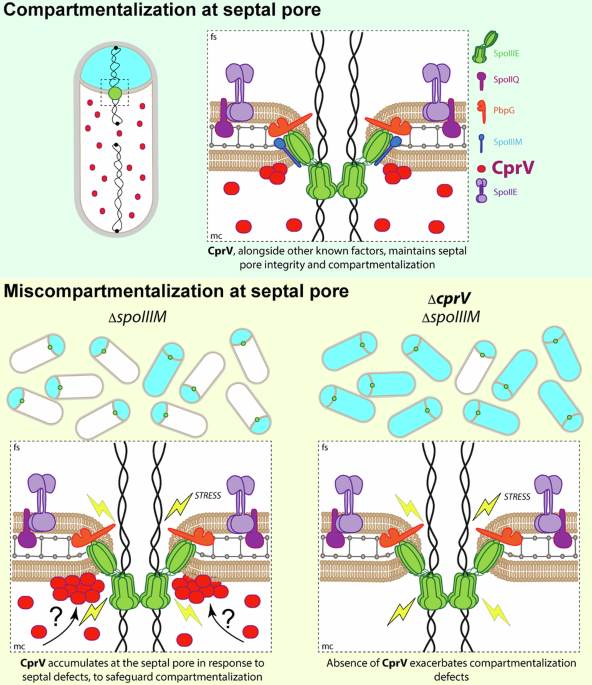
Bacterial endospore formation begins with a polar septum that compartmentalizes two transcriptionally distinct cells, the mother cell and forespore. In Bacillus subtilis, a complex composed of SpoIIIE, SpoIIIM and PbpG maintains compartmentalization at a septal pore during hydrolysis of septal peptidoglycan (PG), by coordinating two critical functions: chromosome translocation from the mother cell to the forespore through the septal pore and preservation of septal pore stability through SpoIIIE-PG interactions and PG synthesis. Disruption of this mechanism leads to cytoplasmic leakage, failed chromosome transfer, and reduced sporulation. Here, we identify CprV (YteV) as a safeguarding factor that maintains compartmentalization in response to septal pore stability defects. Cells lacking CprV show mild defects in compartmentalization and chromosome translocation; however, in mutants experiencing septal pore instability, loss of CprV significantly worsens these defects. Consistent with this role, CprV accumulates at the septal pore in a SpoIIIE-dependent manner when chromosome translocation is impaired. Computational analyses indicate that CprV exhibits structural similarity to Alba proteins found in Eukaryotes and Archaea and is primarily conserved in the Bacillales. Collectively, our data support a model whereby CprV monitors septal pore stability to safeguard compartmentalization during sporulation, providing insight into how cells monitor compartmental integrity during cellular remodeling.