
Five teenagers swept gold at the International Physics Olympiad, the product of 27 years of quiet public investment. The programme’s own data says two of every three medallists will build their lives elsewhere.
The first problem on this year’s International Physics Olympiad theory paper concerned the thermodynamics of paramagnetic cooling — the technique by which physicists in the 1930s first pushed matter below one kelvin. Modern variants of the same idea still cool experiments into the millikelvin regime today.
At heart, it is an exercise in keeping track of where energy and entropy go.
The atoms of a paramagnetic salt carry tiny magnetic moments that line up when a strong field is switched on; that ordering squeezes entropy out of the spins, and if the salt is held against a cold reservoir while it happens, the entropy drains away as heat.
Isolate the salt and ease the field back down, and the spins must recover their disorder, but the only currency left to pay for it is the thermal energy of the crystal itself, so the temperature plunges.
Full marks required a student to run an entropy ledger across cycles of magnetisation and demagnetisation, to hold field, temperature and heat capacity in a single moving picture, and to keep the second law of thermodynamics intact throughout. Universities teach this material in the second or third year of a physics degree, when they teach it at all. In Bucaramanga, Colombia, this July, it was set to teenagers as the opening act of a five-hour paper.
The 56th International Physics Olympiad, which ran from 5 to 12 July, drew 381 students from 87 countries, each one the best school physicist their country could find. India sent five: Kanishk Jain of Pune, Riddhesh Anant Bendale of Indore, Rishit Garg of Delhi, Shresth Suraiya of Mumbai and Svarit Joshi of Ahmedabad.
All five won gold — a clean sweep that placed India joint first in the world alongside China, Russia, South Korea, Taiwan and Kazakhstan, countries that fund science education as an instrument of state power.
Professor Anwesh Mazumdar of the Homi Bhabha Centre for Science Education, who led the team, summarised the performance afterwards in the flat register of a man reading an instrument: across both rounds, he said, the students worked with such diligence that examiners found little scope to deduct marks.
The centre is the body behind all of it: a unit of the Tata Institute of Fundamental Research, funded by the Department of Atomic Energy, it runs the national physics olympiad programme, trains the shortlisted students at a camp in Mumbai and selects the five who fly.
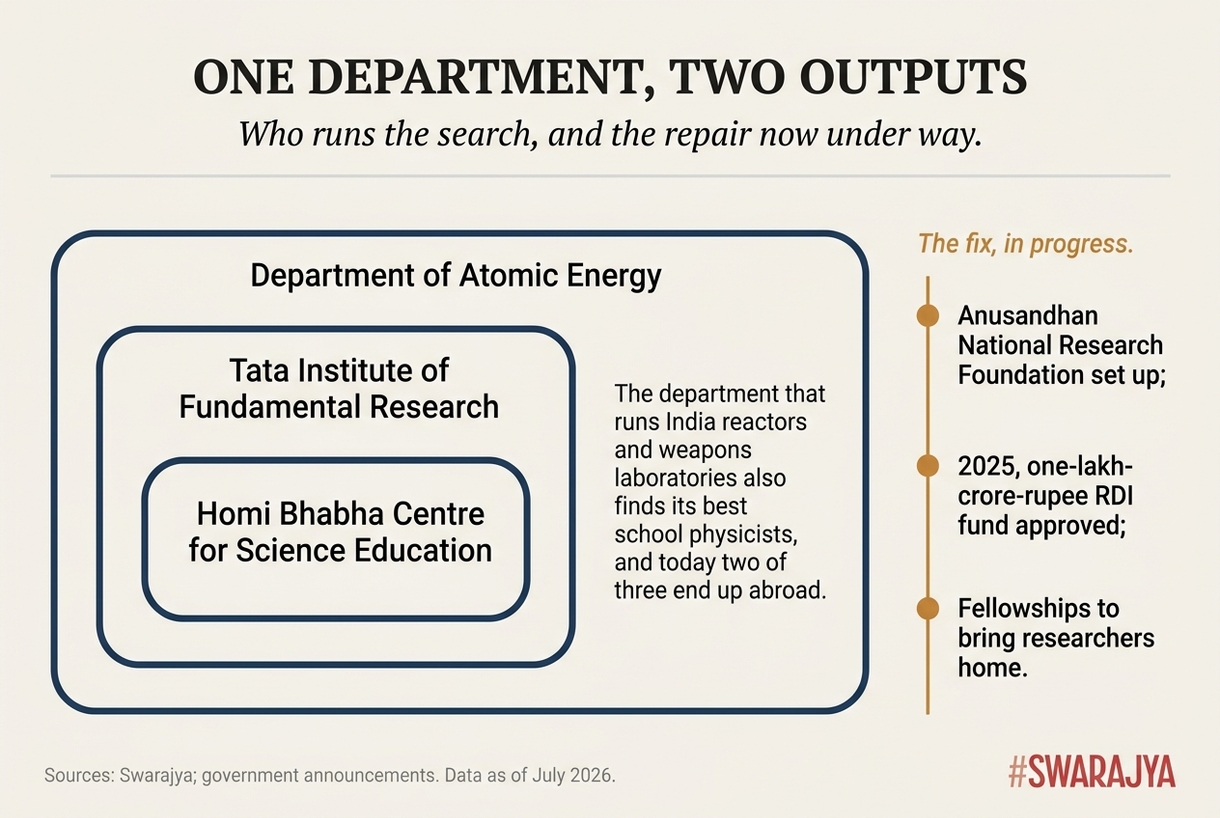
One government department finds the physicists through TIFR and HBCSE, and has now begun funding the laboratories meant to keep them.
Roughly the top eight per cent of contestants win gold. The Indian scripts, by the team leader’s account, were near perfect on theory and excellent in the laboratory. India has managed a five-gold sweep once before, in 2018. This year makes it twice in 27 appearances.
That remark about un-deductable marks points to something much larger. Over the past twenty-seven years, India has quietly built, almost entirely with public money, one of the world’s strongest systems for identifying and training young scientific talent. It has been far less successful at building the ecosystem that persuades many of those students to spend their careers in India.
Both stories emerge from the career of the same man.
Mazumdar, whose team swept Bucaramanga, also keeps the programme’s alumni record, and the record says that about 64 per cent of India’s olympiad medallists go on to a PhD, while about 32 per cent end up settled in India. The pipeline produces genuine physicists at a rate any country would envy, and then watches two of every three build their laboratories somewhere else.
Mazumdar’s numbers show that while India has become very good at finding gifted young physicists, it has been much less successful at keeping many of them. That matters for reasons beyond prestige.
The olympiad programme is funded by the Department of Atomic Energy, the same organisation that runs India’s nuclear reactors and weapons laboratories. When two-thirds of its best students eventually settle abroad, the department ends up supplying talent to physics departments at places like Princeton, Stanford and Berkeley.
The examination (international olympiad) itself explains why the achievement resists comparison with anything in India’s better-known academic culture. The olympiad syllabus reads like a first-year undergraduate course — mechanics, electromagnetism and optics, thermodynamics, special relativity.
The problems live at another altitude. After the paramagnetic salt came the photoionisation of ozone: Einstein’s Nobel-winning energy balance, in which a photon’s energy pays the electron’s binding cost and the surplus appears as kinetic energy, wrapped around a real triatomic molecule in the real atmosphere.
The rule itself fits in a line: light arrives in packets, and a packet either carries more than the twelve and a half electronvolts or so that bind ozone’s outermost electron, or it does not; only above that threshold is the electron torn free, departing with whatever energy is left over.
Everything difficult lives in the application, in how likely a given photon is to succeed, which physicists compress into a quantity called a cross-section, and in what the liberated electrons betray about the molecule they have just left. The student had to move fluently between quantised light, molecular structure, cross-sections and thresholds — the physics of the layer that shields every living thing from ultraviolet radiation.
The third problem concerned electron-positron pairs, which is special relativity with the gloves off: annihilation into gamma rays of exactly 511 kiloelectronvolts, pair production conjuring matter from light near a recoiling nucleus, invariant mass and centre-of-momentum frames.
None of those numbers is arbitrary. A positron is the electron’s antiparticle, identical in mass and opposite in charge, and when the two meet at rest they vanish into pure light; 511 kiloelectronvolts is simply the mass of one electron converted through E = mc², and the two photons must fly apart in exactly opposite directions because the pair had no net momentum and the light may carry none away.
Run the film backwards and a photon with at least twice that energy can conjure the pair into existence, but only in the neighbourhood of a nucleus, because something heavy must absorb the recoil for the books of momentum to balance. The machinery of particle physics, demanded of a school student against a clock.
On another day came the experimental paper: five more hours, in a laboratory, on heat transfer and thermodynamic processes in fluids, with equipment the students had never seen and no procedure to follow. Design the experiment, take the readings, propagate the uncertainties, defend the number.
At this level the medals are decided in the error analysis, because a measurement without an honest uncertainty is a number rather than physics.
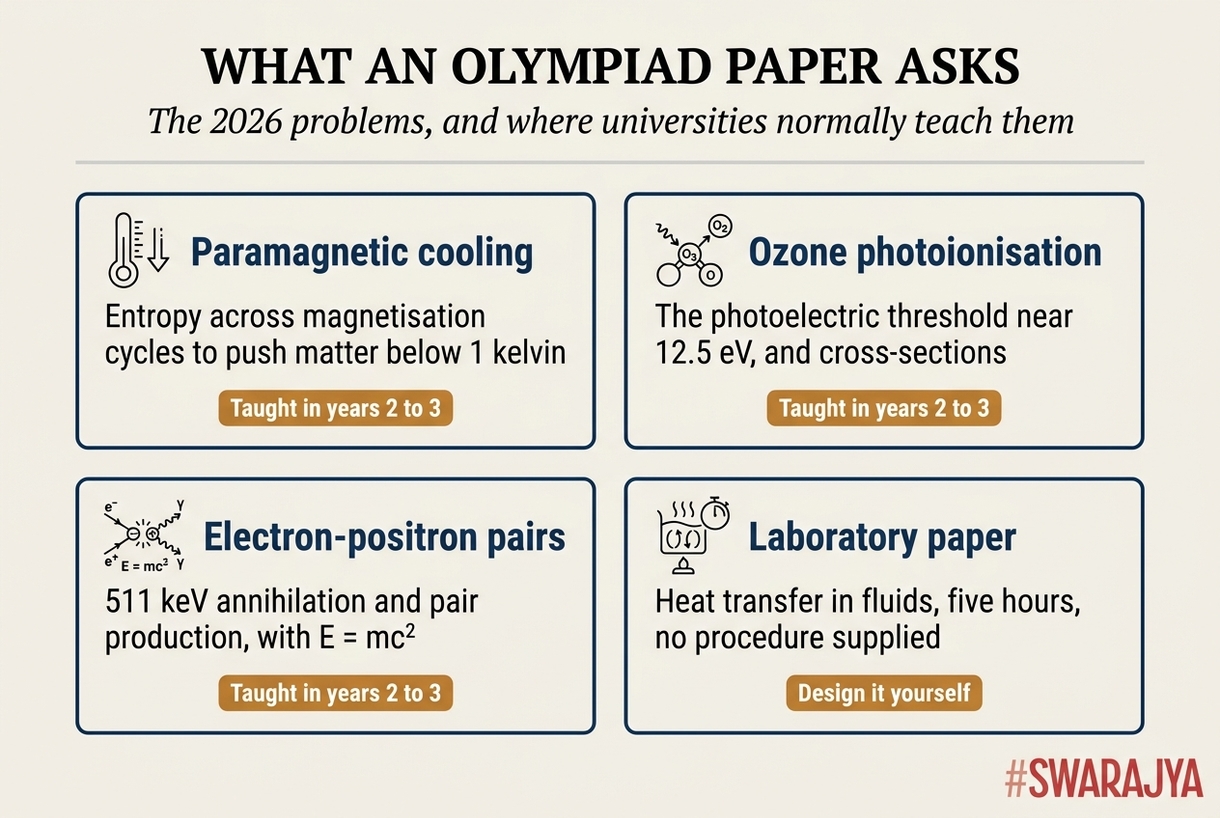
What the 2026 olympiad asked, and the university year at which the same physics is normally taught.
None of this yields to the skill India’s examination culture rewards. The coaching industry has become superbly good at one thing — teaching a student to solve a known problem fast. Pattern recognition, at speed, under pressure: a real skill, and a hard one, and precisely what the JEE measures. An olympiad paper carries no known types. Nobody has taught paramagnetic cooling as a “type”; there is no shortcut chapter and no formula sheet that saves you. A student sits with a problem never seen before, for hours, and either understands physics or does not.
Speed can be trained in months. Depth grows over years, and the institution that has been growing it in Indian teenagers is a government centre.
The Homi Bhabha Centre for Science Education (HBCSE), part of the Tata Institute of Fundamental Research under the Department of Atomic Energy, oversees India’s Physics Olympiad programme. Students first qualify through an examination conducted by the Indian Association of Physics Teachers. A small number then progress to the Indian National Physics Olympiad and a selection-cum-training camp at HBCSE in Mumbai. Five students are ultimately selected to represent India at the International Physics Olympiad.
India’s team was led by Professor M. Mazumdar of HBCSE-TIFR and Dr Leena Joshi of St Xavier’s College, Mumbai. The scientific observers were Professor Ananda Dasgupta of IISER Kolkata and Nisha Kelkar of Gogate-Joglekar College in Ratnagiri, Maharashtra.
India’s record at the International Physics Olympiad has been consistently strong. In its 27 appearances, about 44 per cent of Indian participants have won gold medals and around 41 per cent have won silver. Over the past decade, every Indian participant has returned with a medal—62 per cent won gold and the remaining 38 per cent silver.
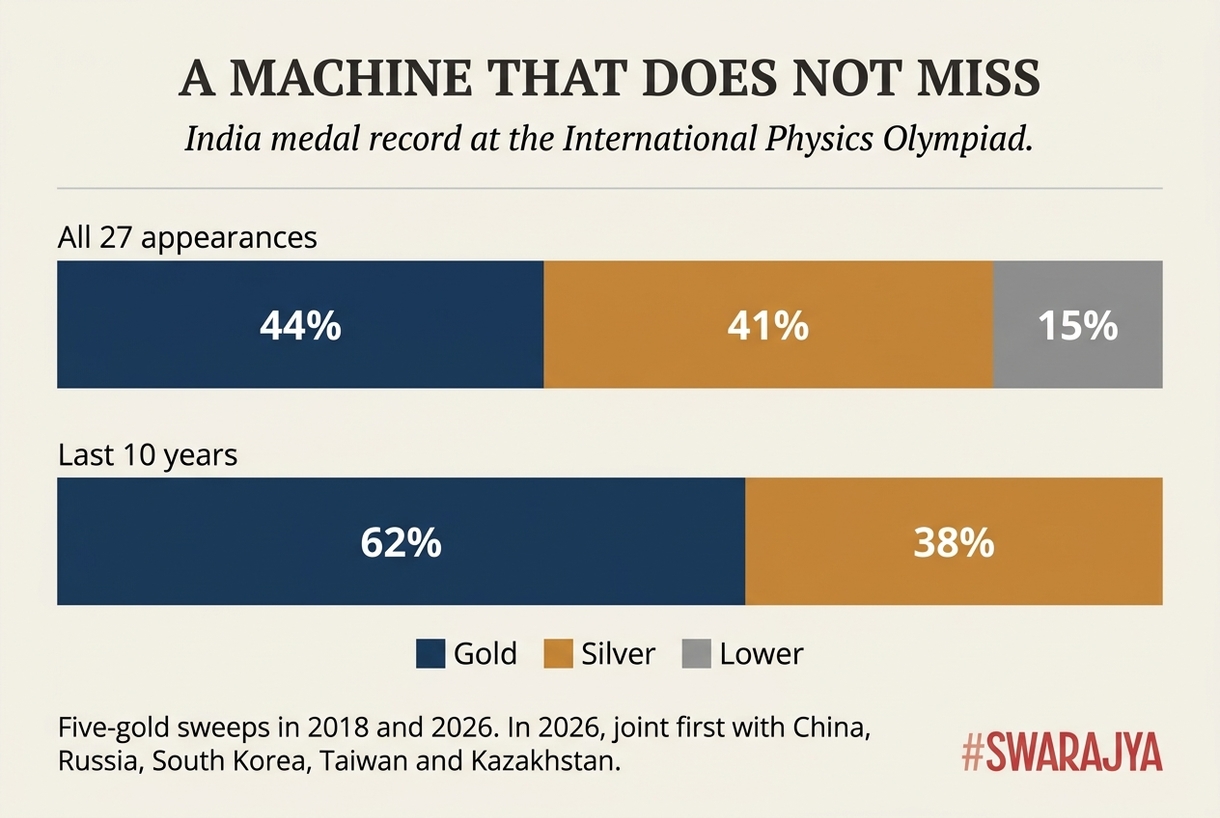
Across 27 appearances the medal rate has risen steadily, and every Indian participant has come home with one in the past 10 years.
The results reflect a long-established selection and training system led by HBCSE, which prepares India’s team for one of the world’s most demanding school-level physics competitions.
Then the medallists leave. Gold in Grade 12; then MIT, or an IIT followed by an American graduate school; a PhD at Princeton or Stanford or Berkeley; a postdoc, a green card, a laboratory, a life. The wider research confirms the pattern at scale. One study tracking the careers of more than 1.5 lakh Indian-affiliated researchers found that barely a quarter of those who go abroad ever return, with the United States the single largest destination. A separate global analysis of elite-university graduates found America capturing nearly four in ten of the world’s mobile top talent.
There is a serious case that none of this should trouble anyone. These five owe the country nothing. They earned every option they now hold in the hardest arena open to their generation, and anyone inclined to sneer at an 18-year-old for accepting a full scholarship to the best physics department on Earth should first attempt what he did.
Scientific research is inherently international. Researchers usually work where the best laboratories, funding and collaborators are, and today those remain concentrated in the United States. India nevertheless benefits through research collaborations, returning faculty and the expertise that many scientists eventually bring back. Restricting talented students from pursuing opportunities abroad would do more harm than good.
Individual researchers should be free to pursue the best opportunities available to them. But migration patterns also depend on the opportunities available in India. A survey of 20,000 IIT graduates found that 41 per cent of those in the early-2000s cohorts settled abroad, compared with less than 16 per cent among post-2010 graduates. The decline coincided with the expansion of India’s software and startup sectors, which created more high-quality opportunities at home. Scientists are likely to respond to similar factors, including better laboratories, greater research funding, stronger academic ecosystems and more opportunities to do world-class work in India.
The ground has, in fact, begun to shift. The Anusandhan National Research Foundation has been set up to put university research funding on a new footing, and in 2025 the government approved a Rs 1 lakh crore Research, Development and Innovation fund — patient capital aimed at exactly the deep, slow work that keeps scientists in a country.
Fellowship schemes now exist whose entire purpose is to bring Indian researchers home. None of it will show results quickly. The olympiad machine took 27 years of unglamorous, compounding public investment to reach joint first in the world; the research ecosystem that must catch its graduates will demand the same patience, and offers the same absence of shortcuts.
In Bucaramanga, over 10 hours, five Indian teenagers were asked everything the world’s examiners could devise about magnetised salts, ionised ozone and annihilating antimatter, and answered so completely that the graders struggled to find marks to remove. Their names — Jain, Bendale, Garg, Suraiya, Joshi — will run in the science pages for a day, in a country that knows a 100 cricketers by their nicknames.
India’s system has consistently identified and trained some of the world’s best young physicists. The larger question is whether it can also offer enough opportunities for more of them to build their research careers in the country. That depends not on the students, but on the quality of India’s research ecosystem.
Kishan Kumar is a graduate in Economics from the University of Delhi, currently working in the political communication space. He focuses on narrative-building, strategic messaging, and public discourse, with a strong interest in politics, policy, and media.
He posts on X from @FreezingHindoo.