
“When asked about the pregnancy, Smith stated that she had miscarried and as a result the stillborn baby and placenta had been flushed down the toilet,” the agreed summary of facts for her case states.
“She further stated she had provided the stillborn baby to a doctor for cremation purposes however did not have any details of the doctor or cremation services provider.”
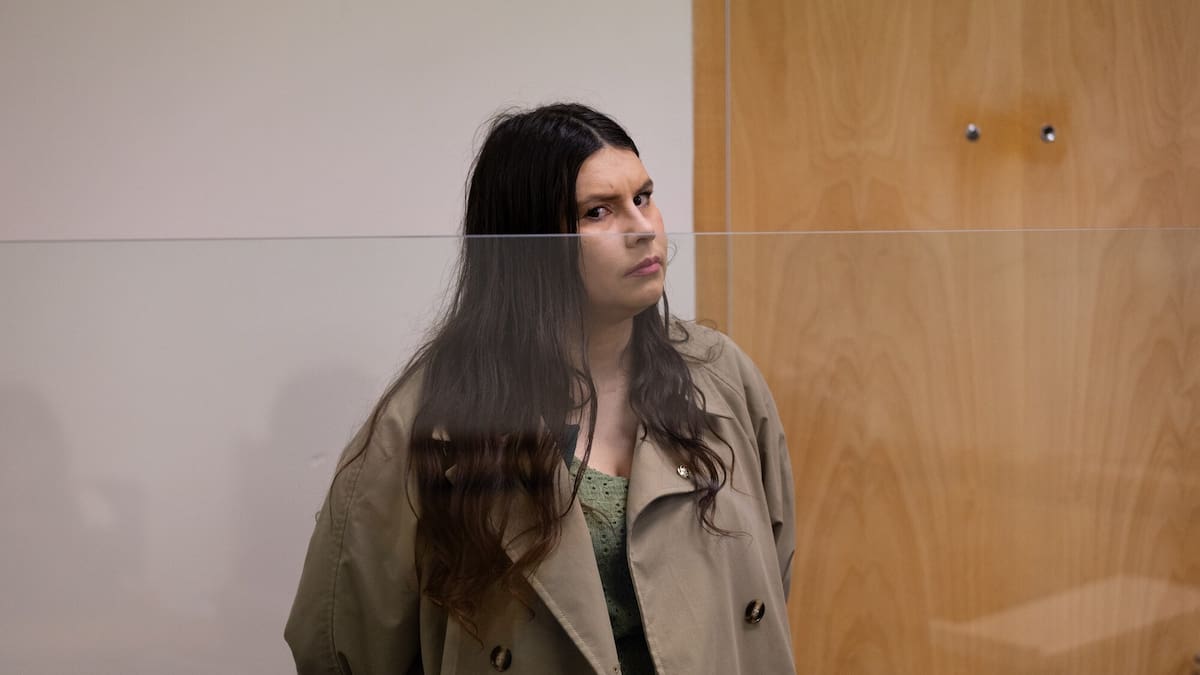
Chanelle Smith appears for sentencing in Auckland District Court after pleading guilty to interfering with the remains of her newborn baby. Photo / NZ Herald
Police were suspicious of the contrary explanations, suspecting she had concealed the baby. They returned to her home the following day with a search warrant.
The corpse was discovered in a rubbish bin.
“I don’t know what she’s talking about,” she said when police asked details about the newborn’s condition, declining further comment.
“The defendant has a significant and recent mental health history and this is believed to have played a role in the alleged offending,” the summary of facts concludes.
Authorities treated the case initially as a homicide investigation, but a preliminary autopsy was not able to determine a cause of death for the baby, or if the child was born alive.
Police investigate the scene in July 2025 where a dead newborn was found in a wheelie bin. Photo / Carson Bluck
Smith spent four and a half months in custody, with at least part of that time at the Mason Clinic, a lockdown psychiatric facility. She has spent the past eight months on electronically monitored bail, which she has had no problems complying with, her lawyer said.
The court ordered a psychiatric report in October to evaluate if Smith had a potential defence of insanity. She pleaded guilty shortly after the report, which opined she didn’t fit the legal definition of insanity, was completed.
Smith faced up to two years’ imprisonment for the interfering with human remains charge. Police prosecutor Yara Alrubayee asked the judge for a two-year starting point and an end sentence of imprisonment.
“This offending is the worst of its kind due to the particular cruelty,” she said. “There is a need to denounce … and send a message this is not acceptable.”
Defence lawyer Joon Yi argued that the punitive element had already been served by the time Smith spent in custody or under restrictive bail conditions. He acknowledged that the case is on “the higher end” of the scale for such crimes but said a 21-month starting point would be more appropriate so that the maximum starting point could be reserved for worst cases in the future.
Flowers were at the scene after a newborn baby was found inside a wheelie bin on July 1, 2025. Chanelle Smith has since pleaded guilty to interfering with human remains. Photo / Dean Purcell
With a reduction to recognise Smith’s mental health issues, the sentence could be reduced to 12 months and converted to home detention or a lengthening of the intensive supervision sentence she was already serving for an unrelated crime.
Smith is doing well under supervision, receiving weekly medication injections and is showing improvement, Yi told the judge.
In his sentencing remarks, Judge Dawson noted that Smith had four prior convictions for violence and 30 other convictions that included dishonesty and drugs. She was assessed as having a moderate risk of reoffending and a high risk of causing harm to others.
“The principal sentencing factors here are denunciation and deterrence,” he said. “This is behaviour that is not acceptable to the community at any time. A sentence needs to make it clear there are consequences for your actions.”
But he also noted Smith’s mental health issues and low cognitive functioning.
Police found a newborn’s remains after executing a search warrant at a Freemans Bay home. Photo / Carson Bluck
Judge Dawson ordered a 20-month starting point and allowed a 20% reduction for her guilty plea, resulting in a preliminary sentence of 13 months. He allowed it to be converted to four months’ home detention, followed by six months of post-detention conditions “to ensure you continue to get the help and assistance you require”.
Smith, who wore bright red Converse high tops and a beige trench coat as she stood in the dock, wiped away a tear at one point as the judge explained his sentence.
Her lawyer had started the hearing petitioning the judge to bar the media from receiving the agreed summary of facts. The fallout of the public knowing the most confronting details would be such that his client would never fully be able to rehabilitate, he argued.
Police cordon off the scene in July 2025 after a deceased newborn baby was discovered in a wheelie bin on Renall St, Freemans Bay.
The judge rejected the argument, noting no psychological evidence of extreme hardship had been submitted to the court.
“It’s a very hard position to maintain when the presumption is the public has a right to know,” the judge said.
However, the judge did suppress some details from the summary for another reason: fairness to the defendant. The passages involved unproven allegations, he said.
Craig Kapitan is an Auckland-based journalist covering courts and justice. He joined the Herald in 2021 and has reported on courts since 2002 in three newsrooms in the US and New Zealand.
Sign up to The Daily H, a free newsletter curated by our editors and delivered straight to your inbox every weekday.