
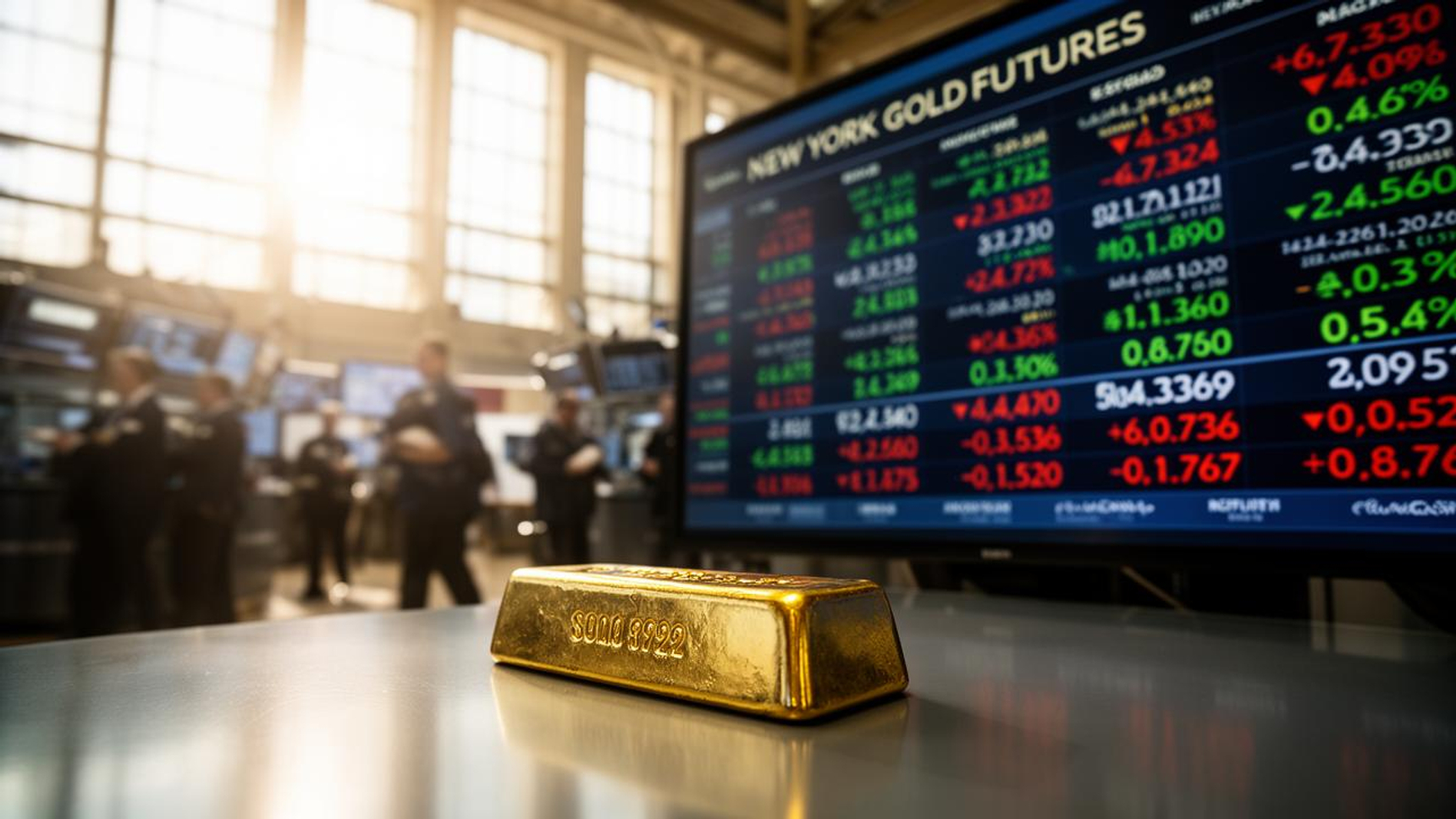
Fresh US inflation data continues to deliver positive surprises. Following an unexpected decline in the Consumer Price Index (CPI), the June Producer Price Index (PPI) also came in below market expectations, significantly easing concerns that the Federal Reserve (Fed) would resume raising interest rates in the near term. However, the precious metals market showed a divergent reaction, with New York gold futures and spot gold closing mixed on Wednesday.
August gold futures on the New York Mercantile Exchange fell $17.90, or 0.44%, to settle at $4,051.80 per ounce. In contrast, the spot market moved in the opposite direction, with New York spot gold rising $7.70, or 0.19%, to $4,060.55 per ounce.
Data released by the US Bureau of Labor Statistics on Wednesday showed that the PPI unexpectedly fell 0.3% month-over-month in June, weighed down by declining energy costs. This was significantly below economists’ expectations for a flat reading and a sharp deceleration from the revised 0.6% monthly increase in May, marking the lowest monthly gain since April 2025. On a year-over-year basis, the June PPI slowed to 5.5% from the previous month’s revised 6.0%, also below the market estimate of 6.2%.
The clear cooling of inflationary pressures rapidly reversed market expectations for monetary policy tightening. Trading data from the interest rate swap market showed that traders’ estimated probability of a Fed rate hike at the July meeting plummeted from nearly 50% the previous day to approximately 10%. Both the US Dollar Index and US Treasury yields declined following the data release, providing some support for gold prices, though the futures market still faced profit-taking pressure.
This trend of cooling inflation has persisted for several days. According to data released on Tuesday, the US June CPI fell 0.4% month-over-month, also better than economists’ forecast of a 0.1% decline, with gasoline prices posting their largest drop since 2022. The core CPI, which excludes food and energy, was flat month-over-month, below the expected 0.2% increase.
During his semi-annual monetary policy testimony before Congress on Tuesday and Wednesday, Federal Reserve Chair Jerome Powell reiterated his commitment to achieving price stability, but his remarks did not alter market expectations for a policy shift. Against the backdrop of consecutive better-than-expected inflation data, the US 2-year Treasury yield fell 8 basis points to 4.20% on Tuesday.
In currency markets, the US Dollar Index (DXY), which tracks the greenback against a basket of six major currencies, fell 0.31% on Tuesday to 100.919. Major currencies broadly strengthened against the dollar, with the British pound rising $0.0042 to $1.3390, the euro gaining $0.0039 to $1.1420 per euro, and the dollar weakening by ¥0.18 against the Japanese yen to ¥162.25 (approximately $1.001).
Among other precious metals, silver futures fell 0.9% on Wednesday to $58.585 per ounce, while copper prices bucked the trend, rising 0.4% to $6.4010 per pound. In energy markets, crude oil prices declined 0.7%, with West Texas Intermediate crude settling at $78.80 per barrel.
Geopolitical developments remain a potential variable influencing commodity markets. Markets continue to focus on the collapsed US-Iran ceasefire and the situation in the Strait of Hormuz. Brent crude oil prices briefly surpassed $87.50 per barrel on Tuesday, rising for a second consecutive day.
Global equity markets broadly closed higher on Wednesday, reflecting market optimism over easing inflation. The Dow Jones Industrial Average rose over 150 points, or 0.32%, to close at 52,675.73. The Nasdaq Composite edged up 0.13% to 26,139.93, while the S&P 500 advanced 0.22% to 7,560.24. In terms of sector performance, consumer discretionary stocks surged 1.2%, while energy shares fell 0.5% due to lower oil prices.
Asian markets also mostly closed higher on Wednesday, with Japan’s Nikkei 225 rising 1.49%, Hong Kong’s Hang Seng Index gaining 1.40%, and India’s BSE Sensex edging up 0.17%, though China’s Shanghai Composite Index bucked the trend, falling 0.29%. European stocks were mixed, with the Eurozone STOXX 600 edging up 0.1%, Germany’s DAX falling 0.7%, France’s CAC 40 rising 0.2%, and the UK’s FTSE 100 slipping 0.1%.
Analysts noted that the PPI data further confirms that US inflationary pressures are easing, giving the Federal Reserve more room for policy assessment. If subsequent economic data continues to show easing price pressures, the probability of the Fed holding steady in July will rise further, which could support the medium-to-long-term trend for non-interest-bearing assets like gold. However, in the short term, the price spread volatility between futures and spot markets still reflects divergent investor positioning at elevated levels.