
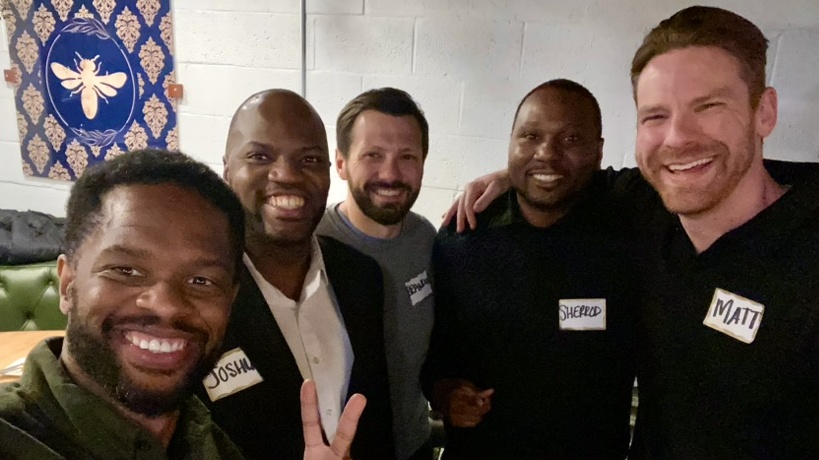

Vernon Foster, left, and a group of founders at one of his business’ Growth Dinners. (Images courtesy Growth Dinners)
Vernon Foster is looking to get leaders from Richmond’s startup scene together to break bread.
Foster recently launched Growth Dinners, a business that hosts dinners for startup founders in Richmond and other areas of Virginia.
The company has held six of the invite-only ticketed, once-per-month events in Richmond thus far, with the goal of connecting like-minded local entrepreneurs in-person to share their ideas and advice on how they can grow.
But Foster isn’t inviting just anyone to the table. Eligibility criteria for participating startups includes over $1 million in annual revenue, a minimum $2 million capital raise or a $5 million-$10 million exit from a prior company.
Foster said he’s hosted over 40 different founders to date, running the gamut of industries from AI to agriculture to food and beverage.
A startup founder himself, Foster relocated to Richmond several years ago from New York City. He hails originally from central Florida and started his first business around 2008 while a student at Florida State University. He later worked on events and programming for several different companies, including Acast in New York City, and founded podcast production company Pod Parrot, which he ran for 12 years before retiring the business in April of this year.
Foster currently owns WebinarRev, a webinar marketing agency that recently produced a launch for Robert Greene, the author of “The 48 Laws of Power.”
Foster and his wife relocated to Richmond in 2022, following the COVID-19 pandemic, and he began looking for opportunities to connect other founders with one another.
“Collective wisdom always allowed me to grow in life and business … that was always something I had at every stage of my journey, and when I got to Richmond almost four years ago now, I was missing that,” he said. “Well if it’s not out there, I’ll go build it.”

Founders chat at a growth dinner.
He told BizSense he began Growth Dinners by cold-calling local founders he felt might make a good fit, paying for the dinners out of pocket.
“I’d go on LinkedIn, stalk people on LinkedIn and be like, ‘This looks like somebody I’d like to have dinner with,’” Foster said of finding people for his first dinners.
Foster’s first dinner was held last December at event venue Studio One Twenty in the Brookland Park neighborhood. The night included a catered meal and an open bar, as well as discussion among nine local founders on how to grow their businesses.
“That was my litmus test of, one, is this something I enjoy … and two, would people get value out of this. And it was a hit,” he said. “It was the first one I did, so it was a little bit rough around the edges, but, from that dinner sparked the series and it became what is now known as Growth Dinners … that solidified the concept and gave me the confidence and the feedback I needed.”
Since then, Growth Dinners has held six incubator dinners in town thus far across various event venues and local restaurants.
Previous attendees include founders like DJ Little of local tech company SEEDStudio, Dennis Kao of Richmond growth equity firm MCH Concepts and Taylor Quinn, CEO of Richmond production and digital marketing agency Filmspire.
Tickets to Growth Dinners’ events are $55 per person and includes the discussion and a prix fixe menu dinner.
After hosting a few dinners, Foster said Growth Dinners is now mostly an application-based concept. Startups who fit the revenue eligibility criteria can request a seat, and are vetted by Foster and extended an invite if applicable. Foster said he typically has a call with each founder before they attend one of Growth Dinners’ events.
Hosted monthly, each dinner seats up to 12 participants, who partake in a roughly two-hour session where they detail their pain points as founders and discuss solutions among their peers. Foster said Growth Dinners typically gets 15 to 25 applications per dinner.

A prix fixe menu at one of the growth dinners.
“I think Growth Dinners is a third space for founders, because we don’t really have an outlet,” he said. “It’s a camaraderie when you can look across the table and be like, ‘Man, they know what I’m going through.’”
With the revenue eligibility requirements in place, Foster said the goal is for “experienced operators” to get together and share ideas.
“I think once people hit $1 million in revenue, they have proof of market. They’ve demonstrated they’ve built something, they usually have teams, they’re starting to have growing pains. So, I’d say that $1 million mark is where we’re aiming,” he said.
Yet Foster said while that is the benchmark, he does still consider applications for those under that revenue mark that also have some sort of proof of concept for what they’re doing.
Growth Dinners’ most recent event, held at Uliveto, included teaming up with local startup incubator Lighthouse Network. The startup and the incubator co-hosted Growth Dinners’ June dinner to get more eyes in front of the concept, Foster said. He hopes to work with other incubators both in Richmond and in other areas of Virginia in the future.
He is currently founding the business through both ticket sales and self-funding, noting that he is currently just focused on breaking even. He has invested around $15,000 into the company thus far.
Foster continues to run WebinarRev as he works on Growth Dinners.
Though the business is called Growth Dinners, Foster said he sees the idea expanding beyond dinners. Ideas include a potential annual conference for startup founders locally. He is currently gathering applications for a monthly session program called “Roundtable Mastermind,” that would gather startups in cohorts to talk more in-depth and long-term.
Foster added that he sees an opportunity to bring together local founders who are already within existing startup networks in Richmond.
“There’s great organizations here. Lighthouse Network, Startup Virginia, CAV Angels … collectively, I don’t know that someone’s bringing them together, and the hope is we may be able to do that,” he said. “I feel like Central Virginia has a lot of talent … the city is ripe for something like that.”
Print Article