
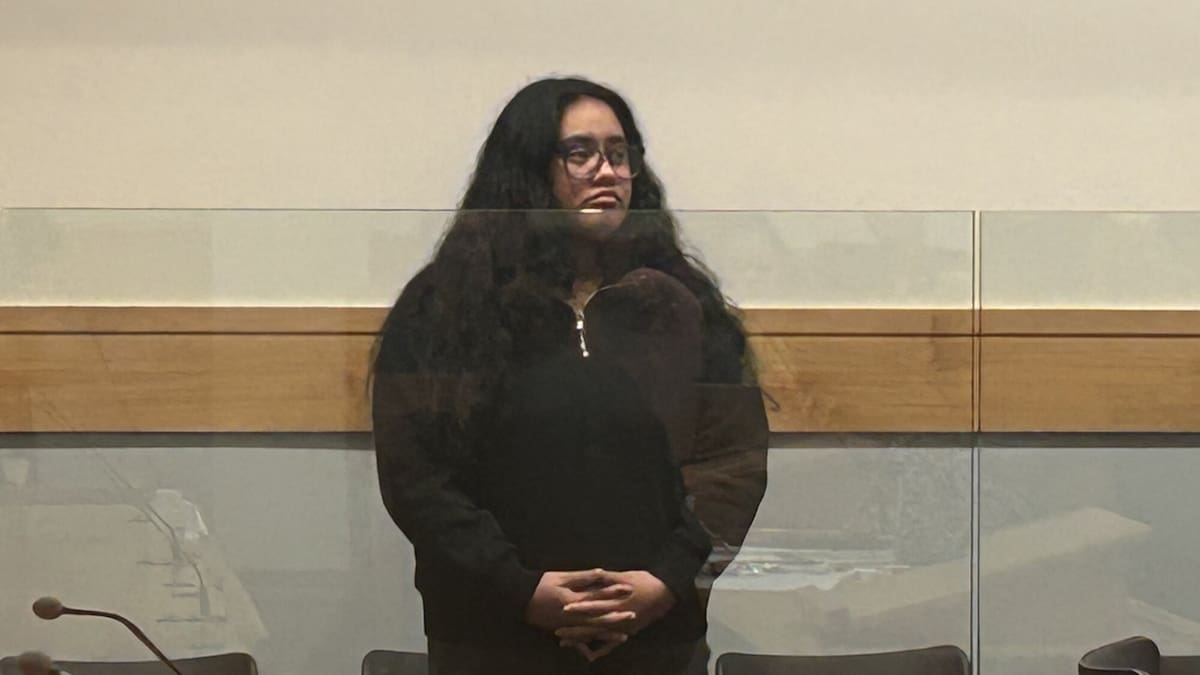
The jury heard evidence that Tahere, 22, of West Auckland, had been in an on-and-off relationship with Kaitāia woman Sunday Howard for a year and a half.
In March 2024, Howard was pregnant with Tahere’s baby, but they had broken up, and she moved to Kaitāia to be with her sister.
Howard ended up staying in Kaitāia and had their son in July, when Tahere first travelled north to meet him.
The couple reconciled, and Howard told the court the relationship had its normal ups and downs.
Howard was good friends with Thompson and would often share with her the challenges of her relationship with Tahere.
On September 7, 2024, Thompson had been at Howard’s home drinking when Tahere arrived before 10pm.
At some point, Howard and Tahere began arguing.
Howard said she was speaking loudly to Tahere when she noticed Thompson nearby, looking “macho”, wearing her hoodie and appearing to “staunch out the situation”.
Howard was angry by this stage of the evening and believed Tahere wanted to drink rather than spend time with her and their son.
She told him if he wasn’t there to help, he should “f*** off”.
Howard told the court Tahere was not angry and told her: “Go inside bro, you’re tired, bro.”
But within seconds, Howard heard a bottle smash and saw Thompson use it to stab Tahere’s neck.
It was the defence case that Thompson was acting in self-defence because Tahere was allegedly bouncing around and being aggressive.
Defence lawyer David Reece said Tahere and Howard were making threats towards each other, Tahere was standing at the time and Thompson put her arm out because he was in her face.
“I put it to you, she had the bottle out to defend herself because he was in her face,” Reece suggested to Howard in week one of the trial.
“False,” Howard said.
“She was holding her arm out as a barrier,” Reece said to Howard.
“False,” she responded.
Justice Natalie Walker allowed daily karakia throughout the three-week trial. Photo / NZME
The jury retired to consider its verdict on Tuesday afternoon and became stuck on question five of Justice Walker’s question trail part-way through Wednesday.
Justice Walker clarified the question for them, which was split into two parts.
“Evidently, you can’t look inside her head at that critical moment to see what she’s thinking. That is why you must draw inferences from facts you find proven,” Justice Walker said.
The question was “Are you sure that when Ms Thompson stabbed Mr Tahere in the neck she intended to kill him?”
That question was followed by an alternative question: “Are you sure that when Ms Thompson stabbed Mr Tahere in the neck she intended to cause him bodily injury that was more than minor in nature?”
“If you answer yes to 5a or all of the parts of 5b, you must find Ms Thompson guilty of murder,” Justice Walker said to the jury.
“If you answer no to 5a and to any of the parts of 5b, you must find her not guilty of murder and guilty of manslaughter.
“It is not enough to say ‘she ought to have known.’
You must be sure that she did know and chose to carry on in the face of that knowledge.”
The jury returned its unanimous guilty verdict about 12.30pm today,
Jurors were thanked for their service before being dismissed.
“Determination of guilt is a significant responsibility; it is not easy to sit in judgment,” Justice Walker told them.
“I hope you can leave this case behind you and return to your families and be proud of the role you have [played].”
Justice Walker acknowledged the respectful way the whānau had conducted themselves throughout the trial, and remanded Thompson in custody ahead of her sentencing in September.
She directed restorative justice to take place, and a final karakia was then conducted by members of Thompson and Tahere’s whānau.
Shannon Pitman is a Whangārei-based reporter for Open Justice covering courts in the Te Tai Tokerau region. She is of Ngāpuhi/ Ngāti Pūkenga descent and has worked in digital media for the past five years. She joined NZME in 2023.