
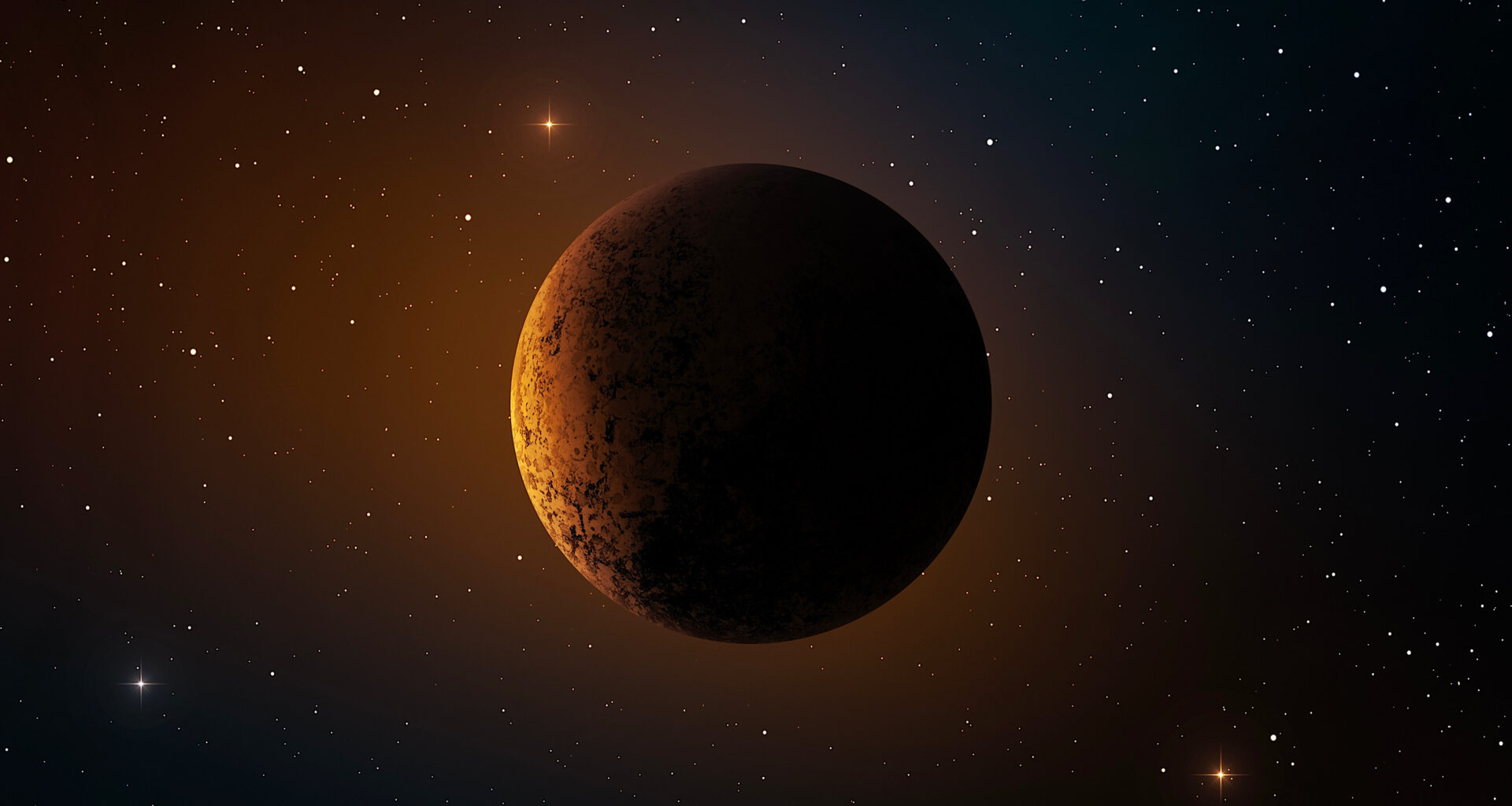
Astronomers have measured the mix of two forms of carbon in the atmosphere of Beta Pictoris b, a young gas giant about eleven times the mass of Jupiter.
The reading cannot reveal where the planet was born. It came out ordinary, close to the values found in the Sun and in the gas drifting between the stars.

For a few years, astronomers used this carbon ratio as one of the only tools to trace a giant planet back to where it formed in its disk.
The most precise reading yet now adds to growing evidence that the tool does not work, leaving the origins of these worlds harder to pin down.
Fingerprint of a planet
Isotopes are versions of the same element that carry slightly different weights.
Carbon comes in a common light form and a rarer heavy one, and in the cold of space both bond with oxygen to make carbon monoxide.
A few years ago, researchers proposed that the balance between the light and heavy versions of this molecule in a planet’s air could record how it was assembled.
The reasoning runs through temperature. Close to a star, carbon monoxide stays a gas.
When it is past a certain distance, called the snowline, it freezes into ice. Ice beyond that snowline was thought to be enriched in the heavy form of carbon.
Heavy carbon as a tracer
A planet that fed mostly on this ice, far from its star, should therefore end up with an atmosphere unusually rich in the heavy version.
The idea gained momentum in 2021. One study reported a young super-Jupiter whose air held an unusual amount of heavy carbon monoxide, or 13CO.
Its ratio of light to heavy sat near 31, far below the Sun’s, which the team read as a sign the planet had formed far out in its disk.
A sharper look
Antonia von Stauffenberg at the Max Planck Institute for Astronomy (MPIA) in Heidelberg, Germany, chose Beta Pictoris b for a closer look.
It is bright and relatively nearby, and one of the few worlds seen through direct imaging rather than found by indirect means.
Her team used GRAVITY+, a recently upgraded instrument that stitches together the light of four large telescopes at an observatory in Chile.
In December 2024, they observed the planet for seven hours using the upgraded system for the first time.
Testing the isotope signal
An earlier attempt with the older version of the instrument had hinted at a heavy-carbon-rich atmosphere, which would have placed the planet’s birth far from its star.
But that measurement was faint and likely muddied by Earth’s own atmosphere, and its authors had urged caution.
The sharper data told a different story. The heavy form of carbon was clearly present.
However, the ratio of light to heavy came out near 91, close to the Sun’s value of about 89. This is not far from the 68 or so measured in the gas between nearby stars.
An ordinary answer
A companion paper, using a separate instrument entirely, arrived at the same ordinary ratio.
The agreement between two independent measurements is reassuring for the result and awkward for the method it was meant to support.
Nearly all of the roughly dozen young giant planets measured show little variation in their carbon ratios.
The method falls short
If every planet gives the same reading, the reading cannot separate a world born close to its star from one born far away.
“It is still difficult to utilise 13CO as a formation tracer of giant planets, due to the uncertainties that still persist in the models and measurements,” said von Stauffenberg.
Several explanations are on the table. The planet may have gathered from multiple regions of the disk, averaging out any single signature.
The chemistry of carbon monoxide ice may also be more tangled than the models assume. Additionally, the galaxy’s slowly changing carbon mix over billions of years may wash out the signal.
Signals in the light
The long night of watching offered a second prize. Because the observations ran for hours, the team could look for small changes in the planet’s brightness as it turned.
They found a faint, wobbling signal that repeats every 4.4 hours or so, producing a brightness change of a little over one percent.
That is close to half the planet’s expected day of about 8.7 hours. Patchy clouds or changing chemistry could make such a pattern as they turn in and out of view. The signal is tentative.
Earth’s atmosphere and the instrument itself leave marks that are hard to fully scrub out, and the seven hours did not cover a full rotation.
Confirming it will take sharper eyes, including planned observations with a space telescope. What the work makes clear is that Beta Pictoris b’s carbon reading is ordinary.
The next generation
Across the young giant planets measured so far, this chemical clue no longer reveals where any of them were born.
Finding a planet’s birthplace will now depend on new chemical signatures and on instruments sharp enough to read them.
How giant worlds are built, and how far they drift afterward, remains an unanswered question. It will be inherited by the next generation of telescopes.
The study is published in Astronomy & Astrophysics.
—–
Like what you read? Subscribe to our newsletter for engaging articles, exclusive content, and the latest updates.
Check us out on EarthSnap, a free app brought to you by Eric Ralls and Earth.com.
—–