
Large seabird colonies carry a strange signature. A ring of thinner food forms around them, so the birds travel farther to eat well.
The name for this pattern is Ashmole’s halo. The usual explanation seems obvious enough.

More birds mean more mouths, which strip prey from the nearby water.
A new look at Adélie penguins and Antarctic krill asks whether eating is the whole story.
The idea has framed how researchers picture crowded colonies for decades. Yet the machinery behind the ring has stayed hard to watch in the open sea.
Penguins beneath Antarctic ice
Study co-author Hina T. Watanabe is a postdoctoral scholar at the National Institute of Polar Research (NIPR) in Japan.
“Traditionally, this pattern has been mainly explained by prey depletion: Predators consume prey near the colony, reducing prey abundance,” said Watanabe.
“However, prey may also become harder to catch if they change their behavior or distribution in response to predators.”
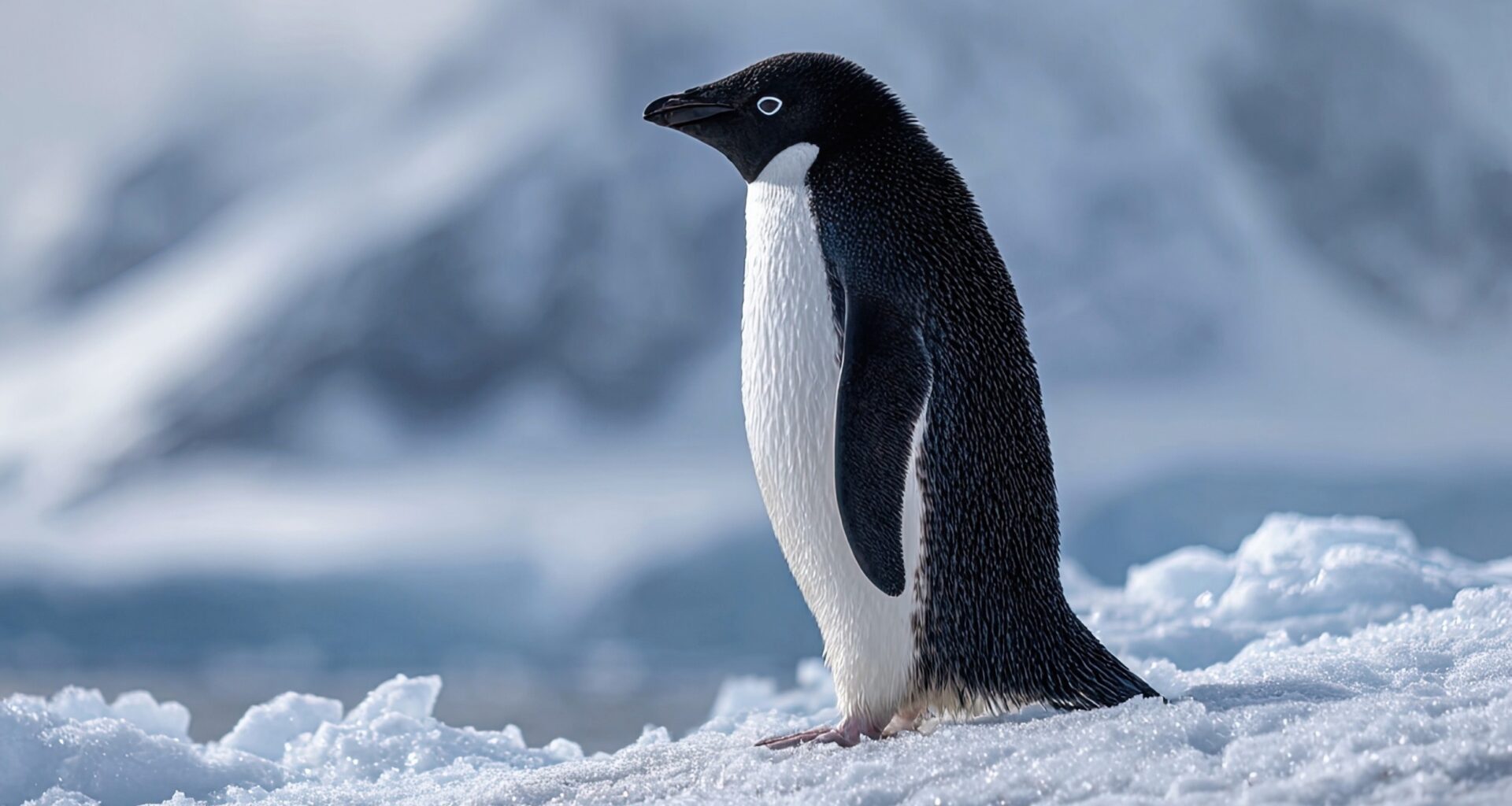
The birds nest at Hukuro Cove in East Antarctica, a small colony of 217 breeding pairs. Landfast sea ice sealed the bay, leaving only narrow cracks and channels as doors to the water below.
Many penguins used the same few openings at once, sometimes more than 10 at a time. That crowding turned each opening into a busy patch of repeated diving.
How the dives were mapped
Each bird carried a small stack of instruments. A logger on the back recorded depth and motion, while a unit lower down tracked position by GPS.
A sensor on the head caught the sharp jerks of a feeding strike. Some birds also wore tiny cameras that filmed the hunt underwater.
From those signals the team rebuilt every dive in three dimensions. The paths showed where each bird went and the instant it seized a krill.
The gear weighed only about 1.6 percent of a bird’s body. Earlier work at the colony had found no clear effect on how the penguins foraged.
Krill made up almost all penguin prey
The menu here was narrow and easy to read. Stomach samples from a separate group of birds held almost nothing but small, shrimplike krill.
Euphausiids made up 99.9 percent of the food by weight. Antarctic krill alone accounted for about 85 percent of that total.
A tight diet like this matters for the whole story. When one prey rules the plate, its movements shape nearly everything the hunter does.
Krill also sit at the heart of the Southern Ocean food web. Whales, seals, and other seabirds lean on the very swarms these penguins chase.
Deeper dives, same feeding rates
“We used high-resolution bio-logging data to reconstruct three-dimensional underwater dive paths and identify feeding events beneath Antarctic sea ice (Fig.1),” Watanabe said.
“This allowed us to investigate how prey accessibility changed as penguins repeatedly foraged from the same sea-ice opening during a foraging dive bout and whether these fine-scale changes could contribute to the formation of Ashmole’s halo.”
The loggers captured 30 foraging trips, more than 6,000 dives, and 23 individual penguins. Dives ran about 61 feet on average, and some birds worked up to 2.6 miles from the colony.
During repeated dives from one opening, the birds sank deeper and ranged farther before meeting krill. Their catch rate, once prey sat in front of them, held steady.
The shift came on gradually rather than as a sudden drop. Dive after dive, each bird had to push a bit deeper, then reach a bit farther out.
Krill moving out of reach
“Food can become harder to obtain even when it has not necessarily been depleted,” Watanabe said.
“We found that penguins had to dive progressively deeper and farther to encounter prey, but once prey were encountered, feeding rates remained unchanged.”
“This suggests that prey accessibility — not only prey abundance – can shape predator foraging patterns.”
That steady catch rate is the telling part of the result. If the birds were simply eating the krill down, patches near the colony should have grown thinner and slower to work.
Instead each patch stayed rich once the penguins found it. The krill had not vanished; they had slipped deeper or sideways, most likely a short escape from the divers pressing in above.
Small effects add up
“Because repeated diving activity is concentrated near breeding colonies, local prey displacement may accumulate over time, contributing to functional prey depletion, where prey remain present but become progressively less accessible,” Watanabe said.
Each small nudge builds up where the diving crowds together. Under the fast ice here, the displacement stays local and probably fades within minutes.
Bigger colonies in open water press far harder on their prey. At the largest sites, tens of thousands of birds can drag a halo out for miles.
The colony-wide pattern matched the single bouts closely. Nearer the colony, dives went deeper and swims grew longer, though catch rates barely moved.
Why the research matters
The deeper hunting is not free for a breeding parent. Every extra foot down costs time and energy that a hungry chick is waiting on.
As the season wore on, the dives crept deeper still. That trend fits a prey layer sinking lower as the polar summer advances.
Reading these signs correctly is the real payoff here. A long, deep dive can look like empty water when the food is only harder to reach.
Prey that is present but hidden is not the same as prey that is gone. Mistaking one for the other could throw off how we judge the health of a whole stretch of ocean.
What the work cannot show
“We inferred changes in prey accessibility from penguin behavior, but we did not directly observe krill movements. The next step is to combine animal-borne sensors with technologies that can directly measure prey distribution beneath sea ice,” Watanabe said.
“Ultimately, I hope to understand how interactions between predators and prey generate ecological patterns across scales, from individual foraging behavior to colony-scale resource landscapes.”
The team never watched the krill directly, only the penguins chasing them. Even so, the dives trace a clear signal beneath the ice, where prey slips away without ever vanishing.
The study is published in the journal Proceedings of the Royal Society B.
—–
Like what you read? Subscribe to our newsletter for engaging articles, exclusive content, and the latest updates.
Check us out on EarthSnap, a free app brought to you by Eric Ralls and Earth.com.
—–