
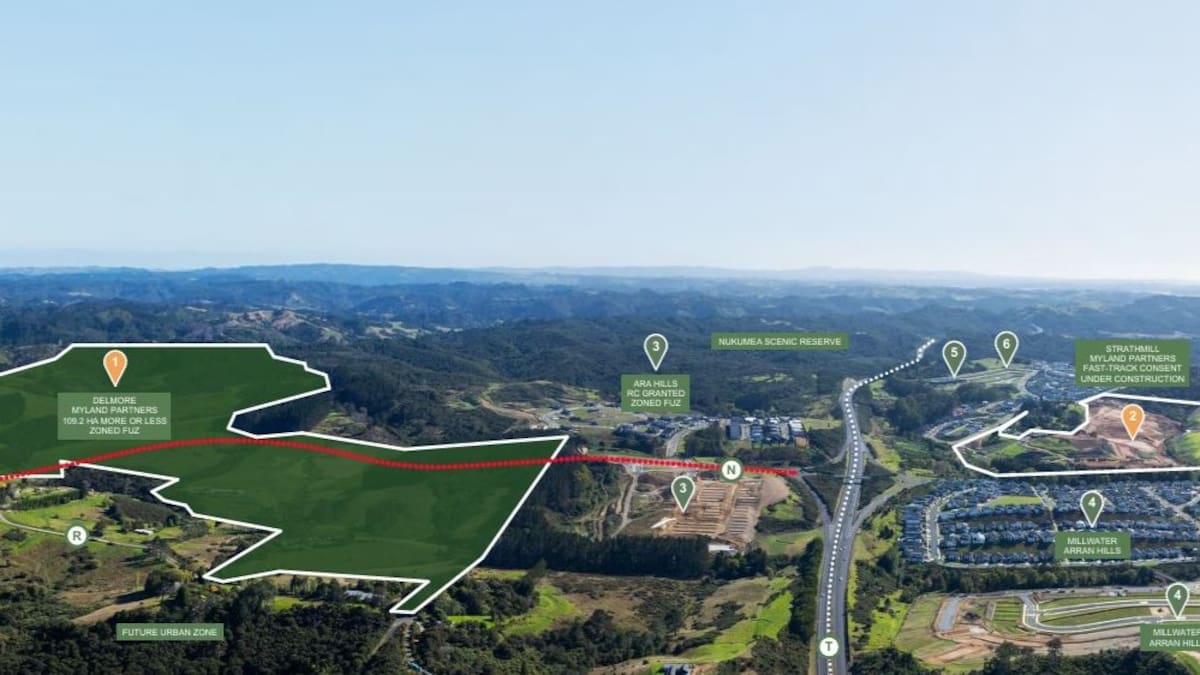
The original application was then withdrawn and a second one later drawn up.
Significant changes have been made, and the project was given the thumbs up this week.
But Richard Hills, the chairman of the council’s planning committee, says the project doesn’t stack up.
“This is not how you plan or build a city. This development is in an area that had either no plan for housing or not for many decades,” the councillor told the Herald.
Hills said some “big assumptions” were being made in the 80-page approval document, which places a large number of conditions on developers for work on and around the 109ha site.
“It’s out-of-sequence growth, which Watercare and Auckland Council have not planned for.
“In my opinion, the thousands and thousands of dwellings in the fast-track pipeline to be built on farmland on the outskirts of our city with no realistic plan for how to service them will make all of us poorer – the effects to surrounding communities will also be immense.”
Richard Hills at the Auckland Council housing density zoning debate at Auckland Town Hall. Photo / Corey Fleming
Conditions include building an on-site wastewater treatment plant and stormwater discharge system, keeping indigenous vegetation and constructing other infrastructure such as retaining walls, communal rain gardens and water pumps.
Water and wastewater will have to be provided privately, with a residents’ association to manage that.
In the documents, Watercare made it clear no part of the development’s wastewater could be serviced by the company.
Watercare warned: “… due to the complexity of connecting 1213 individually owned dwellings to the public … including the vesting of private assets that have been operational, managed and maintained outside of Watercare’s control, future connections to the public networks may not be feasible and cannot be committed to now.”
It said possible network connection capacity was not expected to be available until at least 2050.
Watercare noted that any private water supply and/or wastewater servicing for the project would be subject to regulation by Taumata Arowai as the water services regulator.
The decision acknowledged those concerns.
“Development that is out of sync with the provision of public infrastructure can create significant challenges for infrastructure planning and implementation and can have flow-on effects for other development within existing live zoning.
“We are satisfied that water supply will be adequately provided through the existing water take consent and water treatment proposed.”
That includes onsite wastewater treatment and disposal, with treated wastewater to be tankered offsite in summer months.
“Tankering treated wastewater off-site during summer months is obviously reliant on acceptance by off-site facilities. The volume of wastewater required to be trucked will vary in response to seasonal rainfall and will progressively increase as the occupancy of the development advances.”
In the application, Vineway said the wastewater would be trucked to Whangārei.
“Trucking wastewater to Whangārei is not a good outcome for the city or future residents. I also doubt a residents’ association is the appropriate vehicle to run and maintain a safe water supply from an aquifer,” Hills said.
The Herald sent Myland Partners a list of questions, including the concerns raised by Hills.
A statement from property developer Andrew Allsopp-Smith said Vineway “is pleased with the panel’s draft decision to approve Delmore”.
“We’re currently reviewing the consent and its conditions in detail, and it would be premature to comment further until that review is complete,” the statement said.
Hills also has concerns about the impact on traffic, with the Ōrewa exit points to the northern motorway already very congested.
“Congestion in this area will only get worse with no certainty of funding for appropriate road and public transport infrastructure or services.
No bus stops or public transport will be serviced in the development.
The developers have agreed to build a new roundabout intersection at Grand Drive with Upper Ōrewa Rd, to be completed by the time the first stage of the subdivision is built.
Hills also said the ever-increasing number of fast-track applications was causing “chaos” at the Auckland Council.
“People want us to keep rates down. This is a chaotic way to plan a city; it’s giving us whiplash.”
He estimated a couple of applications were coming into the council a month, meaning staff and resources were being diverted to deal with those.
Auckland Mayor Wayne Brown.
Auckland Mayor Wayne Brown has repeatedly spoken out against unplanned greenfield development, including Delmore.
“This was initially turned down for very good reasons,” he told the Herald.
“But it has now been reapproved with a system that involves trucking treated effluent to Whangārei, and that doesn’t sound like a very good system to me. This decision raises questions about the expertise of the so-called experts.”
Hills has also raised concerns about the financial impact on the rest of Auckland ratepayers.
“The Government say they want growth to pay for growth, but unlike normal plan changes or consents, fast-tracks consent all dwellings on day one, meaning we cannot legally even charge development contributions at the level they should be.
“This means the cost of infrastructure and ongoing operating costs for this out-of-sequence development will fall more heavily on all ratepayers, not on the developer, and will inevitably divert resources away from current urban areas which are also in need of investment. It also makes a mockery of the Government’s rates-capping plans.”
He says the contributions paid by fast-track developers are about a third of the usual payments – leaving the council tens of millions of dollars out of pocket.
Asked to comment on the project and the concerns raised, Infrastructure and RMA (Resource Management Act) Reform Minister Chris Bishop said via a spokesperson that he couldn’t comment on the merits of it because it was still before the panel.
“The FTAA [Fast-Track Approvals Act] provides a pathway for projects with significant regional or national benefits. This may include developments outside planned growth areas, where appropriate. It’s our expectation that growth pays for growth,” Bishop said.
On the issue of “chaos” at the council, he said all councils can recover their actual and reasonable costs from applicants.
“We would expect that councils which have a consistent volume of applications would resource accordingly.”
Bishop said that while fast-track projects were not exempt from paying development contributions, possibly projects that occur out of sequence could pay a lower development contribution.
“The Government is currently undertaking work on replacing development contributions with a new development levy system, which will apply to fast-track as well as the standard planning system.”
Hills is also concerned about the proposed 4000-home Sunfield development, which also has fast-track approval.
“If you count Delmore and Sunfield plus other residential developments gaining approval, that’s up to 10,000 dwellings in places we never expected or planned for.
“I don’t think anyone knows the precise impact on communities and others.”
Bishop said it was up to the expert panel to consider the effects of the project, including on roads and other infrastructure, “and impose appropriate conditions to manage those effects”.
Hills said the Auckland Council’s legal team will be fully reviewing the Delmore decision and might appeal it.
The first panel had raised concerns about the provision of water supply and wastewater management, transport infrastructure impacts and ecological effects.
It said it “was not at the requisite standard required for such a significant project which is in a future urban zone with no infrastructure connectivity”.
In making the decision, the panel said it invited comment from 22 parties, including supporters and opponents.
The latest decision means resource consent and archaeological approvals can be granted.
Twenty-three fast-track projects have been approved and granted consent by expert panels since the scheme began.
Katie Bradford is a senior correspondent at the Herald. She has been a broadcast journalist for more than 20 years and was based in the press gallery for 10 years. She specialises in politics, business and Auckland issues.