
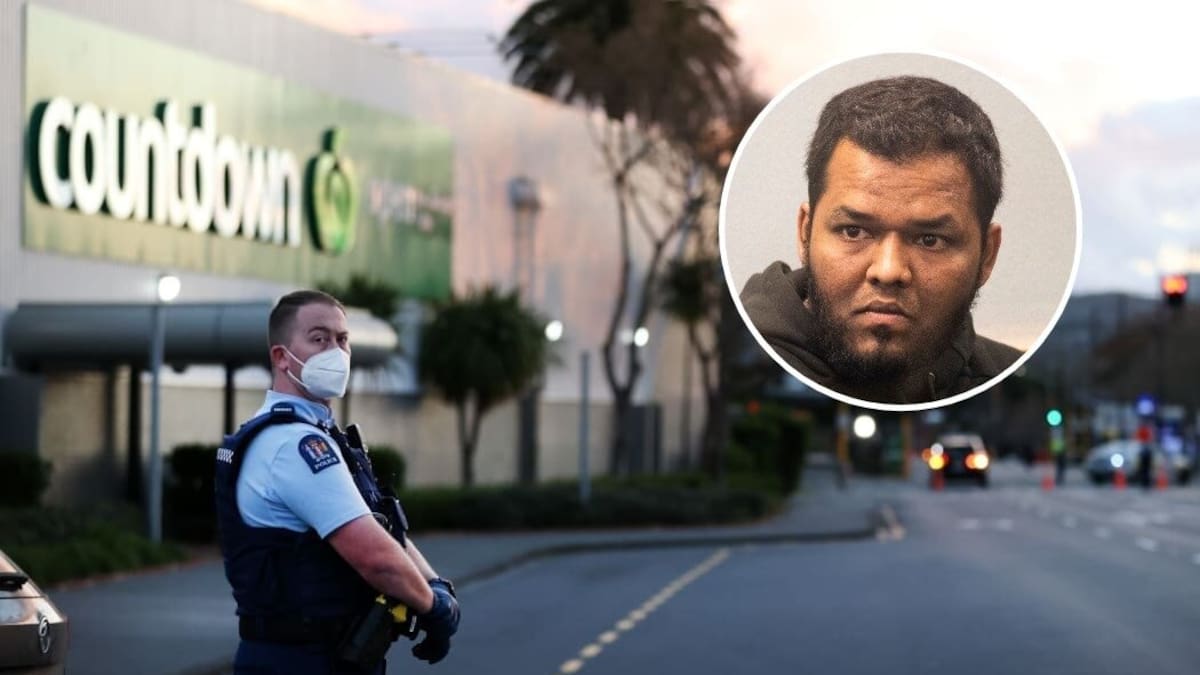
Just seven weeks after he was released he was shot dead by undercover police officers after carrying out a frenzied knife attack at Countdown in LynnMall in 2021. Six people were seriously injured.
Now, the second and third phases of a Coronial inquest into his death are underway in Auckland looking into how the Sri Lankan refugee became radicalised into violent extremism in New Zealand.
It will also question what the various government agencies who knew of his radicalisation could have done to prevent his violent end.
Ahamed Samsudeen in the High Court at Auckland in 2018. Photo / Greg Bowker
This morning, one of the inmates in a neighbouring cell, gave evidence he witnessed Corrections staff make “inappropriate comments” to Samsudeen.
The inmate appeared in court from prison by audio visual link. His identity is suppressed.
He told the court that he had been in the wing that holds “what they’re calling extreme prisoners” with Samsudeen for around “four or five months”.
“Days go by [here], they’re like nothing, they’re like minutes,” he said.
In that wing, each prisoner has a cell that opens into a self-confined yard of the same size, and they get around an hour free time in their individual yard a day, the court heard.
The man said he and Samsudeen, they spoke during yard time over the tall, 10cm-thick walls.
“I did go out of my way to speak to someone who was extremely lonely and vulnerable at the time,” he told the court.
He said when Samsudeen arrived on the unit, the man was quiet for a couple of days, but started “being vocal”, responding to “a lot of verbal abuse” from other inmates.
Some of those insults included inmates calling Samsudeen a terrorist, and the prisoner said he told them to leave the man alone.
“Then we started talking,” the prisoner continued.
He said they first talked about the man’s lawyer, whose name is suppressed, and that Samsudeen claimed the woman was “like family” to him and he had “a lot of empathy” for her.
The prisoner said he thought at the time that Samsudeen couldn’t be that bad if he cared about people who were trying to help him.
“He can’t be a lost cause,” he recalled thinking.
The cell doors in that particular unit featured a window of bulletproof glass to see out of, the prisoner said.
Through that window he claimed to have seen, or heard, Corrections staff making “inappropriate comments” to the Muslim inmate.
He said he also noticed through glimpses of Samsudeen when he was taken in and out of his cell and their talks, that the man was “suffering”.
Ahamed Samsudeeen stabbed four women, one man and dislocated the shoulder of a second who tried to stop him before he was shot dead. Photo / Alex Burton
The prisoner became frustrated when he was being questioned by Department of Corrections lawyer Lilla Diettrich, and Coroner Marcus Elliott had to intervene.
“I don’t know why I’m answering these questions it just seems like it’s just pondering,” he told the coroner.
Diettrich suggested that the prisoner had “limited” opportunity to see Corrections staff interacting with Samsudeen.
But the prisoner said he could often see how “distressed” the man was when he was escorted back to his cell.
Diettrich then suggested that the prisoner, who had a long history of incarceration, had a “deep hostility” to the department and its staff.
For legal reasons, he said, the prisoner declined to answer her.
The Coroner rephrased Diettrich’s question, saying that she was essentially asking if because of his personal grievances, the prisoner was not telling the truth.
The prisoner said “of course” he had his issues with Corrections, but they were personal and not related to the treatment of Samsudeen.
Diettrich again suggested that the prisoner had a “deep hostility” and therefore had falsely accused prison staff of mistreating Samsudeen.
The prisoner completely refuted her statement and said it was not his motive.
Diettrich also said the prisoner had a number of convictions that would indicate he was dishonest, to which the man “completely” disagreed.
Distrusting of police and mobilising to commit a terror attack
In the afternoon the inquest heard from Detective Superintendent David Lynch who was the police’s senior investigative officer for Samsudeen from 2018.
He also oversaw the police surveillance of the man once he was released from prison.
He told the court that the extremist ideology that Samsudeen had prescribed to indoctrinated its followers not to trust police in Western countries, and to engage in violence against them.
Before the attack, Samsudeen was held in prison on remand for four years.
Counsel to assist Samsudeen’s family, Fletcher Pilditch, KC, asked the detective superintendent if, given the benefit of hindsight, the man’s time in prison had increased his “alienation, hostility and increased radicalisation”.
Lynch replied that while that was a valid point, he didn’t see how Samsudeen’s situation could possibly get any worse in terms of his risk to the public.
This was because, he told the court, the police were “certain” that the second time Samsudeen was arrested in 2018, he was “mobilising to commit a terror attack”.
The inquest continues next week.
Ella Scott-Fleming has been a journalist for three years and previously worked at the Otago Daily Times, Gore Ensign and Metro Magazine. She has an interest in court and general reporting. She’s currently based in Auckland covering justice-related stories.
Join NZ Herald’s Open Justice team for Case by Case, a video and podcast series examining the disputes and decisions making headlines across New Zealand.