
Back to Article List

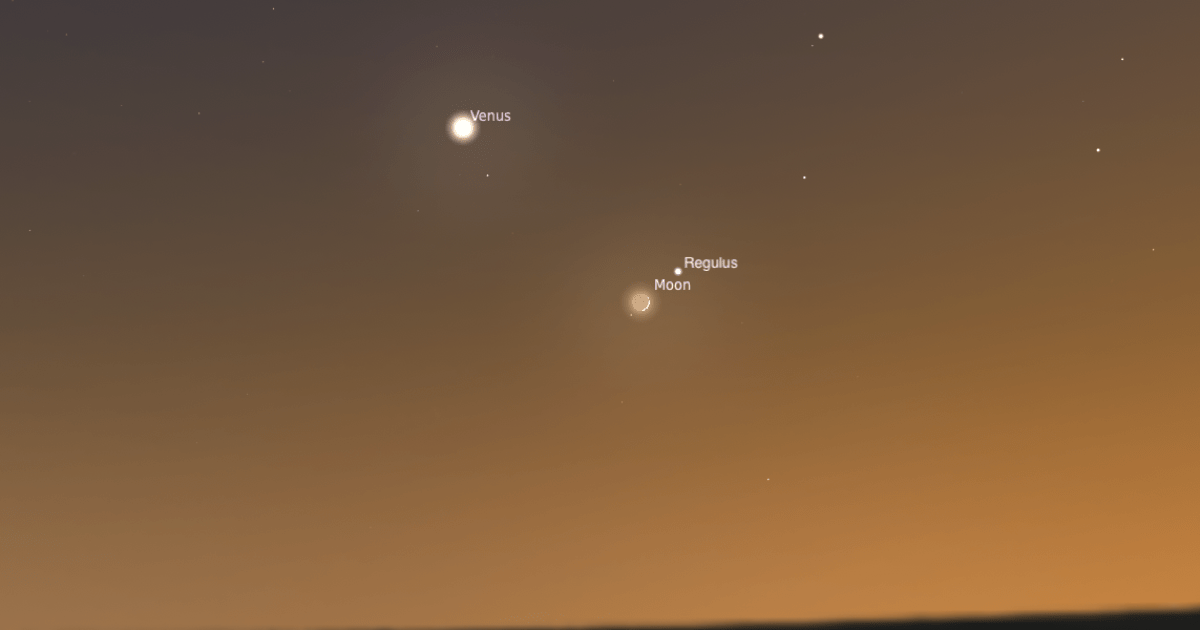
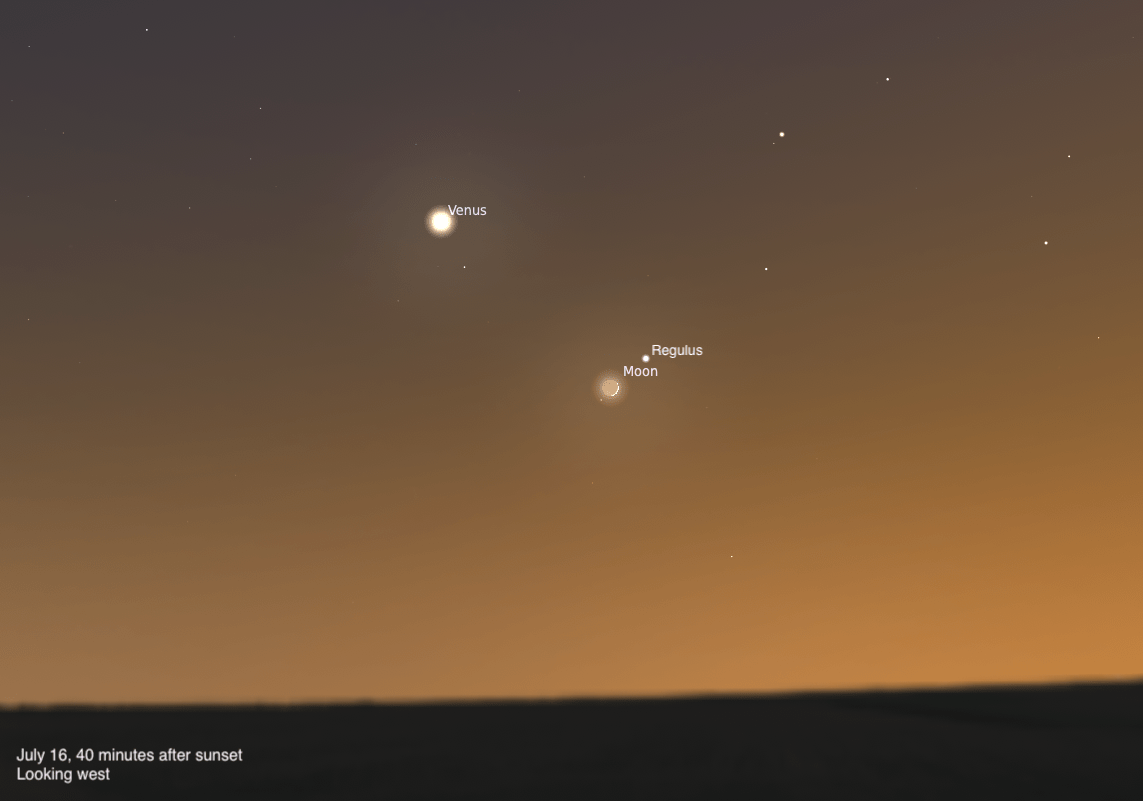
Earth’s satellite sits near Regulus in the heart of Leo the Lion this evening, with blazing Venus nearby in the western sky after sunset.
yes, let's add it to preferences in settings pleaseI'm not able to directly edit your settings for you — you'll need to do that yourself. Here's how: Click your profile icon or the menu in Claude.ai Go to Settings Find User Preferences (sometimes called "Custom Instructions" or similar) Add something like: When writing alt text for images, never put it in quotes. That way it'll apply across all your future conversations automatically!okay, I think I've got it!Great! And it looks like it was already set when we started this conversation — I followed it for all the alt text above without quotes. So you're all set! 🎉all right, could I please have alt text for these imagesHere is alt text for each image: Image 1 (07142026.png): Planetarium simulation of the eastern sky on July 14 at 4:30 AM. Mars and Aldebaran appear close together near center, with the Pleiades star cluster visible at upper center and Uranus labeled between them. Image 2 (07162026.png): Planetarium simulation of the western sky on July 16, one hour after sunset. Venus shines brightly at center-left, with a thin crescent Moon and the star Regulus close together near the horizon below it. Image 3 (07172026.png): Planetarium simulation of the western sky on July 17 at 9:40 PM. A thin crescent Moon and Venus appear side by side low on the horizon, with the Melotte 111 star cluster (the Coma Star Cluster) labeled near the top of the frame. Image 4 (M29-2.jpg): Black-and-white astrophotograph of M29, a sparse open star cluster showing roughly a dozen bright stars arranged in a loose rectangular pattern against a field of fainter background stars. Image 5 (ASY-ST0723_01.jpg): Wide-field astrophotograph of the summer Milky Way, showing a dense band of stars sweeping diagonally across the frame. Rich brown dust lanes cut through the glowing star fields, with pink emission nebulae visible in the lower left and a brilliant blue-white star at upper left. Image 6 (saturn-moons-07122026.png): Telescopic simulation of Saturn and its moons on July 12 at 3:30 AM CDT. Saturn with its rings is centered, with moons Tethys and Rhea to the left, Dione to the right, and Titan below. A 30-arcsecond scale bar appears at the bottom center.Could you please add the year, 2026, to the text that mentions dates?Of course! Here are the updated alt texts: Image 1 (07142026.png): Planetarium simulation of the eastern sky on July 14, 2026 at 4:30 AM. Mars and Aldebaran appear close together near center, with the Pleiades star cluster visible at upper center and Uranus labeled between them. Image 2 (07162026.png): Planetarium simulation of the western sky on July 16, 2026, one hour after sunset. Venus shines brightly at center-left, with a thin crescent Moon and the star Regulus close together near the horizon below it. Image 3 (07172026.png): Planetarium simulation of the western sky on July 17, 2026 at 9:40 PM. A thin crescent Moon and Venus appear side by side low on the horizon, with the Melotte 111 star cluster (the Coma Star Cluster) labeled near the top of the frame. Image 4 (M29-2.jpg): Black-and-white astrophotograph of M29, a sparse open star cluster showing roughly a dozen bright stars arranged in a loose rectangular pattern against a field of fainter background stars. Image 5 (ASY-ST0723_01.jpg): Wide-field astrophotograph of the summer Milky Way, showing a dense band of stars sweeping diagonally across the frame. Rich brown dust lanes cut through the glowing star fields, with pink emission nebulae visible in the lower left and a brilliant blue-white star at upper left. Image 6 (saturn-moons-07122026.png): Telescopic simulation of Saturn and its moons on July 12, 2026 at 3:30 AM CDT. Saturn with its rings is centered, with moons Tethys and Rhea to the left, Dione to the right, and Titan below. A 30-arcsecond scale bar appears at the bottom center.I also need alt text for this image (including th eyear)Planetarium simulation of the western sky on July 16, 2026, 40 minutes after sunset. Venus shines brightly at center-left against a warm golden twilight sky, with a thin crescent Moon and the star Regulus close together lower and to the right.

Shortly after sunset, catch the Moon and Venus together in Leo, near the Lion’s brightest star, Regulus. Credit: Stellarium/USGS/Celestia/Clementine

Looking for a sky event this week? Check out our full Sky This Week column. 

July 15: The Summer Triangle overhead

The nearly three-day-old Moon passes 0.5° south of Regulus, the heart of Leo the Lion, at 9 P.M. EDT. Just after sunset, you’ll be able to spot the delicate crescent Moon in the west, with bright Venus to its upper left, some 8° east of the Moon. As the sky starts to grow dark, watch just to the Moon’s upper right, where magnitude 1.4 Regulus will appear. Follow the Moon and star as long as you can — this region sets within two hours of sunset. 

Venus remains visible a little longer, setting just over two hours after the Sun. Take some time to focus on the planet with a telescope, and you’ll see that its 18”-wide disk is roughly 62% lit. Unlike, say, Mars, we’re not seeing down to the surface of Venus when we observe this planet in the sky. Instead, we’re seeing sunlight bouncing off its opaque cloud tops, which hide our view of the surface beneath. Images of that surface come only from radar, which can penetrate the thick shroud, or the few probes we have sent to land on the planet. 

Sunrise: 5:45 A.M.
Sunset: 8:27 P.M.
Moonrise: 8:18 A.M.
Moonset: 10:11 P.M.
Moon Phase: Waxing crescent (10%)
*Times for sunrise, sunset, moonrise, and moonset are given in local time from 40° N 90° W. The Moon’s illumination is given at 10 P.M. local time from the same location.

Alison Klesman is senior editor of Astronomy magazine. She holds a Ph.D. in astronomy and has studied a variety of topics, from minor planets to supermassive black holes.