
Los tiempos de Dios son Perfectos
Season 1
Episode 8
Editor’s Rating
4 stars
****
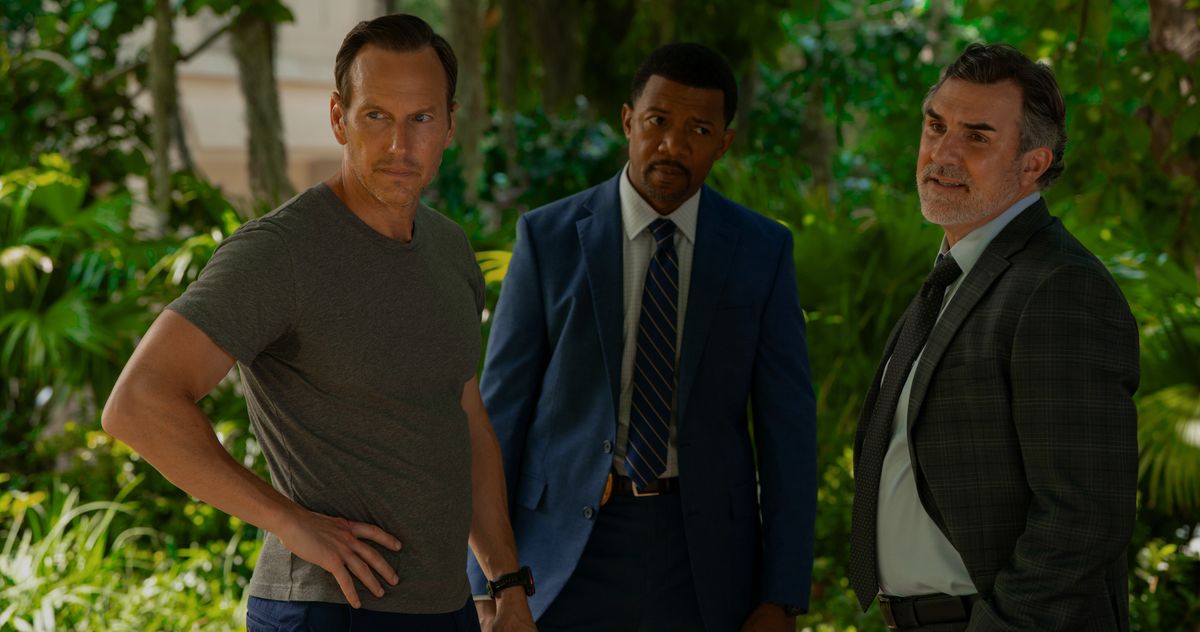
Cady might have gotten what he wanted, but now Anna finds herself with nothing left to lose.
Photo: Apple TV
Perhaps the most significant difference between the TV Cape Fear and the two previous screen versions — as well as the source material, John D. MacDonald’s novel The Executioners — is that Max Cady is not a sexual predator but merely a violent criminal hell-bent on revenge. There’s some wisdom in not having a rape threat hover over ten hours of serialized television, and the shift has opened up some thorny connections between Cady and Anna Bowden, whose pasts continue to intersect in intriguing ways. There are moral distinctions to be made between them — Anna wouldn’t, say, leave a cooler full of dismembered body parts in the deep end of a family swimming pool — but they’re two characters from similar backgrounds who are willing to play in the mud.
Yet the big question hovering over the series is, What to do about the Bowdens’ underage daughter now that she’s not a target of sexual assault? The 1962 film version featured a more innocent family with a daughter who’s presexual and thus a naïve object of lust for Robert Mitchum’s casually lascivious Cady. The family in the 1991 Cape Fear is a mess, and the daughter’s flirtations with Cady, managed beautifully by Juliette Lewis, put her on the razor’s edge of sexual curiosity and parental resentment. The choice to make Natalie older and presumably wiser for the TV series has led to moments of great frustration because it’s hard to believe she has made so many obvious mistakes. While it’s true she acted out of loneliness and desire, coupled with a righteous anger toward her duplicitous parents, the show has strained credulity far past the breaking point.
Now that Natalie is starting to see things more clearly, she has become an emotional force unique among Cape Fear adaptations because she draws from a deeper well of life experience. To that end, the casting of Lily Collias is finally starting to pay off. Collias is known to a handful of critics and indie-movie watchers for her lead performance in the 2024 drama Good One, in which she plays a teenager who grudgingly joins her divorced father and his more recently divorced friend on a weekend camping trip in the Catskills. The film hinges on a small moment that not only sullies the trip but leads her character to reconsider her understanding of her father. It’s as though she’s growing up on the spot, becoming more certain of herself and the way the world works.
That’s the same space Natalie occupies in this episode. She has been burned and humiliated by her dalliances with Nevaeh, who cannot be talked down from her Cady-related psychosis. And she finally gets herself to the point where she cannot believe Cady, either, because the evidence against him is too much for her to deny. Last week, she hedged her bets by accompanying him on a trip back to his hometown near the Cape Fear River in North Carolina, but she toted along a loaded handgun just in case. (This was a dumb idea with predictable consequences, but she took baby steps in the right direction.) Now she realizes with blessed conviction that Cady killed Ray with the gun and she snoozed through it. At long last, she can join the fight.
The shift in Natalie’s perspective galvanizes the show in two great scenes that reveal the depth of her pain and her hidden capacity for empathy. The first is her surprising jailhouse visit with Nevaeh, which allows her to speak frankly with her with a nice thick wall of detention glass between them. Natalie acts on the faint hope that Nevaeh will connect to her because they’re (possibly) daughters of the same bad father and maybe their romance wasn’t entirely a con. (“You are a minor who was groomed,” says Natalie. “And I think maybe, somewhere, you really do care about me.”) But when Nevaeh blows her off, Natalie absolutely lets it rip, perhaps feeling secure that she will never, say, end up occupying the same cellblock with her extremely soon.
More affecting still is a later scene with her mother, who’s reeling both from Tom’s arrest for allegedly killing Ray and hiding the murder weapon and from her sleazy father betraying her after negotiating $100,000 in blackmail money to skip town over the scheme to plant drugs in Cady’s house. (There are so many arrests in the street between the Bowdens’ and Cady’s residences that it’s like an episode of Cops that stays in one trailer park.) With Tom furious at her for not telling the truth about her past relationship with Cady, Anna has finally gotten to a place where she can be honest with Natalie about what happened between them, and she finds a surprisingly sympathetic ear. Anna was given to drinking at the time, and she tells Natalie that Cady wasn’t the first guy to take advantage. But her uncertainty about the identity of her unborn child’s father, combined with her conviction that Cady was likely a killer, led to her conspiring to put her client in the hole. Natalie doesn’t cast judgment over her mother’s lapses, and it’s the one precious moment of grace she gets in an episode where her entire life collapses at her feet.
The Bowden family’s miseries are so extreme that Cady must feel he has the upper hand, even though he’s left hospitalized after Natalie, his possible daughter, shoots him in the gut. The episode ends with 75 percent of the Bowdens under state confinement: Tom is jailed for killing Ray and hiding the murder weapon from police, Natalie is housed in Nevaeh’s prison wing for shooting Cady in the stomach, and Zack is still involuntarily committed for allowing Nevaeh to live in the walls of the Bowden house and for stabbing his dad with a pair of garden shears. The only free Bowden is Anna, who could easily be charged for directing her sleazy father to plant drugs at Cady’s place.
“This is what I wanted,” Cady tells Anna from his hospital bed. “For you to feel this. To feel your family ripped apart. Broken. Caged. Your children taken away.” She absorbs that verbal punch without doubling over, which speaks to her own hardscrabble background and her resilience under duress. Anna reminds Cady that he did actually kill his wife and unborn child despite the implication that she’s responsible for his misfortune. She’s neither hospitalized nor institutionalized. And she can play dirty too.
• Dynamite opening with Natalie discovering Ray’s remains at the bottom of the pool. That cloud of blood leading into the photo-negative image is so striking visually, and the whole macabre affair seems to pay homage to the scene in 1991’s Cape Fear when Robert De Niro’s Cady jokes with Illeana Douglas’s character about hacking his wife “into 52 pieces.”
• Speaking of nods to the ’91 version, there’s also the use of Aretha Franklin’s “Do Right Woman, Do Right Man,” which played over a scene where De Niro’s Cady calls Danielle Bowden (Juliette Lewis) on the phone and cons her into turning up for a private drama class the next day. “Trust me,” he says, “I’m the Do Right Man.”
• “You’re not your momma’s girl. You’re every bit of me”: Anna’s dad is a lowlife, but he’s telling the truth here.
• Something to monitor: Noa Toussaint, deep in grief over Ray, blames herself for “inviting the wolf in” and potentially upending the innocence project she has spent his career building. Seems likely she will take a more active role in stopping Cady.
• Cold resolve from Natalie over her attempt to shoot Cady: When her mother asks what happened, she tersely replies “I missed” as if she were an old Clint Eastwood character.
• Anna driving into Tropical Storm Wesley may be ’91 Cape Fear hat tip No. 3 in this episode because that version was written by Wesley Strick.
Sign Up for the Vulture Newsletter
Entertainment news, for the pop-culture obsessed.
Vox Media, LLC Terms and Privacy Notice