
Back to Article List
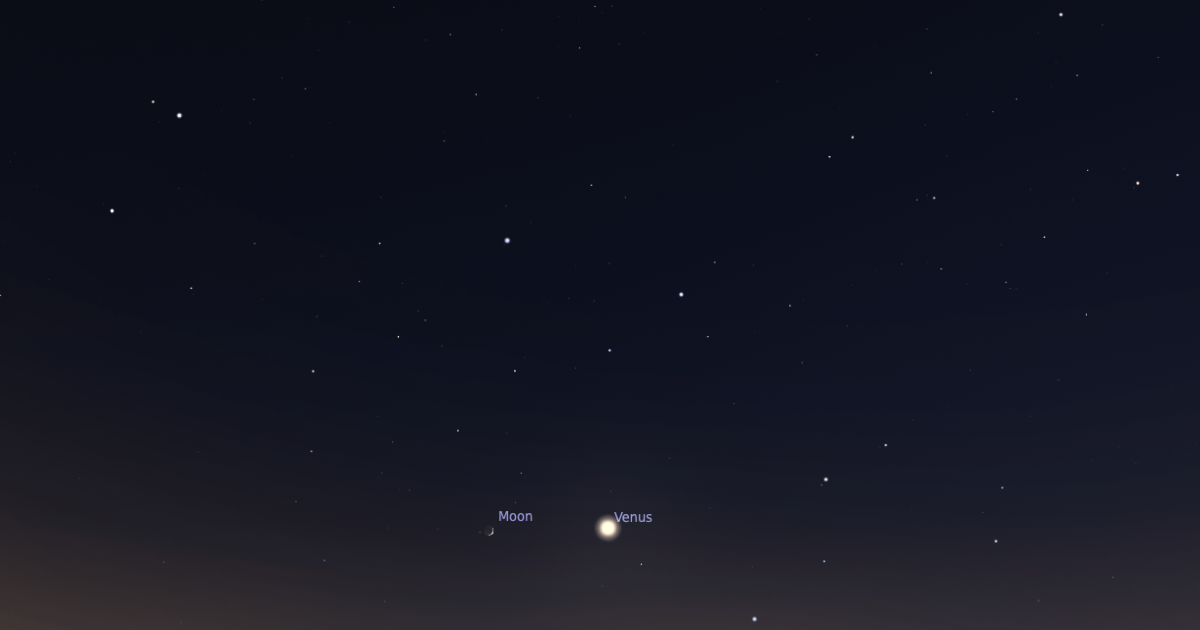
The crescent Moon slides south of Venus this afternoon and stands side by side with the bright planet in the post-sunset sky.
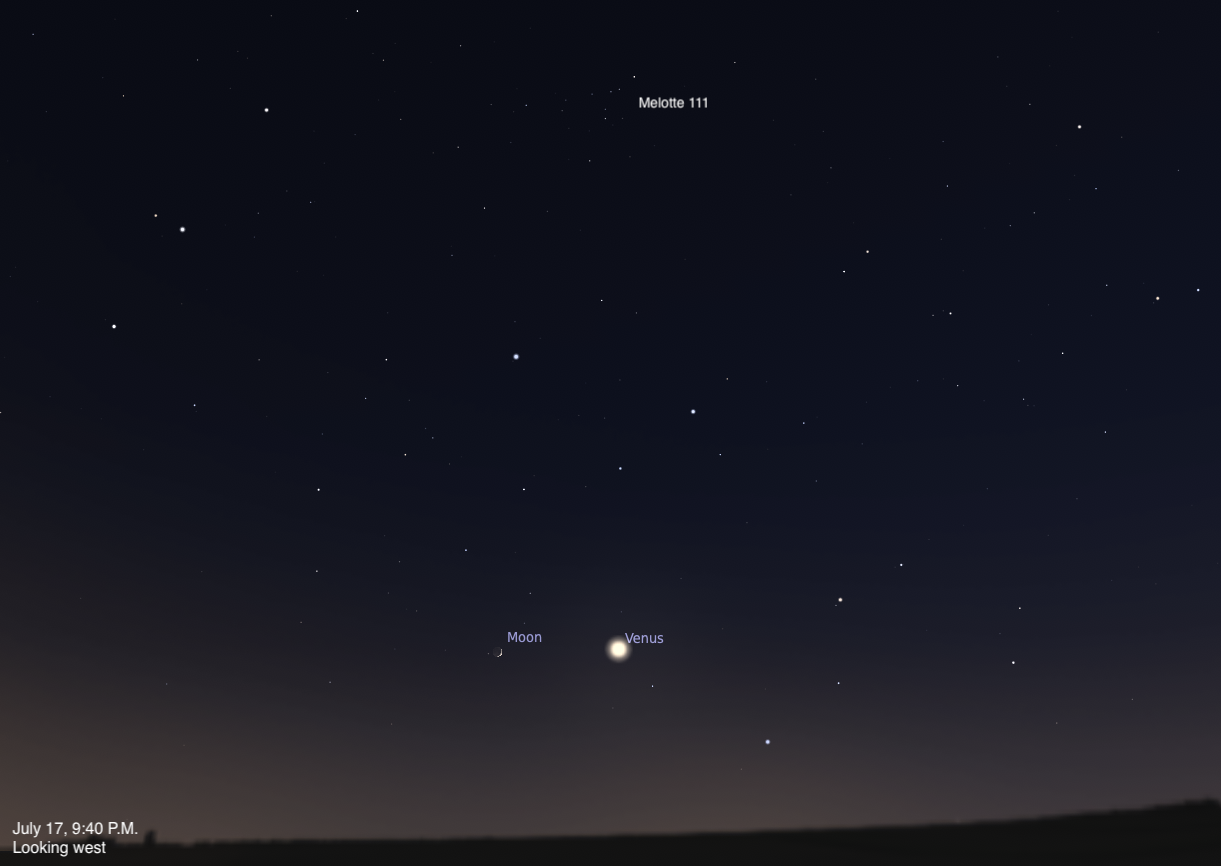
Catch the Moon and Venus sinking toward the western horizon after sunset on July 17, with the Coma Star Cluster (Melotte 111) coming into view above them as the sky darkens. Credit: Stellarium/USGS/Celestia/Clementine
Looking for a sky event this week? Check out our full Sky This Week column.
July 16: The Moon passes the Lion’s heart
The Moon passes 2° south of Venus at 1 P.M. EDT. By this evening, they are roughly 6° apart, with the Moon to Venus’ lower left in the sky tonight, instead of the lower right (as it appeared yesterday). The crescent Moon and Venus sink toward the horizon together at roughly the same altitude, side by side in the growing twilight.
Above them is the hind end of Leo the Lion, and above that is the constellation Coma Berenices, or Berenice’s Hair. This constellation contains an easy-to-spot naked-eye star cluster, called (perhaps unsurprisingly) the Coma Star Cluster. Covering some 4° of the sky, the cluster’s stars glow collectively at magnitude 1.8, and roughly a dozen are visible to the naked eye. If you opt to observe it with binoculars or a telescope, you’ll pull out at least two dozen more suns.
Sunrise: 5:46 A.M.
Sunset: 8:26 P.M.
Moonrise: 9:32 A.M.
Moonset: 10:35 P.M.
Moon Phase: Waxing crescent (18%)
*Times for sunrise, sunset, moonrise, and moonset are given in local time from 40° N 90° W. The Moon’s illumination is given at 10 P.M. local time from the same location.
Alison Klesman is senior editor of Astronomy magazine. She holds a Ph.D. in astronomy and has studied a variety of topics, from minor planets to supermassive black holes.