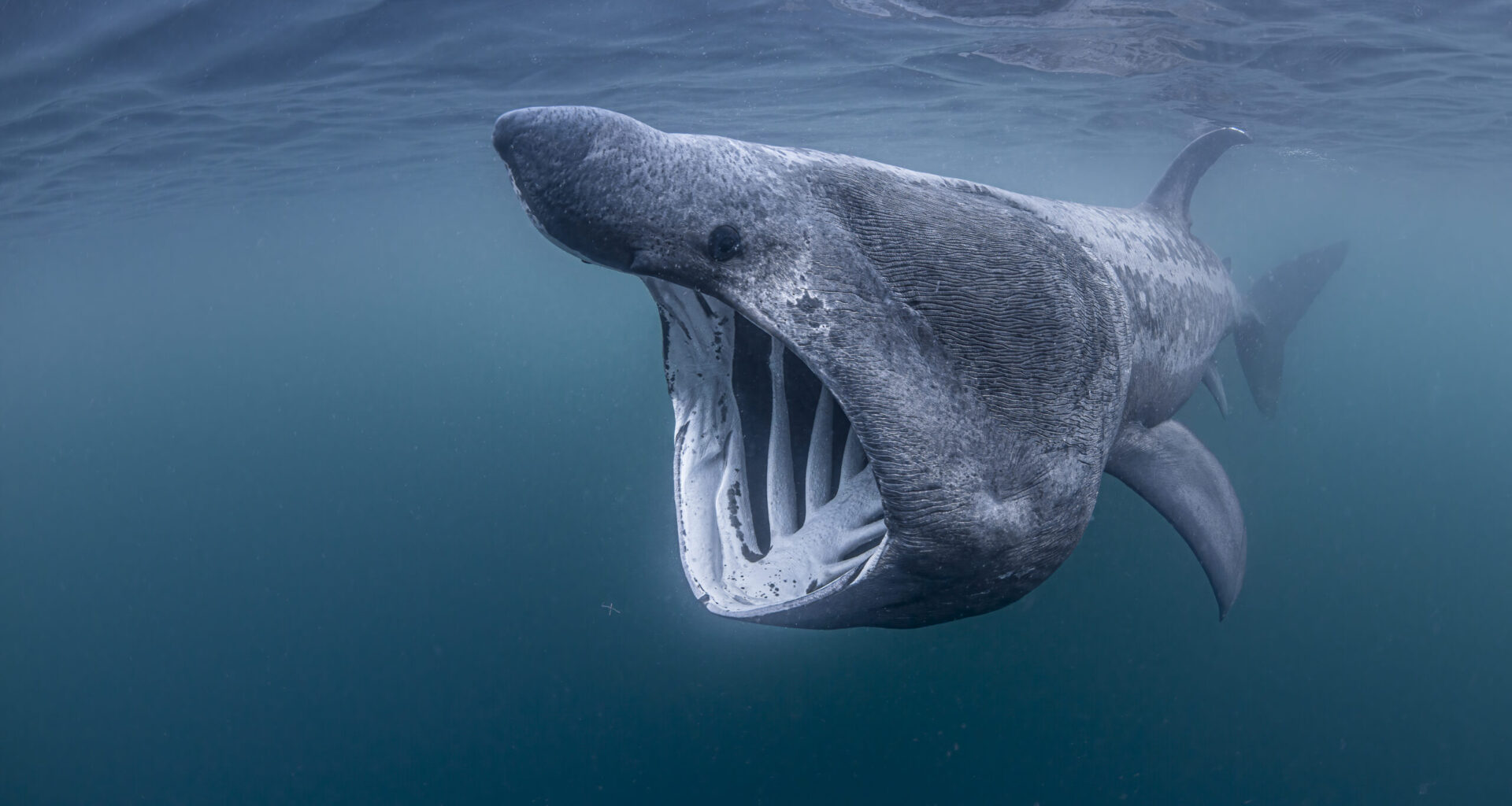
Endangered basking sharks forage some 1000metres below sea level in the ocean’s twilight zones during their 17,000km winter migration journey, highlighting the importance of this little-known ecosystem.
Researchers from the Woods Hole Oceanographic Institute analysed more than 8000 days of tracking data collected from 37 basking sharks tagged between 2004 and 2011 near Cape Cod. In that time, they observed basking sharks diving as far down as the lower boundary of the ocean twilight zone, which extends from 200 to 1,000 metres below the sea level.
“Reaching depths of 800 to 1,000 meters is physiologically demanding. It’s cold, dark, and low‑oxygen. Yet these sharks repeatedly dive into the secondary deep scattering layer, a resource that most large pelagic predators cannot exploit,” said Jaida Elcock, doctoral candidate in the MIT‑WHOI Joint Program and lead author of the paper.
This, they say, highlights the importance of the twilight, otherwise known as the mesopelagic zone. This area hosts more biomass than any other area of the water column, yet very little is understood about the lasting impacts of increased fishing or its role in the carbon cycle.
In June, an international commitment to protect one the twilight zone was launched by Fiji and Panama. The Mesopelagic Zone Conservation Challenge is a call to governments worldwide to take concrete action to safeguard this deep ocean stratum.
Despite this discovery, co-author Camrin Braun, an oceanographer and ecologist at WHOI pointed out that we still don’t know what these elusive and endangered sharks are feeding on when they are diving into this deep-ocean ecosystem.