
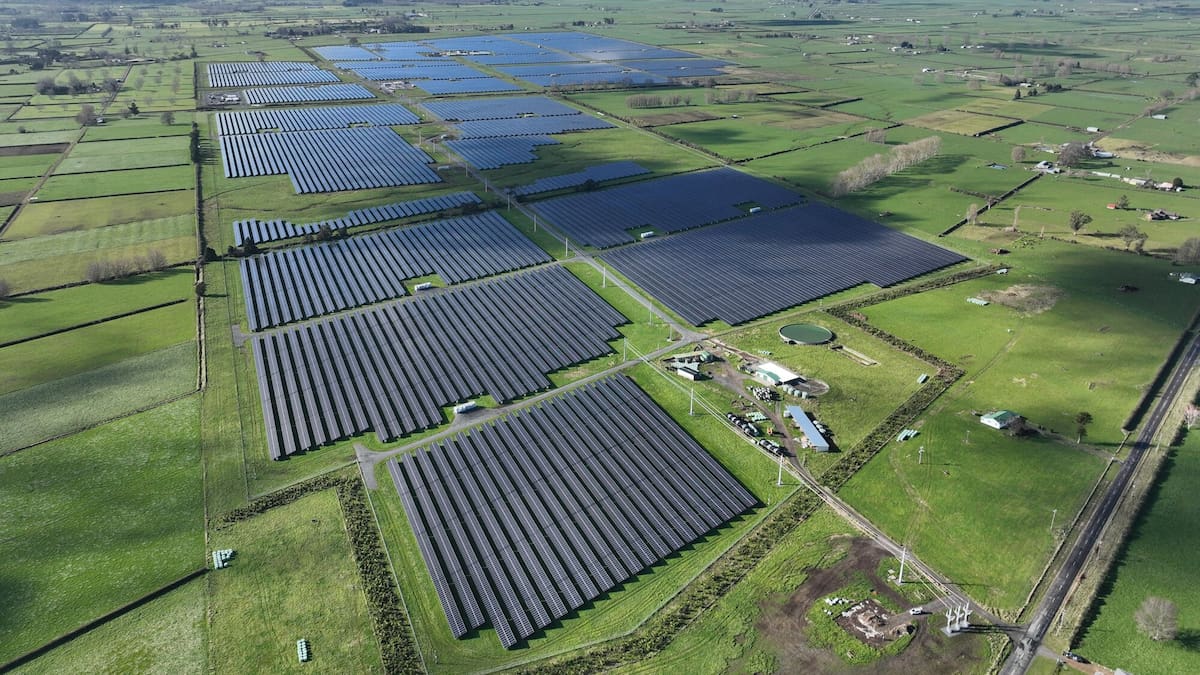
Most of the site will remain in productive farming, switching from dairy to sheep farming.
The photovoltaic panels will provide shelter and shade for the sheep, while also helping to retain moisture in the ground during the hottest months of the year, he said.
The solar farm took 18 months to build, employing 350 construction staff at its peak.
Harmony Energy is now turning its attention to its Carterton solar farm project in Wairarapa, which is expected to reach the final investment decision stage late this year.
Elmes noted the cost of a solar module, or panel, has come down steadily over the past 10 to 20 years.
The company has another nine solar projects in its sights.
There are several renewable energy projects – most of them solar – underway around the country.
But why so bullish on solar?
“In New Zealand, the way we would characterise it is that solar is not the silver bullet to solve our energy needs, but it’s one tool in the toolkit, and it hasn’t had a presence in the New Zealand market previously,” Elmes told the Herald.
“It’s a recent phenomenon, and we see the opportunity for it as a complementary form of generation that fits in with our existing renewable energy base – particularly with hydro,“ Elmes said.
“And the cost of solar has come down over the years, which has meant that it is economically viable as a low-cost source of renewable energy generation.”
Generally, the financing of solar projects is backed by long-term power purchasing agreements (PPAs) with investment-grade counterparties.
In the case of Tauhei, Harmony entered a PPA with NZX-listed Meridian Energy for a 10-year period.
Elmes noted that wholesale and forward power prices are coming down.
“That’s really reflective of the fact that we have abundant hydro generation in the country at the moment, and the fact that there is a lot of new renewable energy generation coming online.”
Transpower commissioned 650MW of new projects in the last financial year and is planning to connect another 900MW to the grid this year.
“That’s around 1.5 gigawatts of additional generation coming into our electricity market, and as it is a free market, it’s an equation of supply and demand.
“We have seen a significant increase in the supply of renewable electricity recently, which does provide a real opportunity on the demand side of the market too.
“We’ve had some scares recently, with the energy shortages a couple of years ago [winter 2024], and the market has responded to that.
“There is quite a lot of new generation starting to come online and that creates a real opportunity for more electrification for Kiwi households and businesses.”
Harmony Energy NZ was once part of Harmony UK, which has just been bought by Switzerland-headquartered power firm Alpiq and will acquire a 90% stake.
Today, Harmony Energy NZ is owned 50/50 by founders Peter Kavanagh and Pete Grogan.
Igneo Infrastructure Partners is a global infrastructure manager and the direct infrastructure team of the First Sentier Investors Group, a global asset management firm.
Stay ahead with the latest market moves, corporate updates, and economic insights by subscribing to our Business newsletter – your essential weekly round-up of all the business news you need.