
“Tariffs in themselves are harmful; they restrict competition,” McClay said as the meeting wrapped up.
“They put up costs on consumers, and they actually make it harder to trade across the border.
“The rules we have in our trade agreements we take from the WTO [World Trade Organisation], and [we take] the commitments we’ve made there seriously.
“We look forward to doing more to bring down barriers and create certainty for our exporters.
“It has always been challenging for small and medium-sized economies when it comes to trade. That’s why you see the 19 members of the partnership talking about working together to reduce barriers to make it easier and much more certain.
“There has never been a time when it’s not important for New Zealand to trade; like-minded countries must find ways to work together.
“So, if we find uncertainty in one part of the world, we can grow greater certainty in others for our export.”
The FIT meeting is the biggest to be held in New Zealand in two decades.
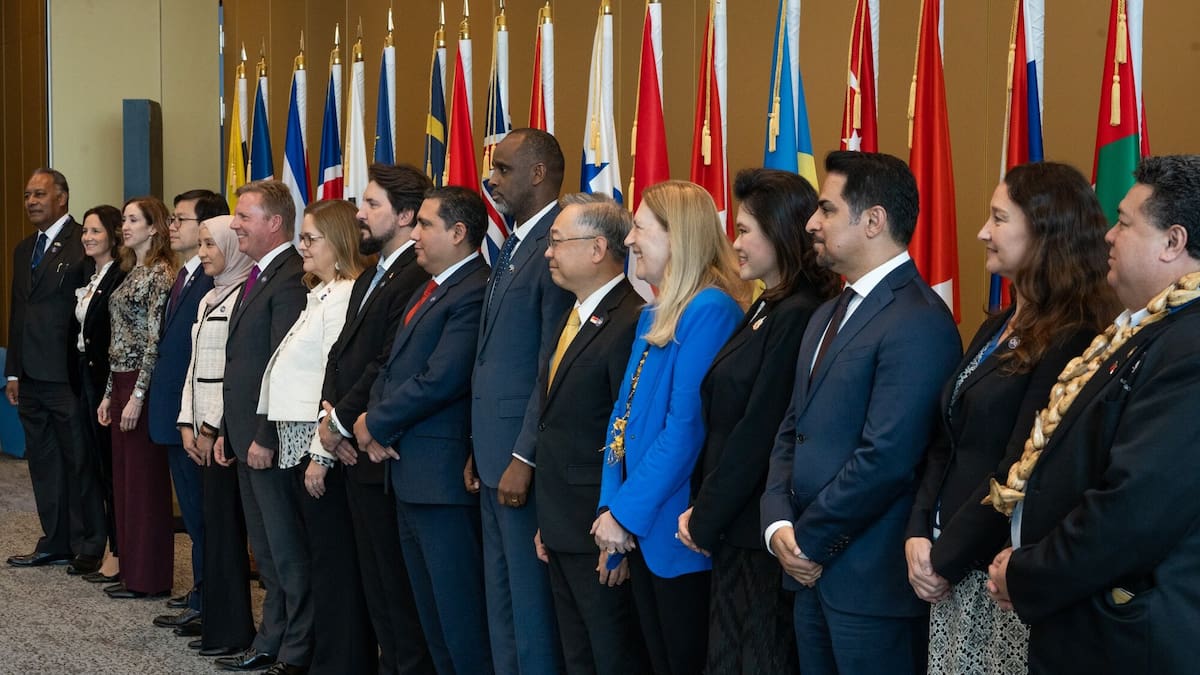
Ten trade ministers and about 100 delegates representing 21 countries jetted into Auckland for the day-long quickfire talk session, with many other meetings on the sidelines.
The 16 FIT Partnership countries (Brunei, Chile, Costa Rica, Iceland, Liechtenstein, Malaysia, Morocco, New Zealand, Norway, Panama, Paraguay, Rwanda, Singapore, Switzerland, the United Arab Emirates and Uruguay) are small and medium-sized economies that rely on trade.
Three other nations – South Korea, Peru and Thailand – officially joined the partnership in Auckland.
Reducing non-tariff barriers, going digital and dealing with supply chain issues were all key topics discussed at the forum.
Trade Minister Todd McClay and other ministers at the Future of Investment and Trade Partnership ministerial summit. Photo / Cameron Pitney
McClay said the progress being made with other FIT countries would benefit New Zealand businesses, as they looked to trade in other parts of the world.
“Companies will make decisions for themselves where they want to put their effort and deploy their capital when rules are fair and respected. As economies can grow, trade increases, jobs are created, and that can be good.
“We have a very straightforward message for New Zealand exporters.
“We will continue to look to negotiate high-quality trade agreements with like-minded partners that are fair and balanced, grow two-way trade equally so that they can have certainty, and we will help them.”
More countries want deals like the world-leading food and fuel agreement signed with Singapore.
The landmark food and fuel agreement between New Zealand and Singapore is now in force.
The Agreement on Trade in Essential Supplies (Aotes) was signed in Singapore on May 4,witnessed by Prime Minister Chris Luxon and Singapore Prime Minister Lawrence Wong.
It was officially ratified and brought into force on Friday.
Under the agreement, Singapore guarantees to supply New Zealand with fuel, medicines and chemicals.
In return, New Zealand will supply Singapore with food.
Singapore’s Deputy Prime Minister, Gan Kim Yong, who doubles as Trade Minister, officially signed the agreement with McClay.
The pair said the deal is unique.
“As conflict in the Middle East escalates, Aotes strengthens supply chain resilience and helps ensure the continued flow of essential goods when supply chains come under pressure,” McClay said.
Other countries are looking to copy or join the agreement.
“New Zealand and I’m sure Singapore would be open to those conversations,” McClay said.
“I think that whilst we won’t want to rush towards that over the next year, we’ll be able to talk about it much more, and I think we will see countries that start to discuss in detail with us, joining this agreement or similarly bilateral ones.”
Yong has had many of those discussions during his time in Auckland.
“And what I have said is it may be very different with other countries,” he told the Herald.
“I think this supply chain agreement has to be quite flexible.
“And what we have entered into with New Zealand serves as a very useful pathfinder, laying down the groundwork and the framework on which this supply chain collaboration can work.
“Then we can discuss with other countries on how we can build on this framework and to decide what kind of products that you need, what kind of products I would need and what are critical to you and what is essential to me.”
He said the FIT partnership was the right place to have those chats.
“It varies from country to country, and there’s a lot of discussion that’s ongoing.”
Switzerland’s representative, Helene Budliger Artieda, said food security was increasingly becoming an issue for her country.
McClay has reason to be happy about the warm words from Artieda as the pair joked about chocolate and cheese, but took the first, quivering baby steps towards free trade talks.
Thailand also expressed interest in being part of a similar agreement.
Costa Rica recently joined the CPTPP (Comprehensive and Progressive Agreement for Trans-Pacific Partnership) and is also in town for the FIT talks.
Indiana Trejos Gallo, the Central American nation’s Minister of Foreign Trade, said that once ratified, the CPTPP would make a big difference to her country.
Once it is officially a member, over 94% of New Zealand exports to Costa Rica will be duty-free from day one, rising to over 99% within 10 years.
New Zealand exports butter, paper, and therapeutic appliances to Costa Rica, while Costa Rica primarily supplies New Zealand with medical instruments and raw sugar.
“Costa Rica has set out a priority to reach out to the Asia Pacific region, and in that regard, the CPTPP is central and, of course, it will bring us closer to like-minded partners like New Zealand,” she told the Herald.
Medical devices are Costa Rica’s main export, and it wants to export more here.
“We have a very strong advanced manufacturing base.”
Trejos Gallo met with business leaders in Auckland yesterday.
“And I heard and had the opportunity to listen to questions to explain what Costa Rica has to offer, and being here opens new doors in every way for Costa Rican exports, but also to think about what else can we import from New Zealand.
“You’re an agriculture superpower; I don’t know what word to use, because you’re so competitive in that area, that I’m sure will continue.
“We do import kiwis. Everyone wants kiwifruit, yes, so we will continue to import kiwis from New Zealand, and [with] the agreement under CPTPP, we will probably be importing dairy goods as well, and so dairy and agriculture is where you see the room to grow.”
And right to the last minute, McClay was showing New Zealand products off to the visiting delegations.
They all received a New Zealand goodie bag containing wine, manuka honey, a blunt umbrella (“to shield them from New Zealand’s sun”), and of course, Whittaker’s chocolate.
And the event ended with drinks at the top of the Sky Tower, so guests could admire Auckland’s views.
Katie Bradford is a senior correspondent at the Herald. She has been a broadcast journalist for more than 20 years and was based in the press gallery for 10 years. She specialises in politics, business and Auckland issues.