
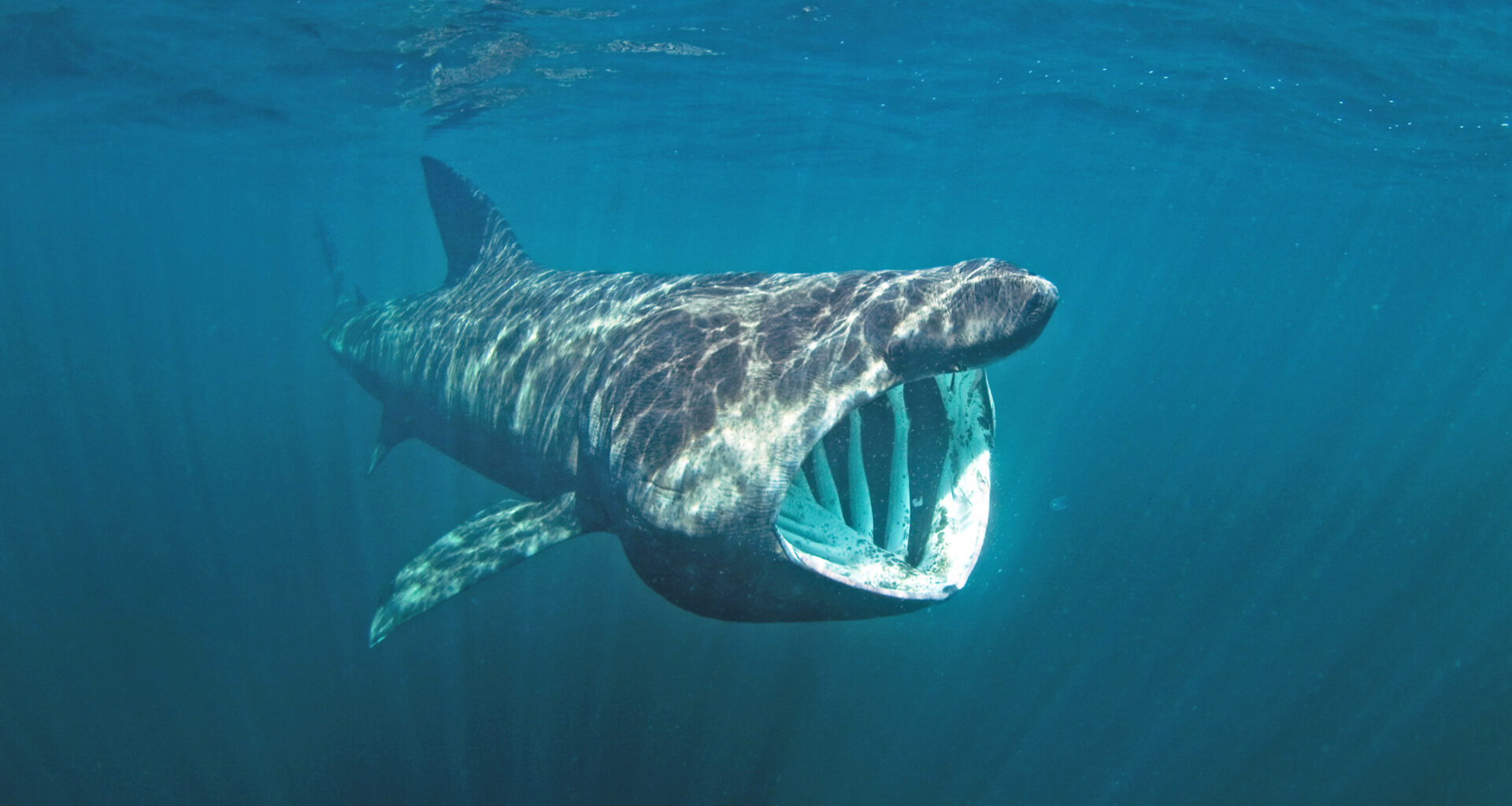
The skin of a basking shark is covered in fang-shaped scales so large and oddly arranged that researchers think they may be the key to how the animal opens its cavernous mouth to feed.
A new study found the scales bunched into tight patches, separated by bare folds of skin that stretch as the jaws gape.

Most sharks are wrapped in tiny scales all pointing toward the tail, a smooth coat built to cut drag through the water.
The basking shark has traded that design for one that bends and stretches. That’s a clue that its skin evolved around eating rather than speed. This is a template engineers could borrow for materials that need to be tough and flexible at once.
An accidental discovery
The find began with a different question. A team had set out to study the filtering structures inside the mouths of beached basking sharks.
Leading the work was Mike Schindler, a Ph.D. student in the lab of Mason Dean at City University of Hong Kong.
That changed the moment they touched it. Where other sharks feel firm but smooth, the basking shark’s skin snagged and shredded the researchers’ gloves.
“When we touched the basking shark’s skin with gloves, they quickly ripped apart,” said Schindler. The tearing was a signal that the scales were not lying flat and pointing tailward the way shark scales normally do.
Basking sharks are among the largest fish in the ocean, second only to whale sharks, and they can grow past 30 feet (9 meters).
They are also endangered and rarely available to study. So the team worked with a mix of real and digital museum specimens to wring as much detail as possible from each one.
Fang-shaped paver blocks
Sharks wear their armor as dermal denticles, tiny tooth-like scales with the same enamel and pulp found in teeth.
On most species these scales are microscopic and tilt toward the tail, a smooth layout long assumed to help the animal slip through water. One study that tested real shark skin found the drag story more tangled than that.
The basking shark broke every part of that pattern. Its denticles are giants by shark standards, reaching roughly 0.02 inches (0.5 mm) across, large enough to see without a microscope.
They also swapped the usual flattened hook for something closer to a fang. Those fangs point in seemingly random directions rather than lining up toward the tail.
Clustered in tight blocks
Stranger still was how the scales were grouped. Rather than spreading evenly across the body, the fangs bunch into tight clusters the team named paver blocks.
These blocks are packed most densely where the body flexes and deforms as the shark moves. Between the blocks run bands of bare skin with no scales at all.
One more oddity set the pattern apart. Shark denticles usually change form from head to tail, but the basking sharks’ denticles looked much the same across the whole body, leaving the skin wrinkled and folded rather than smooth.
Stretching to feed
The way a basking shark eats explains why a stretchy skin might beat a smooth one. It swims slowly with its mouth gaped about 3 feet (0.9 meters) across.
The shark lets seawater flood in and pass out through its gills, where bristly combs called gill rakers strain out the tiny animals it lives on.
This is filter feeding by brute momentum. A large shark pushes more than 100,000 gallons (378,500 liters) of water through its mouth every hour.
To make it work, the mouth and throat balloon open and clamp shut over and over. That deforms the head far more than fast-swimming sharks ever put their bodies through.
How the folds work
That constant ballooning is where the paver blocks seem to earn their keep. The scaled clusters are separated by bare, stretchy folds. That lets the skin pull open along those gaps as the mouth widens.
The folds then gather back together as the jaws relax. Stretch tests and 3D scans backed the idea that the folds let the skin extend far more than a fully armored surface could.
The blocks also fit together in a clever way. With the mouth shut, scales at the edge of each block fold over the bare gaps and mesh with their neighbors. That seals the skin so nothing soft stays exposed.
That mix of stretch and coverage fits what other research shows inside these sharks, where the mouth works as a tuned filter rather than a plain sieve.
An evolutionary trade-off
To understand where the skin came from, the team turned to the fossil record, comparing the giant denticles with those of extinct basking shark relatives. The pattern runs deep.
Those odd scales appear right alongside the earliest signs of filter-feeding anatomy. That suggests skin and feeding style evolved together as these sharks took up a diet of drifting plankton.
Slow swimming may have opened the door. A fast shark needs its scales locked into a smooth, drag-cutting layout, but the basking shark’s unhurried pace loosened that demand.
Unique among its relatives
Other work on slow swimmers has likewise found their denticles wandering from the tidy, low-drag pattern.
“We suspect that, due to this species’ slow swimming speed, denticles were released from a constraint,” said Schindler – leaving the skin free to take on new jobs, stretching to let the mouth open and keeping parasites out of the folds.
What surprised the team was how far the basking shark stands apart, even from its own kind. Its closest living relative, the sand tiger shark, carries ordinary scales.
So do other big filter feeders such as the megamouth shark, which strains plankton in much the same way. The paver-block skin, so far, looks like the basking shark’s alone.
Lessons for engineers
A material that stays stiff in one direction while stretching freely in another is exactly the kind of thing engineers struggle to build. The basking shark has managed the combination for millions of years.
The researchers see its skin as a template for such materials, including stretchable sportswear and medical bandages that flex with the body without tearing.
What the study makes clear is that shark skin can be far more than a drag-cutting shell.
Until this work, the basking shark’s oversized, fang-shaped scales and their odd clustering had never been mapped in this detail. And no one had tied the bare folds between them to the animal’s ability to open its mouth so wide.
The basic picture has already changed. A shark’s armor has long read as nothing more than a tool for slipping through water. It may also work as a stretchable skin built around the act of feeding.
That same design could prove as useful on an engineer’s workbench as it has been in the open ocean.
—–
Like what you read? Subscribe to our newsletter for engaging articles, exclusive content, and the latest updates.
Check us out on EarthSnap, a free app brought to you by Eric Ralls and Earth.com.
—–