
The other two were found not guilty of murder, but were convicted of manslaughter, a charge they had admitted earlier.
Today, Taylor’s sister, Catherine Spooner, told his killers that they would be freed from prison one day, and would be able to reconnect with loved ones and family.
“For my whānau, there will be no ending, no reconnection, no future time with our Boy.
“The thought of this is unbearable, and yet I have to go on – all of us in Boy’s whānau have to go on – with our lives, knowing he leaves such an enormous hole in our hearts, in our future without him.”
Despite this, Spooner said she was trying to find a place in her heart to forgive the men who had taken her brother’s life.
“I wish you wellness, peace and safety in your future journey. We forgive you,” she told them across the courtroom.
Attack captured on CCTV cameras
The attack on Taylor was captured on CCTV cameras, including one in a shop on the other side of the street.
The footage was played to the jury repeatedly during the two-week trial.
It showed the four men punching, kicking and stomping on the man who chose to live on the streets despite offers of help and support from his family.
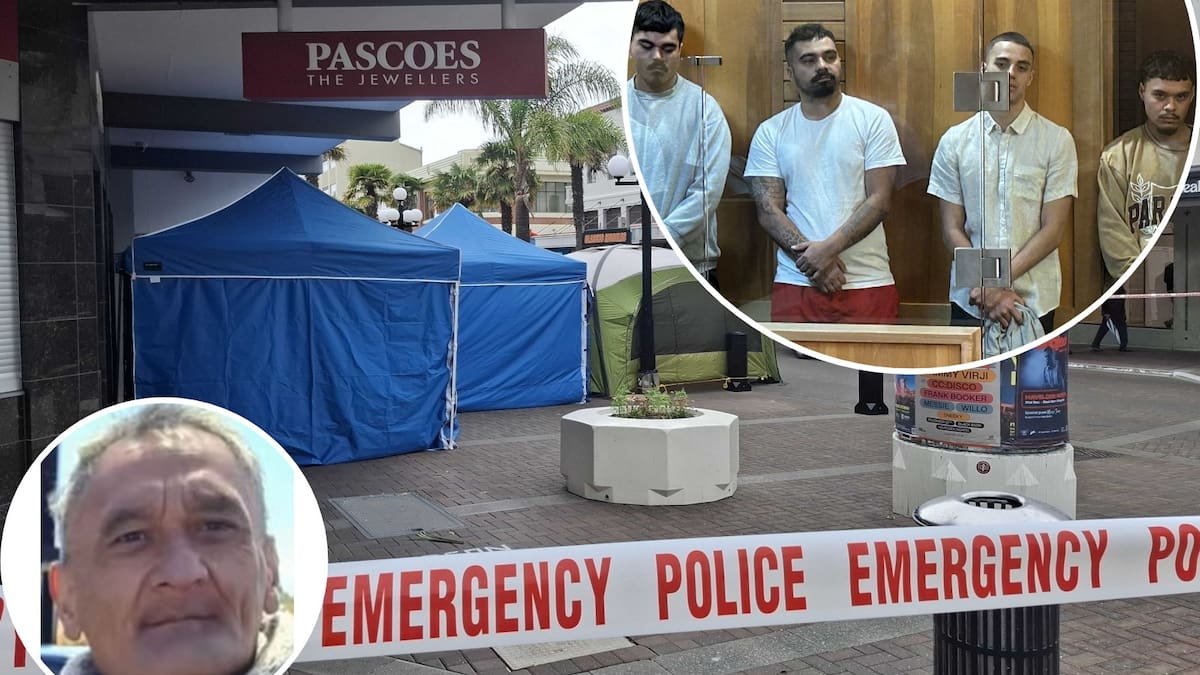
The four men who killed Boy Taylor (from left): Trizarn Henare, Rua Hune, Tuarima Alexander, and Takarangi Kumar. Photo / Ric Stevens
Trizarn Henare, 20, and Takarangi Kumar, 19, were found guilty of murder.
Today, Henare – described in court as the “most involved” in the attack – was jailed for life with a minimum non-parole period of 10 years.
Kumar, a first-time offender, was sentenced to 18 years of imprisonment with no minimum term without parole.
The sentencing judge, Justice David Boldt, said he had taken into account Kumar’s youth, his “sad and challenging” personal history and his potential for rehabilitation in deciding that a life sentence would be “manifestly unjust”.
The two convicted of manslaughter were Rua Hune, 34, and Tuarima Alexander, 22.
Hune was jailed for seven years and two months, while Alexander was given four years and five months.
During the trial, Hune’s lawyer, Matthew Phelps, pointed out to the jury that his client stepped away from the fracas for periods of time while he attended to a cut on his forehead.
Alexander’s counsel, Nicola Graham, said her client was the “least involved” in what happened, generally trailing the others and on the periphery.
Verdicts decided on definition of murder
The defence case for all the accused turned on a provision of the Crimes Act that defines murder: to be guilty of murder, a person must intend to cause another’s death or be “reckless” about whether their actions are likely to cause that person to die.
Lawyers for all four men argued that these conditions had been absent.
The four had also been charged with injuring with intent to do grievous bodily harm, in relation to another man they attacked about two hours earlier.
The jury delivered split verdicts in relation to that incident. Henare and Kumar were guilty, but Hune and Alexander were convicted on the lesser charge of injuring with intent to injure.
Boy Taylor, a street-dweller who died in Napier’s Emerson St shopping precinct a week before Christmas 2024.
Taylor armed himself with bottles
During the trial, the Crown and defence presented alternative pictures of Taylor and the fracas that killed him.
Crown prosecutor Fiona Cleary portrayed the street dweller as being alone and vulnerable on the streets of Napier in the early hours of the morning.
She said the four accused set upon him in “a sustained, repeated and escalating attack”.
However, defence counsel Eric Forster, appearing for Henare, said that Taylor became “armed and dangerous” when he took two bottles from the trolley in which he kept his belongings.
He smashed them, and threw one before brandishing the other as a weapon.
Two of the four accused were cut by glass – Hune on his forehead and Henare above his left eye and on his leg.
Justice Boldt said it was accepted that the bottle-throwing provoked the four men’s response, but the attack that followed was an “extreme over-reaction”.
Victim remembered as a ‘kind man’
Spooner, speaking on behalf of all Taylor’s whānau, said her brother was “cheeky and mischievous” with a great sense of humour.
Police at the sene on Emerson St in Napier after the fatal attack on Boy Taylor. Photo / Doug Laing
“He was such a kind man and would always help people where he could,” she told the court.
“He was hard-working, honest and well-known and liked by everyone, including so many people in the wider community, who got to know Boy as he roamed around the streets of Napier.”
She said Taylor had the offer of a home with any of the family if he wanted, but chose “for his own reasons” to live on the streets.
She went looking for her brother once or twice a week, to take him food, offer him a shower and the chance to do his laundry.
The last time she saw him was a week before she was killed, when they had a Chinese meal together, and she gave him some McDonald’s vouchers.
“When I left Boy that day, I gave him a huge hug and told him I loved him.
“He said, ‘Thank you, my sis – you know you’re my favourite.’
“The next time I saw Boy was at the morgue at the Hawke’s Bay Memorial Hospital. We were warned that he had significant injuries which might be hard to see, but nothing prepared me for the reality of seeing Boy’s face with such terrible injuries.
“The thought of what Boy must have suffered that morning, the terror, the pain, the possibility that he knew that he was about to die; these are the thoughts that haunt me and our whānau every day since we got the news that Boy had been killed.”
Ric Stevens spent many years working for the former New Zealand Press Association news agency, including as a political reporter at Parliament, before holding senior positions at various daily newspapers. He joined NZME’s Open Justice team in 2022 and is based in Hawke’s Bay. His writing in the crime and justice sphere is informed by four years of frontline experience as a probation officer.
Join NZ Herald’s Open Justice team for Case by Case, a video and podcast series examining the disputes and decisions making headlines across New Zealand.