
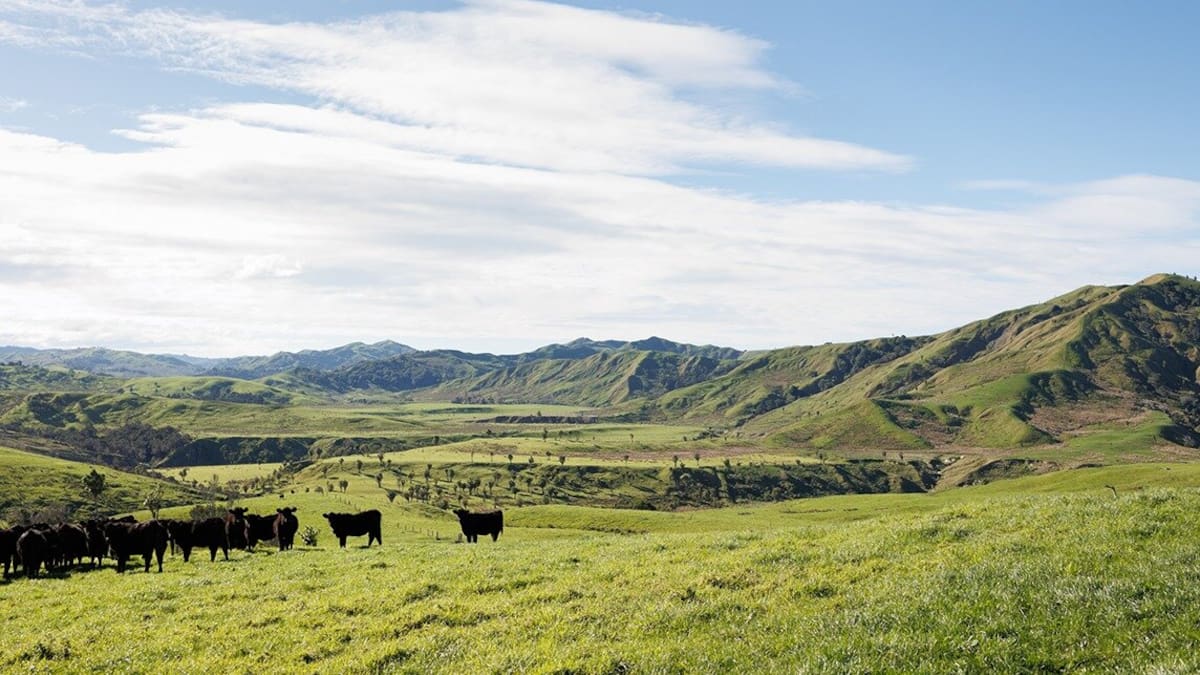
The 76 farms range in size from five to 46,000ha.
Together, they employ more than 400 people, steward at least $738 million in assets, and generate over $51 million annually for the Tairāwhiti economy.
Established in 2023 in reaction to government-proposed RMA reforms, this large network of Māori landowners was formed to amplify the collective voice of the whenua and its people.
At a time when major regulatory shifts were reshaping land governance and environmental responsibilities, Tairāwhiti Māori landowners came together rather than being passive recipients of change.
“I guess what we’ve done is we put a formal structure and discipline around influencing macroeconomic policies,” Collier said.
“We knew how big we were.”
“Council didn’t know, so that’s when the lawyers arrived to the next meeting we had. And after that, we came to an understanding that decisions being made around the table would have a major impact on our operations, and we would defend it.”
The purpose was to ensure these Māori landholders were active in shaping the region’s future, he said.
“Māori land is a lot different to your typical mum and dad farmer in New Zealand.
“You’ve got a whole lot of beneficiaries, owners, shareholders, call them what you will.
“Ownership tends to be there through a lens of connection to place.”
Collier said communication had to be different, too.
When speaking to landowners, describing how decisions impact the land and its future often resonates more than economic arguments.
“It’s not just about making money for the sake of making money,” Collier said.
“I think giving people their cause or their purpose is fundamental to what we do.
“That purpose may be because they want to be a farmer of the year and be recognised for that.
“Others want to see career pathways for their children, grandchildren.”
Chief executive officer of the Tairawhiti Whenua Charitable Trust, Hilton Collier.
Since 2023, the 198,000ha have seen change.
The trust’s research showed that the steep hill country and erosion-prone hills were redundant for farming. So it was planted out in native trees, or already existing trees were registered under the emissions trading scheme.
“The land feeds the people,” Collier said.
“So, if it’s not running sheep and cattle, it’s not creating a job; there is no reason why we can’t be using the emissions trading scheme to provide income.
“For how long now we’ve been told the emissions trading scheme is the death of farming?
“It’s the death of farming if farmers want to sell all their land to the highest bidder.
“We [Māori land owners] can’t sell land, so we’re looking at which parts of our state we put into ETS, because we quite like the idea of $50,000 a hectare worth of carbon.”
The trust’s farms generate over $51 million annually for the Tairāwhiti economy.
Instead of removing existing vegetation growing in the high country, the farmers have registered under the Emissions Trading Scheme and can earn $300 a hectare, ongoing.
“If you’re not making a return, get rid of it,” Collier said.
“Stop wasting money on it and redivert that investment into other parts of the farm, increase carrying capacity – we strip out costs.”
The newly native trees return around $1800 a hectare.
At the heart of the trust’s operation is the influence of the red meat sector, with 130,000ha still used for sheep and cattle.
The trust recently won the Gallagher Innovative Farming Award at the Beef + Lamb New Zealand Awards.
Māori and Pacific peoples form an important part of the red meat sector’s workforce, particularly among younger age groups, making them central to the sector’s future labour supply.
Around 25% of the sector are Māori and 11% Pacific peoples.
“We still have all those socio-economic problems; we’re not going to change it overnight,” Collier said.
“But if we start packaging things in a way that matters to our landowners that they can engage with, why wouldn’t they?”
Collier said much of the trust’s workforce was Māori; however, they employ the best people for the job.
“We invest in trading and upskill our people, whether those people come back to us or don’t, it doesn’t really matter.
“It’s about employing people in our region. And if they’re a good rugby player and they play for the family rugby club, that’s a bonus.”
Overall, the collective has increased farm revenue during its three years of operation, he said.
“A couple of 100 years ago, we probably went out for a hunt and ate whatever we killed,” Collier said.
“But today, it means using the land in a way that creates jobs, it creates enterprises, all those sorts of things.
“And then to be sustainable, not only do we need the jobs, we need somewhere to live, but we also need to make sure the land stays in place.
“That’s why I talk about feeding the whānau — because if we don’t continually look into the horizon and ask what that looks like, we’re going to wake up and we’ll still be producing black and white TVs when the world’s moved beyond colourful iPhones.”
– Supplied by Beef + Lamb NZ