
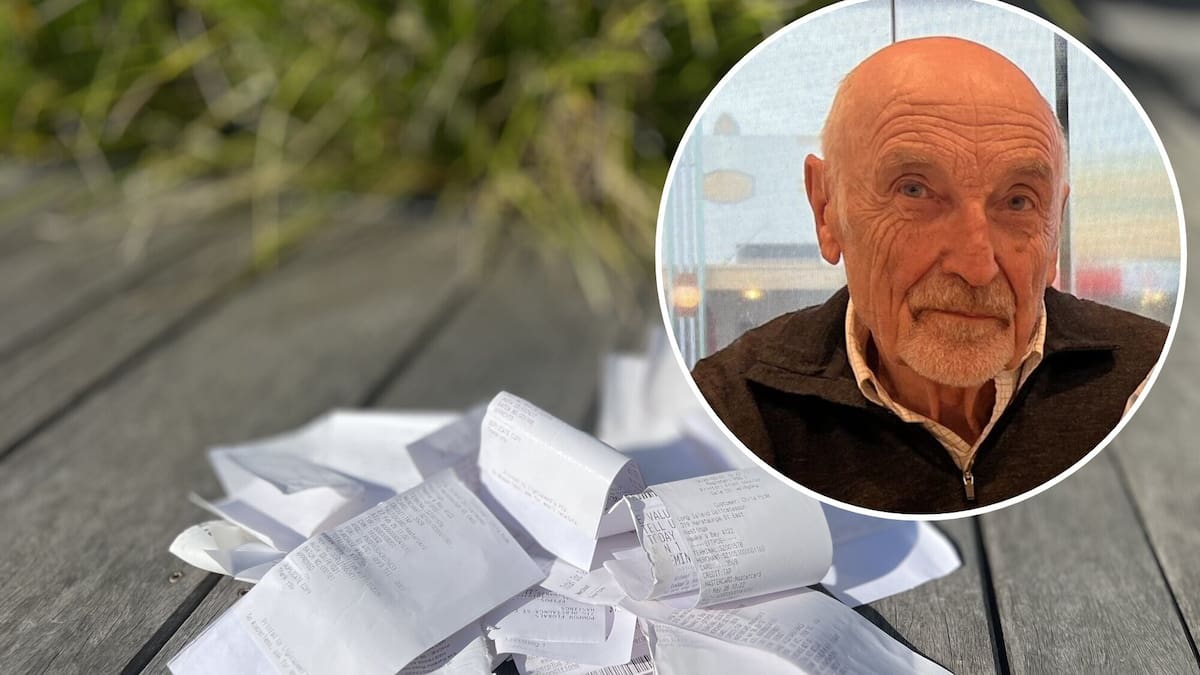
The Ministry for the Environment said it did not have a position on thermal paper receipts and was not considering any regulatory changes about receipt printing.
However, it noted many businesses already voluntarily offered customers the option of declining a printed receipt or choosing a digital one, describing those initiatives as “a good example” of retailers reducing their environmental impact.
For Breustedt, however, voluntary action does not go far enough.
He wants businesses to stop automatically printing thermal receipts.
“If you go to a cafe, they ask you, ‘do you need the receipt?’
“If you don’t, they take the receipt out of the Eftpos machine and throw it somewhere,” Breustedt said.
His discussion paper, supported by local church environmental groups, cited overseas studies suggesting thermal receipts contained chemicals such as bisphenol A (BPA) or bisphenol S (BPS) and that repeated exposure could pose health risks.
He claimed better protection was also needed for workers who handled receipts regularly.
Research cited in his paper suggested that while short exposure was unlikely to harm most people, it could be more concerning for pregnant women, children and those with thyroid issues.
Originally from Germany, Breustedt spent much of his career working on environmental projects and said he believed there was still much to be done in New Zealand.
“People believe when they are recycling plastic, it solves the problem,” he said.
“We have to reduce the amount of plastic that we are using.”
Breustedt said the aim was not to ban all receipts or all plastic overnight, but to push for practical changes and clearer information for the public.
He said he wanted people to be aware that recycling soft plastic into outdoor products could still lead to microplastic pollution in future.
Breustedt said he hoped the paper would start a wider conversation and ultimately lead to practical policy changes.
The Ministry for the Environment said reducing plastic pollution was a key focus through wider waste and resource efficiency programmes, including product stewardship schemes and previous bans on a range of hard-to-recycle and single-use plastic items.
“A third tranche of a work covering additional PVC and polystyrene food packaging phase-outs was to be in place by 2025, but this was put on hold pending further work and consultation with industry,” the ministry said.
“A Cabinet decision is expected in the coming months and, if approved, new regulations would likely take effect in 2030, aligning with similar moves anticipated in Europe.”
Hastings District Council’s waste planning manager Angela Atkins said thermal receipts were not accepted in kerbside recycling and that they should be placed in the rubbish bin.
“Where possible, residents can choose not to receive a printed receipt or request an electronic receipt instead,” she said.
The council encouraged businesses to reduce unnecessary waste where practical, including by using digital tools instead of printed materials where suitable.
“We recognise that the ability to offer electronic receipts may depend on the capabilities of individual point-of-sale systems,” Atkins said.
She said the council worked with businesses, households, schools and community groups to reduce waste through education, waste minimisation initiatives and support for more sustainable practices.