
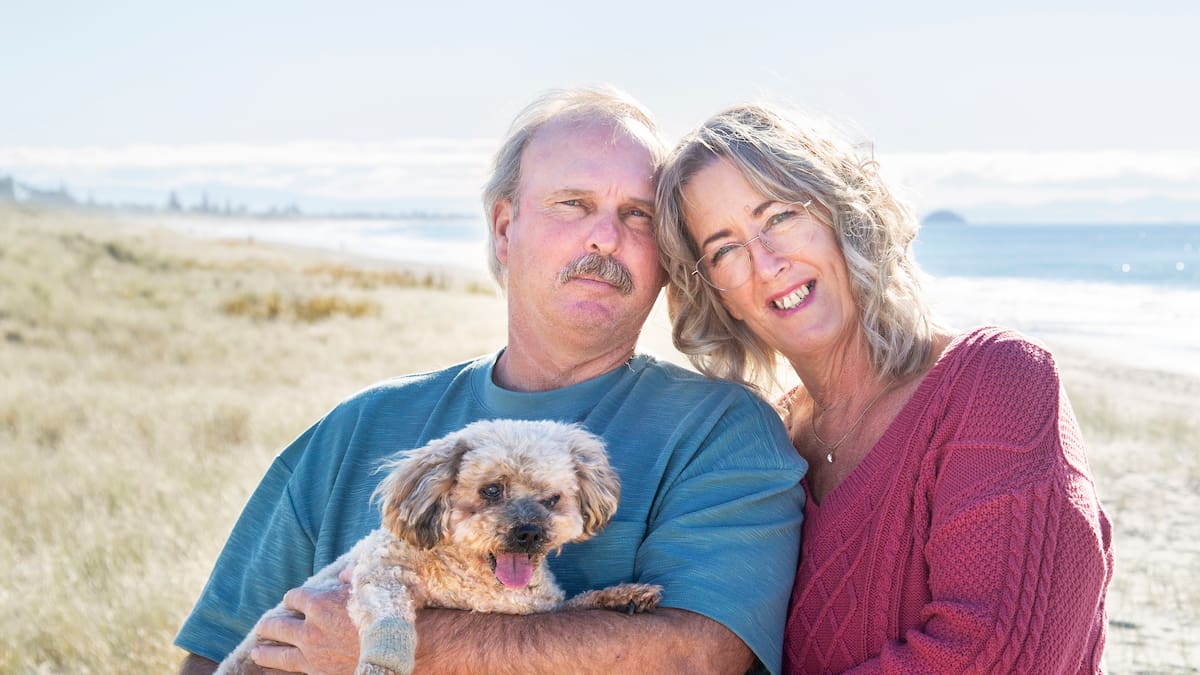
She’s found that people often mistakenly believe the rare disorder is like other forms of dementia. But unlike Alzheimer’s, for example, which usually starts with memory loss, bvFTD primarily attacks the brain’s frontal and temporal lobes, causing sudden and dramatic personality changes.
For Jacqui, it’s heartbreaking how stark the contrast is from the once dependable, loyal family man Kevin, now 56, was before the disease.
The pair met as teenagers in Ruakākā after their brothers set them up. They went on to build a noisy, love-filled family life with seven children that has grown to nine grandkids.
After having four children, Jacqui thought their family was complete, but Kevin had other ideas.
“I said, ‘Why don’t we get a cat instead?’ But I saw how much Kevin wanted it and loved being a dad, and I just couldn’t say no.”
After a vasectomy reversal, the couple welcomed three more children.
“Kevin was just gleaming,” she recalls. “Raising seven children together has been beautiful.”
Kevin was a hands-on dad, says Jacqui. Photo / Juliette Drysdale
Jacqui says Kevin was the kind of hands-on dad who had children climbing all over him the moment he walked through the door from work as a cellar hand.
But looking back, she can now trace the first signs of bvFTD to around the time of the pandemic when the couple was already navigating the stress of lockdowns.
“There were fabricated stories, endless driving, increased alcohol use, irrational decisions, compulsive phone behaviours and increasing isolation,” explains Jacqui.
The escalating changes placed enormous strain on the whole family, and their children expressed how worried they were about Jacqui.
“I had promised myself, and the kids were supporting me, that I’d give Kevin until Christmas and if we didn’t get answers or he didn’t start changing, then we’d separate because I couldn’t keep living that way.”
Desperate to help Kevin, Jacqui organised holidays, encouraged him to join men’s support groups and tried to keep their life together while quietly fearing something was terribly wrong.
“I was trying everything – you don’t leave someone you love floundering knowing he’s going to drown.”
One frightening incident saw Kevin lost for days while driving to Whangārei to visit his mother.
Jacqui shares, “He wouldn’t answer my calls, but I was tracking him on my phone and I ended up ringing the police because I was so worried. They did a welfare check. He was very disoriented, so they confiscated his driver’s licence pending medical clearance.”
Kevin and Jacqui, with their children, partners and grandchildren. Photo / NZ Woman’s Weekly
That started the process of diagnosis. After cognitive testing, blood work and scans, Kevin was formally diagnosed with bvFTD in August 2025.
The hallmarks of bvFTD are personality changes and a progressive decline in socially appropriate behaviour, judgement, self-control and empathy. People with bvFTD typically do not recognise the changes and there is currently no known cure.
“Receiving the diagnosis was devastating, but it also finally explained the years of confusion our family had been living through,” reflects Jacqui. “I’m so pleased I pushed for answers. Imagine if I had left him.”
Kevin was medically retired from his job a month after diagnosis. Nine months later, life now revolves around routines, supervision and care. He needs help with meals and most daily tasks that others take for granted.
When she’s not looking after Kevin at home, Jacqui works as a community caregiver.
“I’m grieving someone who is still physically here,” she confides. “That is one of the hardest parts.”
But Jacqui remains deeply committed to her husband.
“My life is just making sure Kevin is safe, that he feels comfortable and that his dignity is intact,” says Jacqui. “I truly believe this is what I am supposed to do. It’s what I am – his wife and sadly now his carer too.”
While life looks different from what she ever imagined, Jacqui hopes sharing her experiences will reach others in a similar situation.
“If it helps another family recognise the signs earlier, push for answers or not give up on someone they love because of drastic personality changes, then telling our story matters.”