
New Zealand Police declined to comment on whether they provided any help to the North American law enforcement agencies involved.
But the events throw up questions about New Zealand’s closening ties to India, through the recently signed free trade agreement, and through mooted follow-on work, including a commitment to joint action on counter-terrorism.
A common theme across Canada’s well-documented struggle with India-linked crime is the use (and abuse) of temporary visas.
Indian Prime Minister Narendra Modi at the welcoming ceremony for him at Government House on July 11 in Auckland. Photo / Dean Purcell
In a special bulletin released in April, Canada’s financial intelligence agency described sustained campaigns of extortion, focused on the local South Asian population there, by India-linked crime groups and possible local copycat actors.
“These groups appear to recruit or rely on individuals already living in Canada to act as financial intermediaries (“money mules”), enforcers, or “foot soldiers”, typically financially vulnerable, young male Indian nationals in Canada on study permits,” the Financial Transactions and Reports Analysis Centre of Canada warned.
The misuse of student visas and post-graduate visas by the India-linked gangs has also been described by various Canadian police forces.
The likely benefits of New Zealand’s freer trade with India, and its population of 1.5 billion, have been well aired.
The FTA is expected to come into force later this year and will increase goods and container traffic between the two countries, ease customs processes and likely travel, and entrench and extend New Zealand student and post-graduate visa availability for Indian nationals.
The question is, will that make New Zealand’s systems vulnerable to abuse?
Alexander Gillespie, Professor in the Faculty of Law at the University of Waikato, doesn’t think so.
“People are right to be concerned about organised crime … it’s is getting bigger, more complicated, more integrated and it’s coming towards countries like New Zealand with greater speed than ever before. But whether there’s an FTA in there won’t particularly change that … and the more our police forces can co-operate with one another the better that will be.
“I’d be cautious about talking about a particular ethnic group as being a risk. Criminals by nature are going to go outside the lawful process, and so because you’ve got more people coming from one particular country doesn’t mean that you want to associate those people with being criminals. Because 99.9% of them aren’t.”
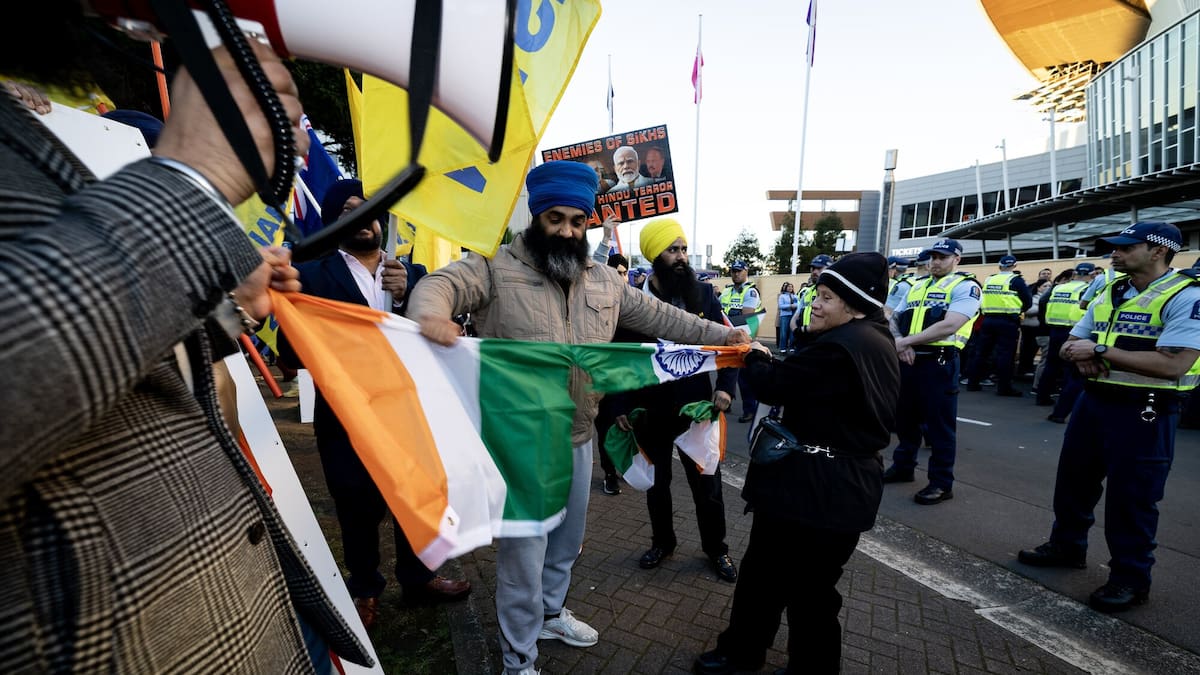
Several protest organisations faced off with supporters during a public event for Indian Prime Minister Narendra Modi in Auckland on July 11. Photo / Dean Purcell
On the other hand, Gillispie said the FTA will act as a gateway to closer work in other areas that does require caution: “this is going to involve more than just kiwifruit”.
During Modi’s visit, a joint India-New Zealand statement reaffirmed both parties’ commitment to stronger co-operation in areas including security, counter-terrorism, law enforcement and defence.
These developments have been broadly welcomed by New Zealand’s Indian diaspora, numbering some 300,000. But minority groups, especially Sikhs, are wary of Modi’s BJP party and its brand of Hindu nationalism.
“India is a democracy but there is a lack of dissent and human rights in India right now, that’s a concern. Their potential links to assassinations or acts which are violations of human rights, in that regard we should be vigilant … New Zealand values dissent and the right to dissent. So the question is, how close do you want to get to countries that don’t have the same values as yours?” Gillispie said.
That question is currently at the fore for Canadians.
Among the crimes alleged in the FBI-led indictments made public earlier this month is the 2023 assassination of the Sikh nationalist leader Hardeep Singh Nijjar, in the Canadian province of British Columbia.
The indictments allege the murder was ordered by India’s Bishnoi gang leader Lawrence Bishnoi, from his jail cell in India.
But that now overlays Canadian claims – made by previous Prime Minister Justin Trudeau – of “credible allegations” that the Indian state was linked to the murder. It’s a view that was subsequently reinforced by a leaked Royal Canadian Mounted Police report.
Nijjar was labelled a terrorist by India in 2020, during Modi’s second term as Indian Prime Minister.
“This [US] investigation could certainly get uncomfortable. There hasn’t been a mention so far of Indian state involvement. But will the Indian authorities co-operate? Will there be extraditions from India?” Robert Huish, associate dean of research at Dalhousie University in Canada and an expert on foreign interference, told the Herald.
After several years of diplomatic freeze between India and Canada after the assassination and the Trudeau accusation, current Canadian Prime Minister Mark Carney is trying to rebuild ties with the subcontinent and working towards a broad free trade agreement.
As in New Zealand, how this marries the two countries’ very different approaches to thorny issues like Sikh nationalism remains to be seen.
Stay ahead with the latest market moves, corporate updates, and economic insights by subscribing to our Business newsletter – your essential weekly round-up of all the business news you need.