
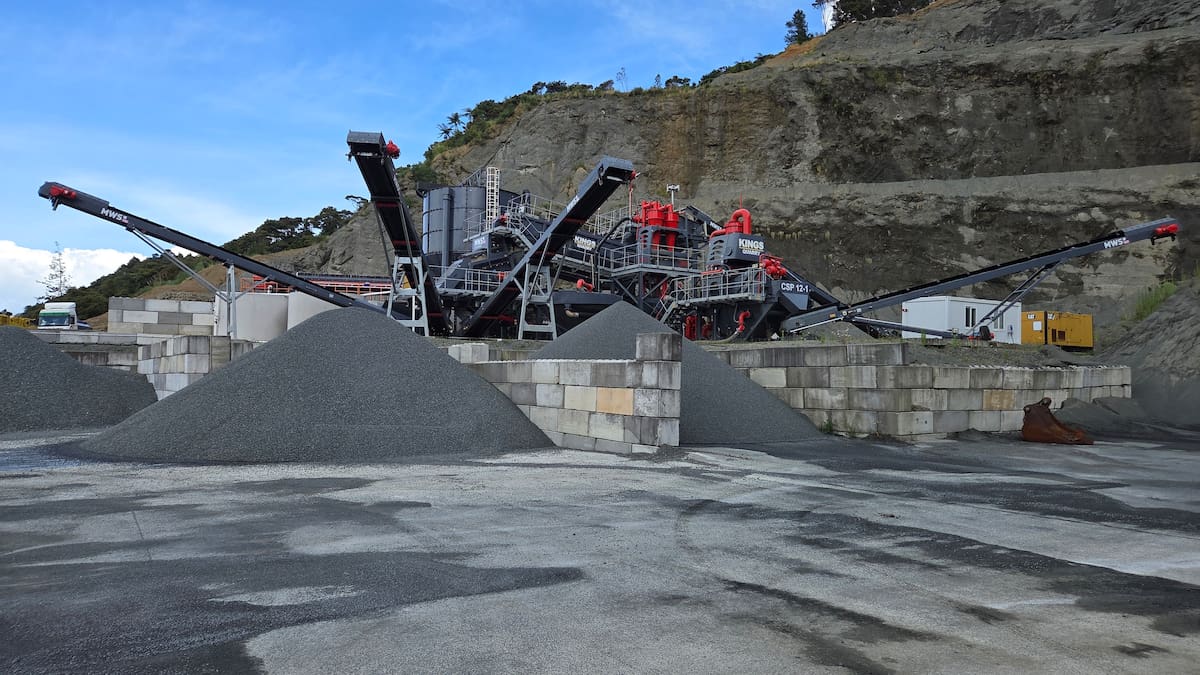
The quarry’s location reduced the need for long-distance transport, cutting about 12,000 tonnes of carbon emissions and saving about $20m in transport costs each year, he said.
After buying the site, Semenoff and business partner Andrew Ritchie applied to expand their quarry under Labour’s Covid-19 Fast Track legislation. The company was later invited to enter the current Government’s Fast Track process as part of a wider call for eligible projects.
Semenoff said Fast Track may be quicker than traditional consenting pathways but still required years of consultants, lawyers and paperwork – four and a half years in Kings Quarry’s case.
“I wouldn’t say that I’m a champion of it [the Fast Track process]. It was very, very, very, very, very costly.”
Asked whether Fast Track was genuinely faster, Semenoff said, “I guess it probably is … but gee whiz, it’s very expensive”.
He said applicants needed confidence in their project and their ability to satisfy the approval process.
“You’ve got to believe in it. You’ve got to know that you can get through it, otherwise it will burn you.
“The bureaucracy speaks for itself.”
Despite the cost and time involved, he believed the quarry would still be stalled under a conventional process.
“We probably wouldn’t have got there or may have never got there, who knows?” he said.
With stages one and two complete, Kings Quarry could now operate at its expanded capacity for up to 60 years and potentially up to 200 years if it entered another stage, Semenoff said.
The quarry added to Auckland’s overall sand supply rather than replacing existing operators, he said.
Combined with output from his Tomarata quarry near Mangawhai, sand from Kaipara Harbour, the Waikato, and manufactured sand produced elsewhere in Auckland, the city was well supplied, Semenoff said.
“So yeah, I’m sure Auckland’s not going to run out of sand. That’s for sure.”
An overhead view of Kings Quarry.
He said plans were underway for a ready-mix concrete plant at the quarry, also reducing the need to transport raw materials long distances before processing.
Asked whether Kings Quarry was solving a supply problem or acting as a backup, Semenoff said it was “definitely solving part of the Auckland problem”.
He would not comment on whether Kings Quarry’s output reduces or rules out the need for new projects such as McCallum Bros’ controversial proposal to extract sand from Bream Bay, also in Fast Track.
“I’m not in a position to judge any of the stuff relating to competitors.”
The decision was up to the consenting panel after considering submissions from local communities, he said.
“We’ve been through the [assessment] judicial system, and we sort of stand by it,” Semenoff said.
He said a dispute before the courts involving Ritchie, himself, his son Alexander Semenoff and the Kings Quarry board had not affected daily operations.
“It’s a bit of a governance thing, but it’s going through the process … I have faith in the judicial system; it’ll come out fine,” he said.
Previous Herald reporting noted Kings Quarry co-owner Andrew Ritchie was a director of AJR Finance, which donated $55,000 to NZ First and Shane Jones during the 2023 election campaign.
The reporting also noted Semenoff previously donated to Jones’ 2008 campaign and is a distant relative of the minister.
The Government said any ministerial conflicts in Fast Track decisions would be managed under Cabinet Manual rules.
Sarah Curtis is a news reporter for the Northern Advocate, focusing on a wide range of issues. She has nearly 20 years’ experience in journalism, most of which she spent reporting on the courts in Gisborne and the East Coast.