
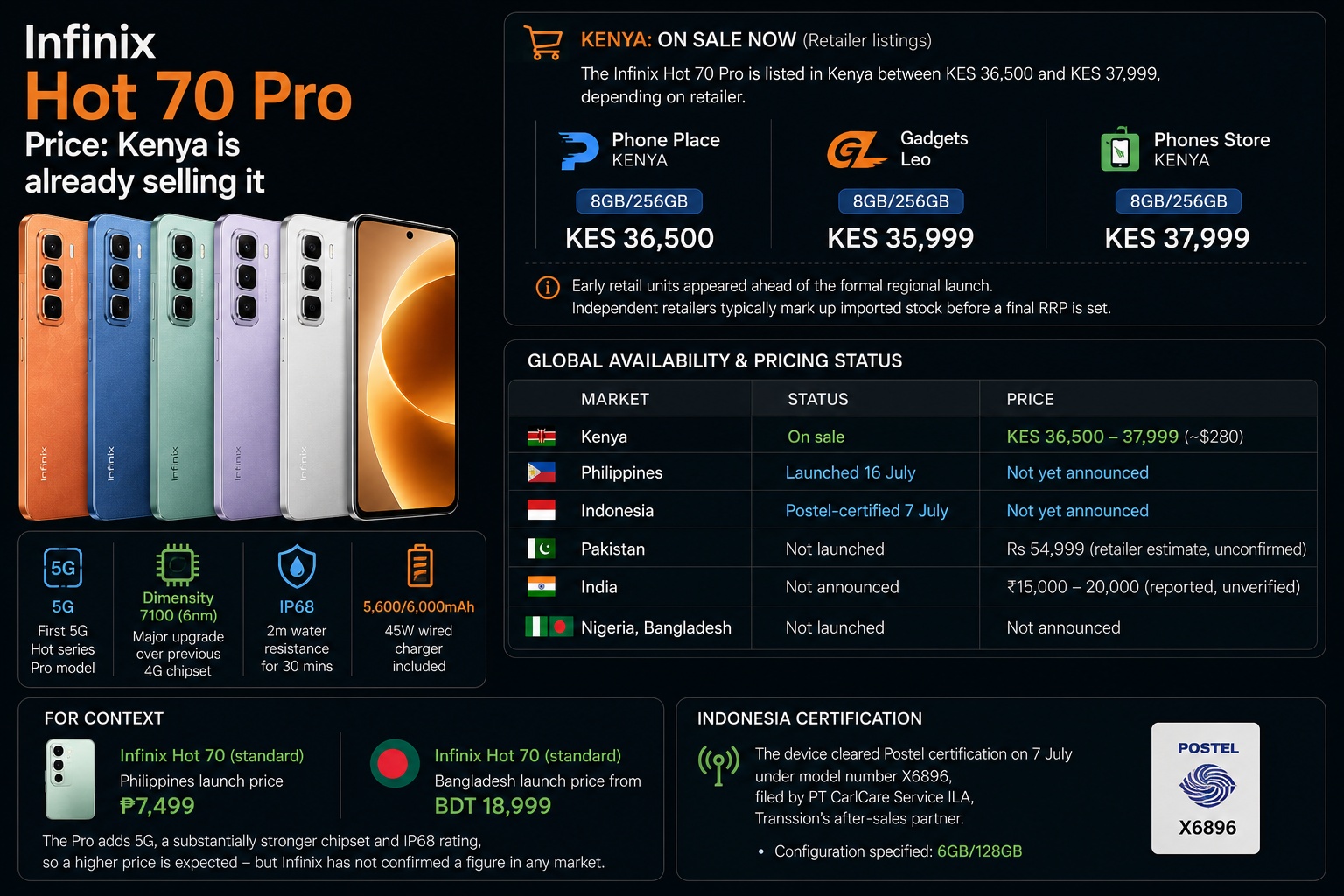
The Infinix Hot 70 Pro is listed in Kenya between KES 36,500 and KES 37,999, depending on retailer. Phone Place Kenya lists the 8GB/256GB configuration at KES 36,500, while Phones Store Kenya has the same configuration at KES 37,999. Gadgets Leo sits between the two at KES 35,999.
Kenyan outlet TechBlogs Africa reported that early retail units appeared ahead of the formal regional launch, and cautioned that independent retailers typically mark up imported stock before a recommended retail price is finalised. That caveat matters: these are retailer listings, not an Infinix-confirmed RRP.
Elsewhere, the picture is thinner:
MarketStatusPriceKenyaOn saleKES 36,500–37,999 (~$280)PhilippinesLaunched 16 JulyNot yet announcedIndonesiaPostel-certified 7 JulyNot yet announcedPakistanNot launchedRs 54,999 (retailer estimate, unconfirmed)IndiaNot announced₹15,000–20,000 (reported, unverified)Nigeria, BangladeshNot launchedNot announced
For context, the standard Infinix Hot 70 launched in the Philippines at ₱7,499, and in Bangladesh from BDT 18,999. The Pro adds 5G, a substantially stronger chipset and IP68 rating, so a higher price is expected — but Infinix has not confirmed a figure in any market.
In Indonesia, the device cleared Postel certification on 7 July under model number X6896, filed by PT CarlCare Service ILA, Transsion’s after-sales partner. The certification listing specified a 6GB/128GB configuration.
Full specifications
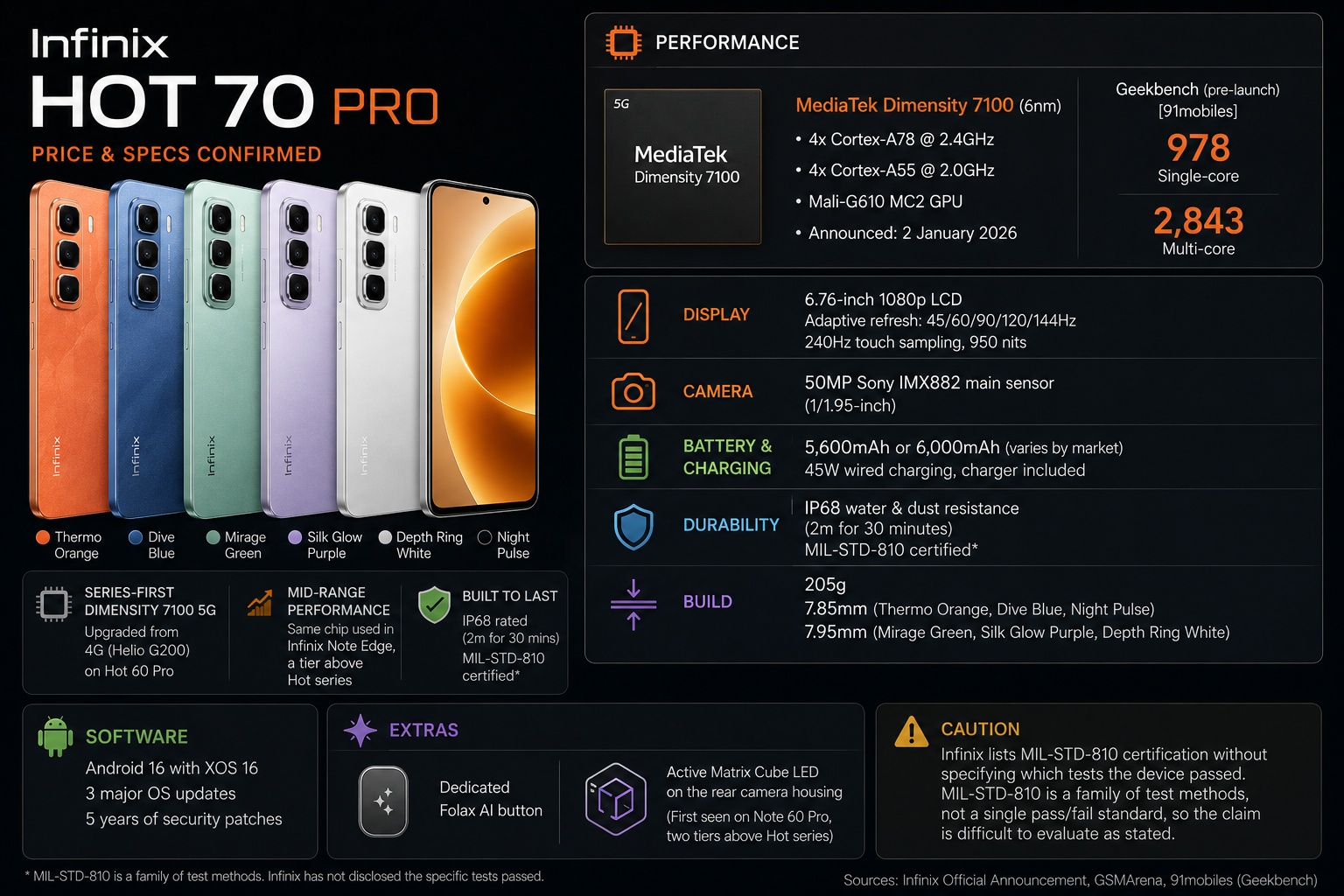
The Hot 70 Pro runs the MediaTek Dimensity 7100, a 6nm chip announced on 2 January 2026 with four Cortex-A78 cores at 2.4GHz, four Cortex-A55 cores at 2.0GHz, and a Mali-G610 MC2 GPU. A pre-launch Geekbench listing spotted by 91mobiles showed scores of 978 single-core and 2,843 multi-core.
That is a meaningful jump for the line. According to GSMArena’s February report, the Hot 60 Pro ran a Helio G200 and was 4G-only, meaning the Pro moves from an entry-level 4G platform to a mid-range 5G one in a single generation. It is the same silicon used in the Infinix Note Edge, which sits a tier above the Hot series in Infinix’s own lineup.
The rest, per GSMArena’s specifications and Infinix’s announcement:
Display: 6.76-inch 1080p LCD, adaptive refresh (45/60/90/120/144Hz), 240Hz touch sampling, 950 nitsCamera: 50MP Sony IMX882 (1/1.95-inch) mainBattery: 5,600mAh or 6,000mAh depending on market, 45W wired, charger includedDurability: IP68 (2m for 30 minutes), MIL-STD-810Build: 205g; 7.85mm (Thermo Orange, Dive Blue, Night Pulse) or 7.95mm (Mirage Green, Silk Glow Purple, Depth Ring White)Software: Android 16 with XOS 16, three major OS updates and five years of security patchesExtras: dedicated Folax AI button, Active Matrix Cube LED on the rear camera housing
The Matrix Cube LED is not new — it debuted on the Infinix Note 60 Pro, a phone two tiers up the range. Its appearance here is a fairly clear signal of where Infinix thinks the Hot series now sits.
One caution worth flagging: GSMArena notes Infinix lists MIL-STD-810 certification without specifying which tests the device passed. MIL-STD-810 is a family of test methods, not a single pass/fail standard, so the claim is difficult to evaluate as stated.
Why every spec page lists a different RAM figure
Search the Hot 70 Pro right now and you will find pages claiming 6GB of RAM, others claiming 8GB, and several insisting the chipset is a Helio G200 or a Dimensity 7025.
Infinix’s own announcement resolves the confusion, and it is the detail most coverage has skipped: the Hot 70 Pro ships with 4GB, 6GB or 8GB of RAM and either 128GB or 256GB of storage, configured per market, with up to 8GB of virtual RAM expansion on top.
There is no single Hot 70 Pro spec sheet. The Kenyan retail units are 8GB/256GB. The Indonesian certification filing is 6GB/128GB. A February Carlcare Indonesia listing, reported by GSMArena at the time, showed 6GB/128GB as the only configuration — accurate for that market, wrong as a global claim.
This suggests most of the contradictions circulating are not fabrications so much as regional variants reported as universal facts, compounded by pages that scraped January leak data and never revised it. The Helio G200 and Dimensity 7025 claims are simply wrong against the announced hardware.
The front camera remains genuinely unresolved. GSMArena lists an 8MP front sensor; multiple Kenyan retailers list 13MP. Infinix’s announcement does not specify. We have not been able to confirm which is correct, or whether this too varies by market.
The LCD question splits opinion
The Hot 70 Pro uses an LCD panel, and the reaction on GSMArena’s specification page was immediate and hostile: “no oled/amoled no buy,” “LCD display? We have gone back to the stone ages.”
Indonesian outlet Disway reported that the Hot 60 Pro used an AMOLED panel, framing the Pro as a display downgrade. MemeBurn has not independently verified the Hot 60 Pro’s panel type, and Infinix has not addressed the comparison.
But the commentary is not one-sided. Within hours, other GSMArena readers pushed back: “I’d easily take a better performing phone instead of crying over a display,” and “70 Pro is 100 times better than the 60. It actually has a decent processor, camera is a huge upgrade.”
The key difference is what the trade buys. Infinix appears to have spent its budget on the Dimensity 7100, 5G, IP68 and a Sony IMX882 rather than on the panel — a defensible allocation for buyers in Nairobi, Karachi or Lagos who want durability and network longevity, and a poor one for anyone who spends their day looking at the screen. It remains unclear whether Infinix will position a Pro+ variant to serve the second group.
The pricing pressure nobody has mentioned
There is a reason the Hot 70 Pro’s price is being announced market by market rather than globally, and it sits outside Infinix.
Memory is in the middle of a severe shortage driven by AI datacentre buildout. Counterpoint Research director Tarun Pathak told TechCrunch that smartphone DRAM prices rose roughly 50% and NAND flash over 90% quarter-on-quarter in Q1 2026, and that memory prices have risen more than fourfold since Q4 2025. Apple raised prices across its iPad and Mac lines in June, citing the same cause.
Based on the available figures, a phone whose specification varies between 4GB and 8GB of RAM by market is a phone whose bill of materials varies substantially by market. That is consistent with Infinix declining to name a global price. Philippine outlet Technobaboy reached the same conclusion from the other direction, noting the Pro is expected to cost more than its predecessor partly because of rising memory costs.
Transsion, Infinix’s parent, competes almost entirely on price — the same pressure applies across its Tecno and Itel brands, and to rivals like the recently launched Vivo Y500 in the same segment.
FAQsHow much is the Infinix Hot 70 Pro?
Kenyan retailers list it between KES 36,500 and KES 37,999 (roughly $280) for 8GB/256GB. Infinix has not confirmed pricing in any other market.
Does the Infinix Hot 70 Pro have 5G?
Yes. This is confirmed, and it is the headline upgrade — the Hot 60 Pro was 4G-only.
Does the Infinix Hot 70 Pro have an AMOLED display?
No. It uses a 6.76-inch 1080p LCD with adaptive refresh up to 144Hz.
Is the Infinix Hot 70 Pro waterproof?
It is IP68-rated for up to 2 metres for 30 minutes, and Infinix also claims MIL-STD-810 compliance without specifying which tests.
When does the Infinix Hot 70 Pro launch in Pakistan, Nigeria or India?
No dates have been announced. Retailer estimates of Rs 54,999 in Pakistan and ₹15,000–20,000 in India are unconfirmed.