

Key Insights
Drug manufacturers have quietly discontinued trials in long COVID and related illnesses, leaving patients in the lurch.
Some patients have advocated for expanded-access studies that allow them to keep taking experimental medications. But such studies can imperil a drug’s long-term approval prospects. It’s an ethical quandary for manufacturers.
Precision-medicine approaches show promise, but researchers need buy-in from drugmakers.
In the picture on her GoFundMe page, Mia Delli Gatti looks bright and cheerful. She sticks out her tongue and curls her left hand into a “rock on” symbol. The sun shines through the short, dark curls that halo her face.
In real life, Delli Gatti isn’t always able to muster this kind of energy. Don’t get her wrong—she recently graduated college, and she works part time and makes cupcakes during some of her off hours—but she also lives with postural orthostatic tachycardia syndrome, better known as POTS, that developed after she got COVID-19 in 2022 as a student at Brigham Young University.
“I was just getting through my college experience,” Delli Gatti says. POTS threatened to derail that.
POTS is a neurological disorder in which the autonomic nervous system fails to communicate with the rest of the body properly. Delli Gatti’s autonomic nervous system is supposed to—among other things—tell her heart to pump blood toward her head when she gets ready to sit or stand upright, but it’s faltering, leaving her heart to try to compensate by pumping too fast. People with POTS might black out, faint, have difficulty getting their heart rate back down, or get tired from the sheer cardiac exertion.
“My POTS symptoms include a lot of shakiness, a lot of shortness of breath, muscle weakness,” Delli Gatti says. “That feeling when you go for a really long run, and your body is kind of shaky and not all the way there.” She estimates she was bedridden about 65% of the time during the worst of her illness.
Delli Gatti tried a few treatments. She started wearing compression socks to help direct blood flow upward. She took midodrine, an α-adrenergic agonist, to tighten blood vessels and increase blood pressure.
Then, in 2023, Delli Gatti joined a clinical trial testing a drug called efgartigimod in POTS driven by long COVID, like hers. The trial would ultimately throw Delli Gatti into the unstable world of long COVID research and development, showing how a tangle of competing corporate and scientific priorities—and regulatory catch-22s—have hamstrung experimental treatments for postinfectious conditions.
Long COVID affects more than 400 million people globally, and it’s a complicated, heterogeneous disease that often overlaps with other illnesses, including POTS and myalgic encephalomyelitis. The US Food and Drug Administration has not approved any drug for long COVID, and treatments for related disorders are lacking, if they exist at all.
The GoFundMe, which Delli Gatti set up in November, is part of a last-ditch effort to move development of efgartigimod forward after Delli Gatti and other trial participants were left by the wayside. But nothing is a sure bet in long COVID research.
Stabilizing long COVID POTS
Efgartigimod was first approved under the name Vyvgart as a treatment for the rare disease myasthenia gravis. Like POTS, myasthenia gravis involves a breakdown in communication between the nervous system and the rest of the body. The drug works on the neonatal Fc receptor (FcRn), which transports antibodies. Blocking FcRn can stop certain autoantibodies that interfere with the body’s communication from reentering circulation.
So researchers at Argenx, Vyvgart’s manufacturer, thought Vyvgart might be able to treat POTS as well. The company sponsored a trial that enrolled 53 patients, including Delli Gatti.
Vyvgart was a game changer for Delli Gatti. While she was on the drug, midodrine and compression socks no longer felt necessary. She went months without a flare-up, although she sometimes felt like she was on the brink of one. At school, she was able to manage a full course load again, and when summer rolled around, she picked up a physically demanding job, staining wood in the summer heat.
Other patients in the trial reported similar improvements. Nicole Barrick, a nurse with long COVID POTS who’d previously been unable to stand for more than 1 min without developing extreme fatigue, gradually got her strength back and began working part time again. Others saw improvements in their energy levels. Their heart rates evened out. Their fatigue began to dissipate.
When the initial study period ended, Argenx launched an open-label extension so that participants could stay on the drug, or transition to it if they’d been in the placebo group, and many did. Some of the participants got to know each other through a group on the messaging app Discord. Barrick estimates that at least 12 study participants responded well to Vyvgart.
As far as anyone could tell, things were going well. Then, in June 2024, one of the patients in the Discord group spotted a paragraph halfway down a press release highlighting Argenx’s upcoming R&D day. In the long COVID POTS trial, Vyvgart had shown “no clinically meaningful improvement compared to placebo,” the release read. Argenx would not move forward with development.
The press release dropped less than 24 h before Delli Gatti was supposed to go in for her next Vyvgart infusion. About an hour after the Discord message, Delli Gatti’s patient coordinator called and canceled her appointment at the clinic.
“The communication piece was kind of trash,” Delli Gatti says. “I have no idea where the patient coordinator heard about it. But they had no warning. . . . She was scrambling.” (The clinic has since closed, and attempts to reach former employees were unsuccessful.) A research assistant at Barrick’s clinical site was apparently scrambling too. The assistant called Barrick early in the morning, asking if she’d “seen the press release yet,” according to Barrick. Other trial participants began contacting their respective clinical sites to “find out what was going on,” she says. They felt they’d been left in the dark, without access to their own data or a path forward for treatment.
Ben Petok, a spokesperson for Argenx, says that when the study ended, the company communicated in writing and verbally with patient advocacy groups and clinical trial investigators. The company also put together a question-and-answer document, which Petok shared with C&EN. “We did learn that some patients felt better while participating in this clinical trial and we see that in the data,” the Q&A reads. “What we don’t see in the data is that efgartigimod was the reason those patients felt better during the trial as there was no meaningful difference in the proportion of patients who felt better on efgartigimod versus placebo.”
Stanford Medicine neurologist Mitchell Miglis, one of the site investigators, says by email that there was an unexpectedly high placebo response. Petok tells C&EN that the trial’s control arm used a 0.9% saline solution, which he describes as a “standard placebo.” (Intravenous saline can reduce symptoms in POTS, since it increases blood volume.)
Miglis says he doesn’t know how Argenx decided to stop the trial or communicate with patients. “It is very common for companies to halt trials when results are negative,” he writes in an email. “I do recall it was fairly abrupt, but I’m not sure this is unusual in clinical trials.” Patient advocates disagree. “That is poor form on the part of any pharma company,” says Lauren Stiles, president of Dysautonomia International, a nonprofit that advocates for people with POTS and other autonomic nerve disorders.
Stiles says she reached out to Argenx on behalf of the trial participants, asking if patients who responded well to Vyvgart could stay on the drug through a compassionate-use protocol. The company declined the request, according to Stiles and Barrick. Petok says he is not aware of any formal compassionate-use requests Argenx received after the trial.
“I never heard back after that,” Barrick says.
Postviral illnesses beyond POTS
Long COVID takes many forms. It disrupts people’s bodies in different ways, depending on the individual. Some people end up with lower natural killer (NK) cell activity, others with mitochondrial dysfunction; plenty endure both, among other physiological changes. Researchers have chronicled more than 200 symptoms that can crop up in the wake of a COVID-19 infection, ranging from loss of smell and gastrointestinal changes to autonomic dysfunction—like POTS—and, perhaps most seriously, a profound, all-encompassing fatigue brought on by even the mildest activities.
Ramiro Valdes falls into the last camp. A lawyer in Miami, he got COVID-19 in March 2020 and, like so many first wavers—people who were infected in the initial wave of the pandemic—“became ill, and the symptoms never left,” he says. Valdes spent the next few years mostly bedbound. He continued working remotely, using medical leave from time to time, before finally quitting in 2023. “I was crashing way too much, and I used all my [medical leave],” Valdes says.
Valdes was diagnosed with long COVID and myalgic encephalomyelitis, or ME, which is sometimes referred to as chronic fatigue syndrome (CFS) or by the hybrid abbreviation ME/CFS. In 2023, a friend told him about a trial near Miami testing Ampligen, a drug approved for ME/CFS in Argentina, to see whether it would treat long COVID. Valdes enrolled and started getting infusions around July of that year.
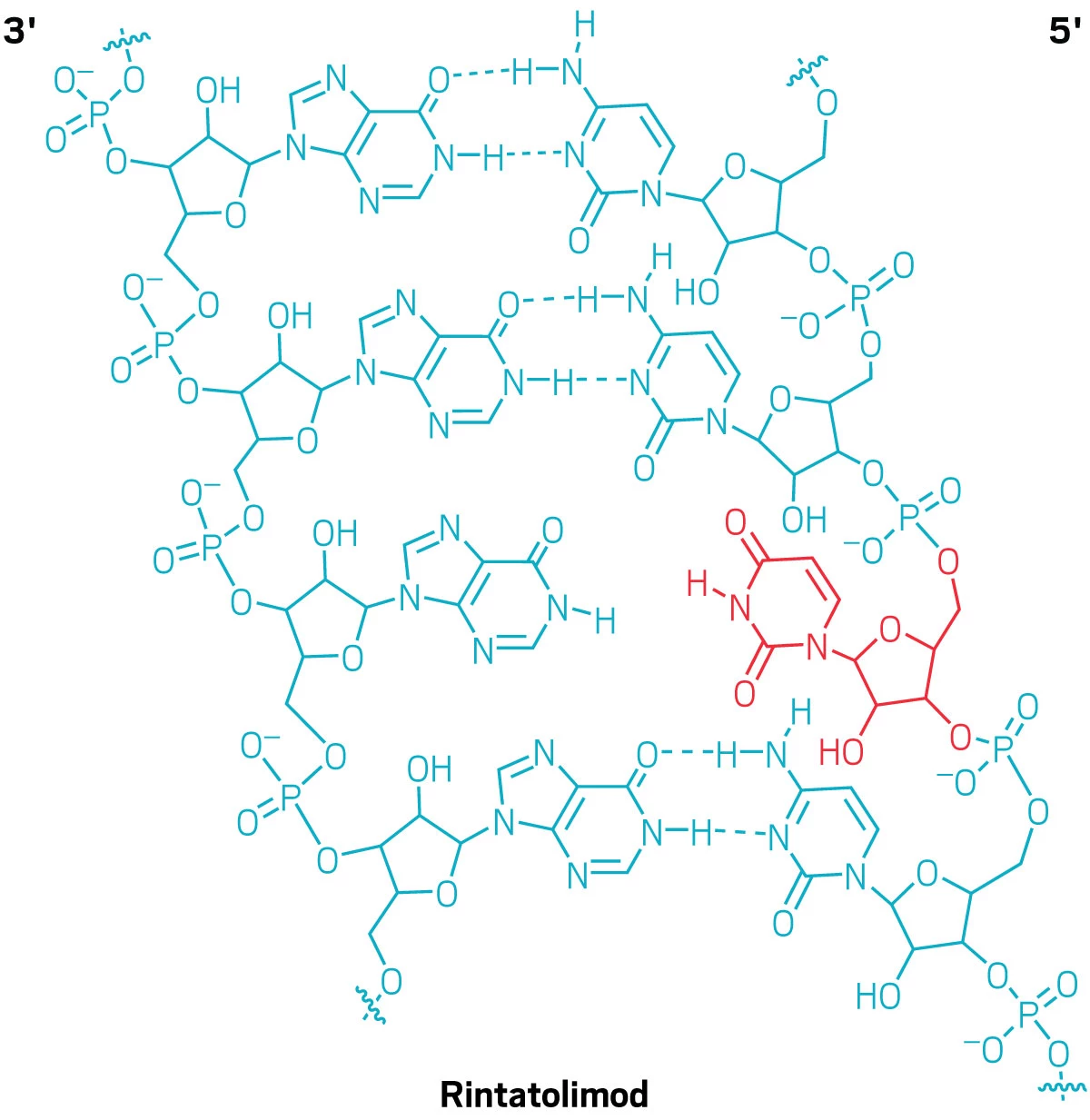
Chemical structure of rintatolimod.
Rintatolimod is a double-stranded RNA made up of a single polyinosine strand hydrogen bonded with a single polycytosine strand containing a uridine (red) that appears once every 12 cytosines. The hydrogen-bonding mismatch between inosine and uridine creates thermodynamic instability.
Valdes describes dramatic improvements around the 2-month mark. He went from being able to walk a maximum of 2,000 steps a day to consistently hitting anywhere between 8,000 and 10,000 steps. Unfortunately, the gains didn’t stick around after he stopped taking Ampligen when the study period ended in October 2023. By December of that year, Valdes’s baseline had started to decrease again. For the next 12 months, he was once again bedbound 23 h a day. He now relies on disability income and parental support.
Ampligen, or rintatolimod, is an unusual molecule. It’s been around since the 1970s, when researcher William A. Carter modified a double-stranded RNA molecule. Ampligen is a toll-like receptor 3 (TLR3) agonist. It stimulates TLR3, a protein critical to immune responses, and in turn induces interferons, cytokines that interfere with viral replication.
Carter joined Hemispherx Biopharma in 1978 to develop Ampligen for market, believing that its immune-stimulating properties could make it a potent treatment for viruses, cancer, and chronic conditions, including ME/CFS.
But the going has been slow—and fraught. Hemispherx has been trying and failing to get the FDA to approve Ampligen as an ME/CFS treatment since 2007. The agency refused to even consider its first application, citing deficiencies including missing and inadequate data, database discrepancies, and inconsistencies in statistical analysis. Hemispherx’s attempts to address those concerns didn’t yield much: the FDA rejected a revamped application in 2009.
As far as the agency was concerned, Hemispherx needed to run another, better trial. But instead, Hemispherx reanalyzed its existing data and presented it to the FDA and an advisory committee in 2012. It appeared by then that Ampligen had helped improve exercise tolerance in at least some patients, as measured by time on a treadmill, but the FDA and the committee agreed that Hemispherx’s data weren’t statistically significant.
Since the FDA’s last denial 13 years ago, Hemispherx, which rebranded as AIM ImmunoTech in 2019, has not initiated any new placebo-controlled trials of Ampligen in ME/CFS. Instead, it has run expanded-access programs, which allow qualifying ME/CFS patients to enroll in unblinded studies where they know they are receiving Ampligen. Insurance companies pay for the care team. Patients cover the cost of the drug, which is around $40,000 a year. The expanded-access studies have become established as the only way for people with ME/CFS—and long COVID, which has an overlapping set of symptoms—to get access to Ampligen in the absence of FDA approval. Only Argentina has approved Ampligen for treatment of severe ME/CFS.
AIM’s expanded-access model is basically identical to the compassionate-care protocol that the Vyvgart trial participants sought from Argenx. But it isn’t particularly useful for regulatory submissions. When a patient knows they are taking a drug, and when that drug isn’t compared with a placebo, it’s difficult to prove that any improvements are attributable to the drug and not some confounding factor.
The stories of Vyvgart and Ampligen illustrate an ethical minefield that manufacturers must navigate. Launch an expanded-access program, and you can’t get the kind of data that FDA reviewers care about, imperiling a drug’s chances at approval. Spend years trying to get funds, clinical trial sites, and a study protocol that satisfies regulators, and you leave patients in limbo. Some drug companies die in the interim. Some patients do too.
Daniel Peterson is a physician and ME/CFS expert who’s been giving patients Ampligen through various studies since 1987. “Patients told me they were grateful for the years they’d been on the drug under whichever protocol they’d been on, but there was no way to continue it,” he says. “For many years, it was, ‘We’ll wait and see, and we’ll get FDA approval.’ ”
But the expanded-access studies “would never be the appropriate route for doing more trials or even to open a treatment center,” Peterson says. FDA approval has not happened, and the expanded-access studies are on borrowed time.
“Why the company has never found a way to do a decent follow-up trial in the past 40 years or so, I don’t know,” says Cort Johnson, an ME/CFS patient who runs an online ME/CFS and fibromyalgia resource called Health Rising. AIM has maintained that data from the expanded-access studies could support future studies or FDA submissions.
Ampligen access dwindles
Without Ampligen, Valdes’s condition was seriously deteriorating. His father called a research site in North Carolina that was running an Ampligen study in ME/CFS. Valdes says his father spoke with a receptionist a few times, but “he never got any straight answer” about how exactly to move forward.
“He stopped trying to contact them because nothing was clear,” Valdes says.
Then, in late 2025, some patients noticed that the official record for the ME/CFS expanded-access study on ClinicalTrials.gov was adorned with a dark red flag. The study, the site said, was “temporarily not available,” and patients didn’t know why.
As it turns out, the reason comes down to corporate resources. AIM is running out of money. The expanded-access studies don’t bring in much revenue, and the company has stopped trying to sell Ampligen in Argentina, because hyperinflation has made selling the drug cost prohibitive.
AIM’s leaders recently decided to devote all the company’s resources to a single program developing Ampligen as a pancreatic cancer treatment. Everything else—including placebo-controlled trials, like the one Valdes was in for long COVID, and the expanded-access studies for ME/CFS—has been “placed on hold,” according to AIM spokesperson Jenene Thomas. AIM categorizes the ME/CFS expanded-access program as “active,” but it is not enrolling any new patients.

A person wearing a white KN95 mask lies on grassy ground. At their head is a gravestone made from cardboard with the words “DIED FROM COVID” handwritten on it.
A person lies on the ground as part of a “die-in” demonstration in 2022 calling for better access to care for people with long COVID and myalgic encephalomyelitis.
Credit:
Bryan Olin Dozier/NurPhoto via Associated Press
The pancreatic cancer trial is the top priority because it could “lead to the most lucrative outcome,” AIM says in a recent securities filing, but the company doesn’t have enough money to complete even that study. At the end of March, the company estimated that its short-term financial needs were between $7.2 million and $10.8 million—far more than the $5.9 million cash it had on hand at the time. Its revenues were only $22,000 in the first quarter of this year; the company posted a $3 million net loss in the same period.
For patients who’d come to rely on the expanded-access studies to get Ampligen, the situation is dire. By April, only four participants were taking Ampligen for ME/CFS. That number held true in July. “There is no projected completion date yet” for the pancreatic cancer trial and thus no projection of when other studies might resume, says Charles Lapp, a physician and ME/CFS expert in Charlotte, North Carolina, whose clinic has been a site for an expanded-access study. Lapp is also a consulting medical officer for AIM.
Mark Stewart was one of Lapp’s ME/CFS patients. He participated in the expanded-access study in North Carolina between August 2023 and February 2025. Like Valdes’s, Stewart’s condition improved significantly while he was on Ampligen. “It was, for my physical capacity, miraculous,” he says. “For my cognitive capacity, it’s harder to tell.” But 18 months was all Stewart could afford. He hoped Ampligen would have a lasting effect, but after 6 weeks off the drug, he lost everything he’d gained.
“Just to not feel sick is wonderful. When I relapse, I feel sick again.”
Mary Schweitzer, patient with myalgic encephalomyelitis/chronic fatigue syndrome
Relapsing is common, according to Peterson. His patient Mary Schweitzer first started on Ampligen for her ME/CFS around 30 years ago at a hospital in Delaware, where she lived at the time with her husband and kids. She set three goals as benchmarks for her recovery: put her feet in the ocean, read a book, and dance at her son’s wedding. She did all three within 6 months of starting Ampligen. But Schweitzer was forced to stop and restart the drug several times over the next few years as the Ampligen studies changed hands, and she relapsed each time she went off the drug.
“When you’re sick with this, you feel sick 24 hours a day, 60 minutes an hour, 60 seconds a minute,” Schweitzer says. “Just to not feel sick is wonderful. When I relapse, I feel sick again.”
In 2010, Schweitzer moved to Incline Village, Nevada, so she could consistently see Peterson, who by then was one of the only doctors in the country administering Ampligen. But she and other patients were only ever able to buy the drug a month or two at a time, and Peterson has warned with increasing urgency about low supply.
The people who had hoped for an Ampligen approval—or at least a lower price tag for the expanded-access protocol—are beginning to make other plans. One has identified a retirement community close to family members who can offer physical support. Others have looked into other drugs. Valdes, for instance, enrolled in a study testing the monoclonal antibody sipavibart in long COVID, although he says it hasn’t made a difference for him.
Stewart recently had surgery to remove a growth on his thymus, a small organ where immune cells develop, and his condition briefly improved. But after about 2 weeks, it began deteriorating again. Some days, Stewart cannot think straight enough to talk to his mother, who’s become his caretaker. Other days, his thoughts turn bleak.
“I don’t know if this is something I would pull the trigger on if I got approved, but just to give you a sense of my quality of life, I have been actively exploring and researching assisted-suicide options in Switzerland,” Stewart says.
Patients are left in limbo
Corporate realities often do not align with the needs of very sick people.
AIM has tried and failed to get additional funding to test Ampligen in long COVID and related conditions. Former scientific officer Chris McAleer told C&EN in 2024 that the company expanded into long COVID in part because he and his peers thought there would be money from the US National Institutes of Health’s RECOVER program. But RECOVER has not prioritized drug trials. McAleer left AIM last year.
Peterson believes that AIM’s decision to deprioritize long COVID and ME/CFS drug development comes down to “corporate pharmaceutical” realities. “It’s just what it is,” he says. “I think, for example, if someone came to AIM and said, ‘I want to run a trial for, let’s say, $1.2 million, and here’s the money. You produce the drug and monitor it,’ I think they would be happy to go along with that.”
According to Barrick, the nurse who participated in the Vyvgart trial for long COVID POTS, Argenx has told patient advocates that an independent researcher or medical facility would need to do the legwork for an additional study. Argenx spokesperson Petok says the company has no intention of running another trial of Vyvgart in long COVID POTS, based on the previous trial results. “I think most drug developers would follow similar protocols,” he says. “I don’t think that it is in anybody’s interest to continue to provide therapies once they have been demonstrated not to work.”
“The reason why so many trials get stopped or paused is because of mediocre results.”
Sadie Whittaker, chief scientific officer, Solve ME
Some patients are still mobilizing to get researchers on board with a new and different trial. In October, Delli Gatti, Barrick, and five others who say their symptoms improved during the Vyvgart trial in long COVID POTS published an op-ed in The Sick Times, a nonprofit publication covering long COVID and postinfectious diseases, asking the US government to pick up where Argenx left off and study the drug.
Crucially, they write, a new study will need a different design from the one for the Argenx-sponsored trial. That trial used two clinically validated questionnaires as primary end points to measure efficacy: Composite Autonomic Symptom Score 31, or COMPASS 31, and the Malmö POTS Symptom, or MAPS, score. Both are commonly used in POTS trials. Argenx’s Q&A describes them as “the most widely recognized clinical tools for POTS.”
But these end points missed a critical part of the picture, Delli Gatti and Barrick say. Patients may have continued to experience symptoms including dizziness and fatigue, but it took much more to trigger those symptoms, allowing several participants to return to work, school, and exercise. “We continued to have symptoms, but they were manageable,” Barrick says.
Miglis, the Stanford investigator, says in an email that while the trial “was well designed,” researchers “need more specific end points and biomarkers for these kinds of trials.” Argenx’s scientific team has submitted results to a peer-reviewed journal, but they have not yet been published.
At the Icahn School of Medicine at Mount Sinai, the neuroscientist and long COVID expert David Putrino is collecting blood samples from some of the patients who responded well to Vyvgart. He hopes the samples could enable better immune phenotyping so clinicians can predict whether a person with long COVID might respond to Vyvgart or similar drugs.
The sampling builds on work that a research team including Putrino and Yale University’s Akiko Iwasaki published in Cell in May showing that mice that were given immunoglobulin G (IgG) from the blood of humans with long COVID went on to develop neurological symptoms. Specifically, the experiment showed a causal link between those symptoms and autoantibodies, such as the long COVID patients’ IgG, in the blood—the same autoantibodies that FcRn inhibitors like Vyvgart are designed to disrupt.
“We have expressed that we’re interested in FcRn inhibitors as a treatment option for a subset of folks with long COVID for quite some time,” Putrino says. By July, Putrino had collected blood samples from about 15 people. Beginning a clinical trial this year is a major goal, pending funding.
Breaking up patients into different groups by using precision approaches is likely to be critical for future research in long COVID and related diseases, says Sadie Whittaker, chief scientific officer at the patient advocacy nonprofit Solve ME and a serial biotech entrepreneur. Such illnesses can have different symptom presentations and pathophysiologies. “The reason why so many trials get stopped or paused is because of mediocre results,” she says. “And the reason the mediocre results are happening is because of this heterogeneity and not being able to identify a respondent population.”
Peterson agrees. In fact, he uses biomarkers in his own ME/CFS practice. Among other things, Peterson measures natural killer (NK) cell function to help determine whether a patient is a good candidate for Ampligen.
“This is perfect territory for precision medicine,” Peterson says. “Once you get a profile, you can match a therapy to the profile, and then just go for it. You could feed it into a program that says, ‘Well, this long COVID person still has active viral infections, so they should be treated with antiviral therapy.’ The patients with the inflammatory response—the high [interleukin]-6, IL-10 bunch—there’s so many drugs that can be used for that, that are available now. At least try and see.”
Trying and seeing, however, requires buy-in from drug manufacturers. Putrino says that large companies have diminishing interest in long COVID research, in part because of a lack of guidance from the FDA about what enrollment criteria and end points should look like.
In December, Delli Gatti flew to New York with her husband to provide blood for Putrino’s study. She spent around $800 to get there, using the money raised by her GoFundMe page where she so cheerfully stuck out her tongue. “Tickets were really expensive,” she says. “I know other people’s tickets were even more expensive.” Putrino has since set up a way to collect blood samples by mail so patients won’t have to travel.
Since returning from New York, Delli Gatti has gradually lost the energy she’d gained while taking Vyvgart. She’s still working part time, but she consistently takes two or three naps a day. She has started wearing compression garments again. Meanwhile, she’s been waiting to see her neurologist at the University of Utah. A year between appointments had seemed manageable when she scheduled last year. But lately, she’s been struggling.
“The last couple of months have made it feel a lot longer,” she says.