

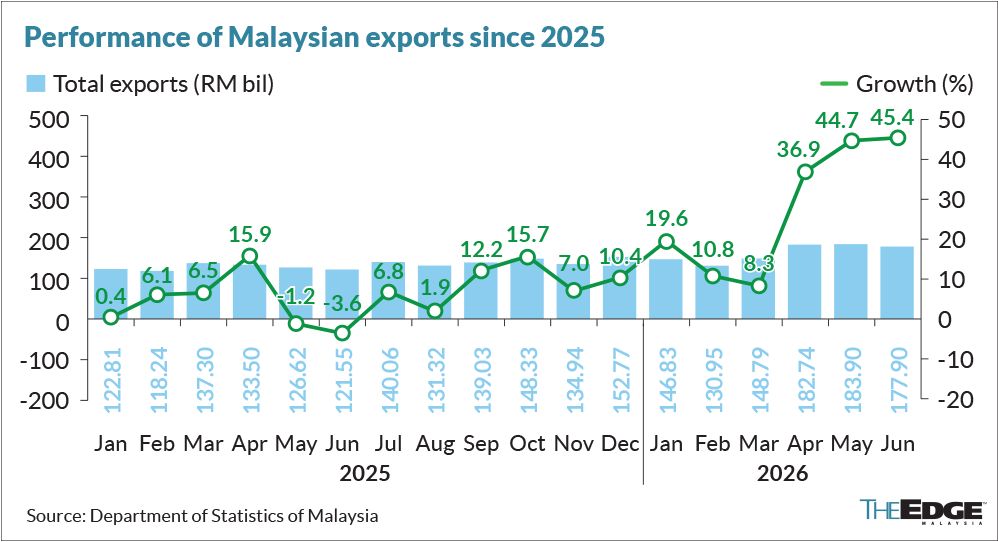
KUALA LUMPUR (July 20): Malaysia’s export growth is expected to moderate in the second half of 2026 as favourable base effects fade, according to economists, after strong outbound shipments of electronics and energy products drove June exports’ growth to its fastest pace in nearly four years.
Malaysia’s exports rose 45.4% year-on-year to RM177.89 billion in June, accelerating from May’s revised 44.7% growth. The latest print, however, came in below the 47.3% median estimate in a Bloomberg survey of economists.
The stellar export performance was driven by robust shipments of electrical and electronic (E&E) products, petroleum products and liquefied natural gas (LNG).
Imports climbed significantly by 43.9% to RM163 billion, narrowing the trade surplus to RM14.89 billion from RM39.9 billion in May as inbound purchases rebounded sharply.
Inbound shipments of capital goods jumped 67%, driven by non-transport items, while intermediate goods — components and parts used in final assembly — increased 41.3% in June. Consumption goods rose 17.2% from inbound non-durables.
June’s export growth exceeded MBSB Research’s forecast of 42%. The research house noted that the robust export performance in the first half of this year (1H2026) was supported by resilient global demand for technology products, inventory building and higher re-exports as well as positive price effects.
While the research house expects exports to moderate in the second half as the favourable base effect diminishes, it maintained its forecast for exports to expand by 18.9% this year — up from 6.6% growth in 2025.
The expansion will be underpinned by strong demand for technology products and higher demand for commodity-related products such as petroleum products and LNG, it said in a research note.
The research house also projected imports to post a stronger growth of 13% for 2026, up from 6% in 2025, supported by domestic consumption, investment activity and Malaysia’s role in regional production networks.
However, it cautioned that risks remain tilted to the downside from supply disruptions, elevated costs and price pressures, potentially weaker demand and the risk of tighter trade rules, mainly by the US.
Pantheon Macroeconomics, which had forecast June export to grow 45.7%, expects E&E export growth to moderate in the coming quarters as stronger base effects take hold.
In a separate note, Pantheon said renewed tensions in the Middle East could also provide some support to July exports through firmer energy prices.
While June’s export growth print missed UOB Global Economics & Markets Research’s 48% forecast, the research house is maintaining its full-year export growth forecast at 25%, supported by resilient demand for AI-related products.
“The ongoing global AI investment cycle and supply chain diversification, particularly in energy markets amid Middle East tensions, appear to be providing a stronger-than-expected boost to Malaysia’s export outlook,” UOB said in a note to clients.
It also highlighted that the robust export outturn over the past three months has revived export growth rates last seen during the post-pandemic digitalisation and automation boom, alongside the global commodity upcycle, when exports grew by 26.1% in 2021 and increased by 24.9% in 2022.
However, UOB said year-ago high base effects, shifts in the global environment and El Niño-related risks remain as wildcards.
“Furthermore, some of the recent strength in exports may reflect frontloading of orders, inventory accumulation and temporary trade rerouting, which could lead to export normalisation over time,” it added.
It also noted that uncertainty surrounding prospective US semiconductor tariffs and the newly proposed 10%-12.5% tariff framework are also a key downside risk in the near term for exports.
Record trade surplus in 2Q lifts current account outlook
The record trade surplus in the second quarter points to a significantly stronger current account position for Malaysia, according to UOB.
While June’s trade surplus contracted 62.7% on a month-on-month basis as imports outpaced exports, it still widened 64.9% to RM14.89 billion when compared to June 2025.
More notably, the cumulative trade surplus widened to a record RM84 billion in the second quarter — a sharp increase from RM63.3 billion in the first quarter of this year.
According to UOB estimates, this performance translates to a 2Q current account surplus of RM33.5 billion — more than double the RM15.2 billion recorded in 1Q.
If realised, Malaysia’s first-half current account surplus would already surpass its full-year forecast of RM38 billion for 2026 and the total RM32.8 billion current account surplus recorded in 2025, UOB noted.
Read also:
Malaysia’s exports surge 45% in June on electronics, petroleum shipments