
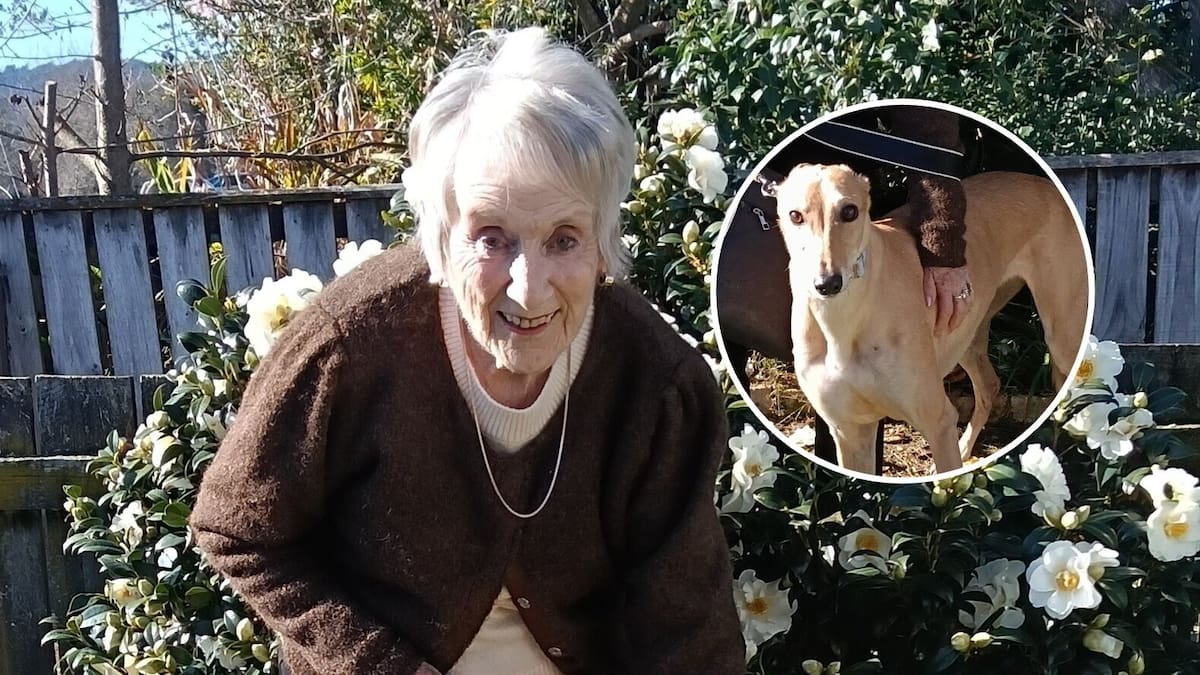
The adoption followed a difficult start to the year for McHale.
Her eldest daughter, Glenda Rainey, died from Motor Neurone Disease in January, and her Christchurch-based daughter Karen Luskie noticed her mother was struggling with grief.
McHale knew she needed to pick herself up, but when Luskie raised the idea of adopting a greyhound, she wasn’t convinced that was the solution.
“I’m 90, darling,” she told Luskie.
“But you’re a sprightly 90, Mum,” Luskie replied.
Luskie, who owns a greyhound cross, knew many retired racing dogs were still searching for homes.
She told her mother a dog would give her some company.
About an hour after their conversation, McHale received another call — this time from her granddaughter – Luskie’s daughter.
She told McHale a parcel was on the way.
“It’s not for you, Grams … it’s for your new addition.”
Only then did McHale realise her family had already set the adoption in motion.
“So my beautiful family really coerced me into it,” McHale joked to the Rotorua Daily Post.
Dawnie had already settled into her new home after about a week.
McHale said she had “certainly changed” her routine but enjoyed having to think of another again after a period of living alone.
The greyhound greeted her enthusiastically after bridge sessions – becoming such a talking point that less of the game was played.
June McHale, 90, and 9-year-old greyhound Dawnie.
McHale said it was “wonderful” how she had been welcomed into a community of greyhound lovers.
The adoption surprised plenty of people — including greyhound industry veteran Jenny Bartlett.
“I beg your pardon?” was Bartlett’s reaction when she first heard that a 90-year-old had adopted a retired racer.
In more than two decades supporting greyhound rehoming efforts, she had “never heard” of such a thing.
Bartlett had adopted six retired racers, served as president of the Waikato Greyhound Racing Club and founded the Shoebox Appeal, a charity that provides gift-filled shoeboxes of toys, treats and other goodies to fostered and rehomed greyhounds.
The match between McHale and Dawnie was the “icing on the cake”.
Dawnie was adopted through Nightrave Greyhound Adoptions.
“What’s the oldest dog you’ve got?” Luskie asked Nightrave’s Rachel Ray.
Nightrave had the “perfect dog”.
Dawnie, formerly known on the track as Yarn’s Sister, stayed with her owner-trainer, Bartlett said.
She moved into foster care for about four months following the racing ban.
Bartlett said prospective owners fill out an application detailing their lifestyle, living situation and any other pets they have.
Rehoming agencies then carry out a home check to ensure the property is suitable before matching the family with a greyhound that fits their circumstances.
Bartlett said they needed to determine people were “good enough to have one of our dogs”.
The dogs are desexed, health checked and assessed before being placed in a home, and Bartlett described greyhounds as “fun” and an “affordable pet”.
A “great network” of support was available through agencies and fellow adopters.
Bartlett said even in unpredictable circumstances, such as a “fabulous job in New York” which meant someone could no longer look after a dog, agencies would step in to help.
Bartlett said rehoming greyhounds was nothing new, but the looming ban meant “more pressure” as all of a sudden there were about 1500 dogs needing homes.
Nightrave Greyhounds, Kiwikiwi Hounds, Greyhounds As Pets (Gap) and May Hounds were the official rehoming agencies, Bartlett said.
Annabel Reid is a multimedia journalist for the Bay of Plenty Times and the Rotorua Daily Post, based in Rotorua. Originally from Hawke’s Bay, she has a Bachelor of Communications from the University of Canterbury.