
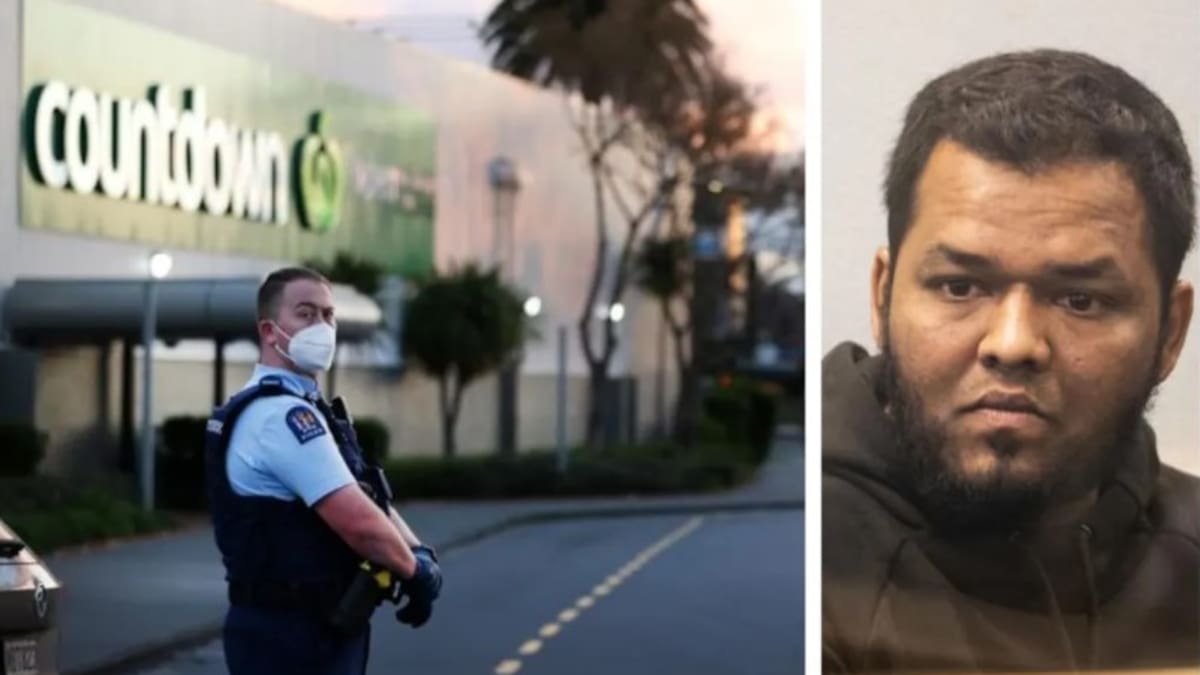
Samsudeen had become radicalised by violent Islamic extremist ideas when he launched into a frenzied knife attack on shoppers in a West Auckland mall supermarket in 2021.
He was shot dead by undercover police after injuring six people.
The second and third phases of the inquest began in Auckland last week, and aim to examine how the Sri Lankan refugee became radicalised in New Zealand.
He was flagged by authorities as being influenced by a rapidly growing jihadist group – the Islamic State of Iraq and Syria (ISIS) – by 2016, and was arrested the following year and remanded in custody for four years.
He was sentenced and released in July of 2021 and committed the attack seven weeks later.
Part of the testimony Samsudeen’s relative gave was read out by Coroner Marcus Elliott last week. A redacted version was released to the media this morning.
The relative said that Samsudeen’s time in prison, including 17 months in segregation, and dealings with the justice system had “exhausted” him.
What unfolded in the supermarket was unlike his true character and she believed “something was done to provoke him”.
“He was not himself.”
He “especially” would not have hurt his elderly and female victims, as he treasured his elders and had a “soft spot” for the “weak and vulnerable”.
The relative said on the day he died, Samsudeen was acting out his normal routine of shopping and Friday prayer.
“I wonder if anyone knew of his routine and used that knowledge to make something happen to him,” she questioned.
Samsudeen’s early life and move to NZ
Her testimony began, however, by detailing how Samsudeen was a happy teenager and good student.
But when he was kidnapped and tortured by “political enemies” in Sri Lanka, it “wounded him” physically and psychologically, she said.
She said he chose to move to New Zealand as he was looking for a “beautiful” and “peaceful” country where he could continue his studies away from Sri Lanka’s “problems”.
Ahamed Samsudeen in the High Court in Auckland in 2018. Photo / Greg Bowker
When he first arrived, however, he would fall asleep while on the phone with the relative because he didn’t want to be alone or with the lights off, she said.
Her testimony told how Samsudeen had seriously injured his back by carrying a microwave to a mosque on foot during Ramadan because he thought God would “reward him” for his efforts.
This led to a separated spinal disc and months in bed where he was online a lot.
“This period is what exposed him too much to graphic material online,” her evidence said.
During those bedridden three months, she said Samsudeen became isolated, helpless and lonely.
After his back healed, she encouraged him to get out into the community and go on group trips.
It was during one of those trips that a photo of him holding a gun was taken and he shared it on social media.
The woman said that photo was “used to suggest him as a terrorist,” but it was not a real gun, and there was never any “ill intention” behind posting it.
His 2017 arrest
When Samsudeen was first arrested, the woman said she didn’t think it was serious, and when he was arrested a second time while on bail in 2018, she was “completely in the dark” about his situation.
For the first two years he was in prison, she said Samsudeen would call her and never let on about the “worry and loneliness” he was suffering.
Looking back on their conversations, the woman suspected that New Zealand authorities didn’t want to release him but couldn’t prove their allegations.
Ahamed Aathil Mohamed Samsudeen pictured taking aim with a firearm in a photo from one of his social media accounts, which were later deleted.
She thought his time in segregation would have had a “psychological effect” on him.
Upon his release, Samsudeen was being followed by undercover police, she said, which the woman said made him nervous and he was showing signs of stress, having lost a significant amount of hair while in prison.
‘Provoked, threatened or cornered’
She said she “cannot believe” Samsudeen had attacked vulnerable people with a knife in a supermarket.
The relative said she would like to investigate what “provoked, threatened or cornered” Samsudeen into that situation.
“This was a sad ending to the life of a person with a beautiful heart,” she said.
“Sadly, his life is now defined by his final years which seem to be the worst of his life.”
She said his life took a particular turn because of how he was “regarded and treated” by those on his criminal case, who she believed didn’t help him.
She asked the court to investigate what “really happened” to Samsudeen on September 3, 2021.
What was also distressing, her evidence dated February 2025 said, was that Samsudeen’s burial went ahead without his family’s approval and they didn’t know where he was buried.
“I am curious as to why the police rushed the burial of his body.”
The relative said the authorities claimed it was a “miscommunication” that he was buried without their permission, which she said was untrue.
“We have lost faith in the system.”
Yesterday afternoon, the inquest heard in-person testimony from Detective Superintendent Sean Hansen, who has been part of the police’s National Security Group since 2021.
Fletcher Pilditch, KC, representing the interests of Samsudeen’s family, asked Hansen about the multi-Government agency “co-ordinated review” into Samsudeen’s death.
The review found that he had spent an “unduly lengthy” time in custody on remand that had magnified his grievances against the system as well as his “alienation, hostility and risk of increased radicalisation”.
Pilditch asked if Hansen agreed with that observation, to which he replied “potentially”, but it was important to look at the broader context, with the benefit of hindsight.
Hansen said when police first dealt with Samsudeen in 2016, when they twice visited him to warn him about posting images and videos of graphic violence on Facebook, he had already been radicalised.
By that time the New Zealand Security Intelligence Service had flagged that Samsudeen wished to travel to Syria to join ISIS, and later that year he took a trip to Samoa in what Hansen said was a test by Samsudeen to see if he could travel freely.
Pilditch asked if radicalisation was on a spectrum of how entrenched a person could be, and whether 2016 would have been a good time to intervene.
Hansen replied that in that year, Samsudeen was painting a false picture to police that led them to believe he was not a concern, when he probably was.
The court heard that after the Christchurch mosque terror attack in 2019, all agencies changed their response to terrorism, but anti-terror legislation was still in its fledgling stages.
Law fast-tracked after Samsudeen’s attack in 2021 criminalised the planning and preparation of a terrorist act, but Hansen said legislation could be further expanded to give police more power to track high-risk offenders in the community on sentence.
He Aranga Ake
Hansen also talked at length about He Aranga Ake, a multi-agency violent extremist disengagement framework led by police, formulated in late 2022.
Coroner Elliott asked if when Samsudeen was first flagged as a violent extremist, after posting graphic content online, he would have been a candidate for He Aranga Ake.
Hansen said “no” – to be put through the framework a person has to meet the threshold of a violent extremist – they must hold those ideologies and the intention to commit an act of terror.
Samsudeen was not identified as meeting that threshold in 2016.
Even now, if they referred people in the early stages of radicalisation, the pool would be too large for the five people working on that framework to process, he said.
The inquest continues.
Ella Scott-Fleming has been a journalist for three years and previously worked at the Otago Daily Times, Gore Ensign and Metro Magazine. She has an interest in court and general reporting. She’s currently based in Auckland covering justice related stories.
Join NZ Herald’s Open Justice team for Case by Case, a video and podcast series examining the disputes and decisions making headlines across New Zealand.