
In describing her style, Compton says she likes “to do section cuts so that [viewers] kind of get a glimpse into these mysterious worlds that [viewers] otherwise might not see into”.
She hopes this particular piece “pays homage to the architectural history of the space but also all of the performance precinct area.”
“It’s all […] little pockets of joy and moments. The intention is that people stop and take it in and find new things each time.”
Work underway to fill Compton’s mural with bright colours on Press Lane. Photo / Anna Heath
Behind the hundreds of pieces of urban art across Christchurch city is a vast spiderweb of artists, the council, event organisers, project managers and facilitators.
Dr Reuben Woods has observed this network closely. From attaining a PhD in Art History exploring local urban art in 2016, to being creative director of Watch this Space, a comprehensive street art resource, he has insight into the city’s evolution, particularly post-earthquakes.
“We had this authentic art that responded to a real lived experience which is probably the most impactful event that the city has had since its formation,” he said.
“That has embedded in a way that’s different to other cities.”
Dr Reuben Woods of Watch This Space in front of an artwork by Monti. Photo / Anna Heath
While Woods labels the earthquakes as a rebirth of urban art due to newfound blank spaces, he also notes that it is an evolving reflection of the city as it grows and changes. Murals and installations don’t last forever, and new ones pop up all the time.
“I often say that it feels like I’ve lived in five different cities over the last 20 years because of, you know, the change, particularly post-quake.”
Walls full of urban art line Cathedral Square. Photo / Anna Heath
Artist Jacob Yikes has seen first-hand how urban art has played a significant role in revitalising Christchurch city, having contributed to the first shoots of colour post-earthquake himself.
Many works were unpaid. “I was doing it because, essentially, I could,” he said.
“There were a lot of areas that were very derelict in a sense, and kind of, you know, broken down.
“Bringing colour into a broken city seemed to help bring people back, who didn’t necessarily have any reason to go in there because it was not much of a city at that point.”
A mural recognising Christchurch as a gateway to Antarctica by Dcypher and Jacob Yikes at Cathedral Square. Photo / Anna Heath
Like Compton, he says he gets a lot of positive engagement and curiosity while he’s out on the job.
“You do have to have a fairly tough skin to paint in public, but to be honest, I’ve never had any full-on negative experiences.
“If somebody’s chatting to you while you’re painting, they seem pretty hyped about it because they often don’t get to see it.
“It’s not like most art practices that are behind closed doors and you only see the finished product.”
A mural remembering the 1970s dawn raids by artist Kophie Su’a-Hulsbosch on Armagh St. Photo / Anna Heath
Woods echoes the importance of art in public engagement, saying he likes to see art as a way to pull people intuitively across the city.
“I like to say to people, if you see a flash of colour, go and see what it is. If you smell something amazing, go and hunt out where it’s being cooked. If you hear music, go and see who’s playing it.
“Let those sensory things drag you, because you’ll often open up these doors to really cool things.”
Gazer, by Jessie Rawcliffe, peeks out of a doorway at Cathedral Square. Photo / Anna Heath
He hopes this liveliness will encourage those who visit Christchurch to return.
“I’d love to think that someone could come and visit the city, and every year there’s new things to see and experience,” Woods said.
“That’s one of the qualities I think of murals and street art, that it’s living and breathing.”
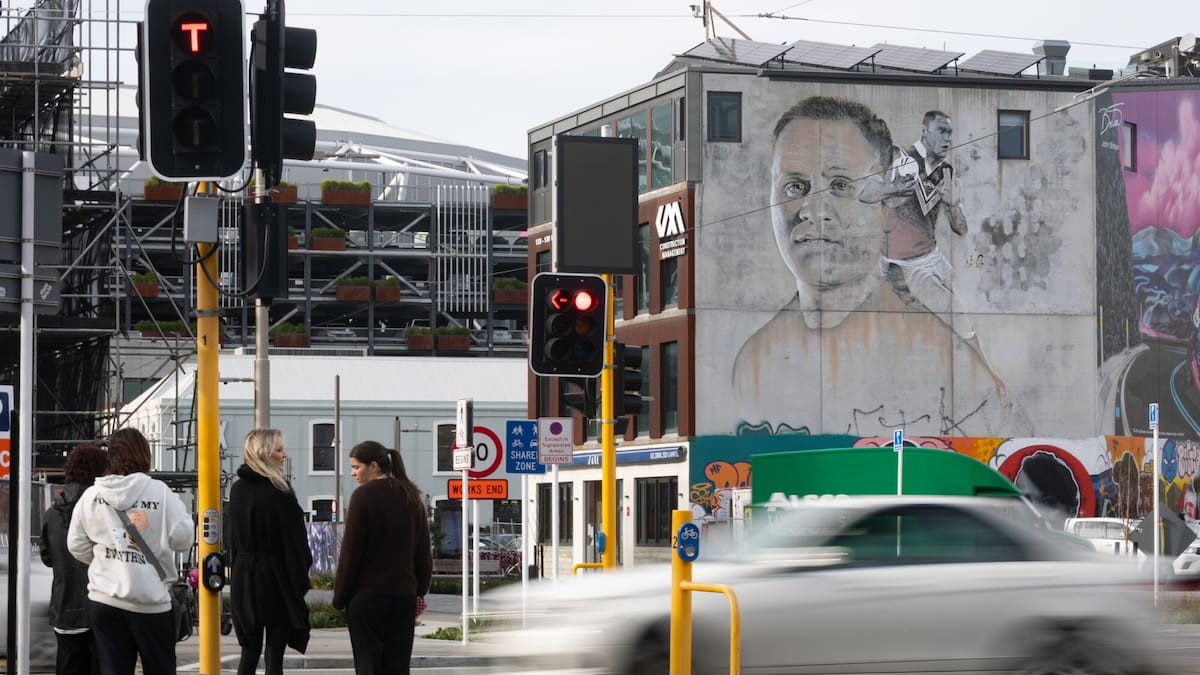
A mural of rugby coach David Kidwell by Mr. G on Lichfield St. Photo / Anna Heath
Navigating Christchurch’s CBD, it doesn’t take long to find someone staring up in awe, or traipsing around with camera in hand. It’s clear the storytelling woven into the city’s urban artworks resonates widely.
Compton says this is her incentive.
“With big murals, it’s not often you get to kind of take in a whole world or connect with a particular idea all at once.”
“It’s my motivation to tell stories through art so that people can connect with it and find joy and fun.”