
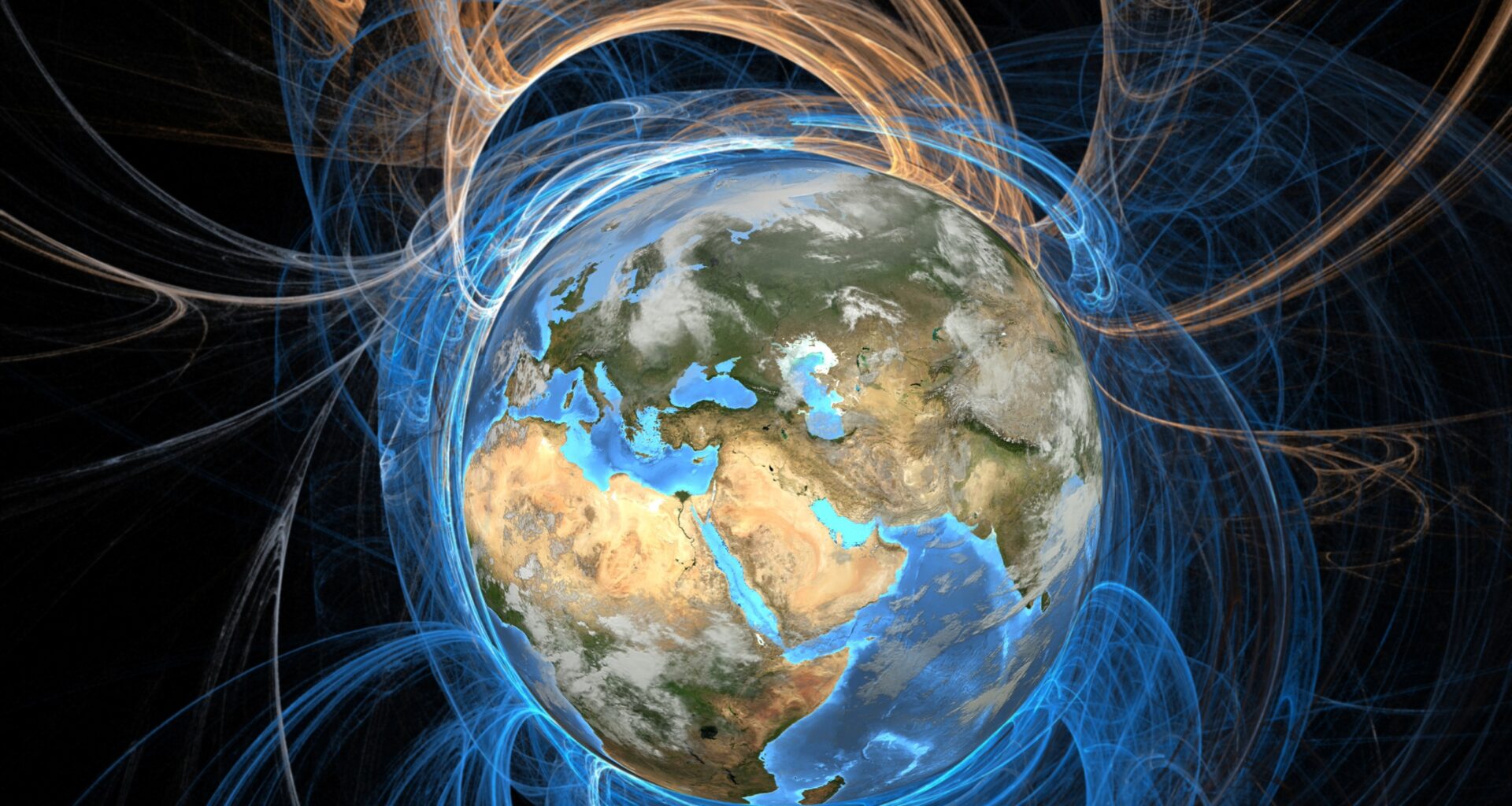
The Moon has been getting pelted by solar wind for billions of years, but here’s what nobody could confirm until now: its two hemispheres haven’t been taking that beating equally.
New research shows that Earth’s own magnetic field causes the difference. It has left a chemical signature buried in lunar soil that scientists have finally managed to read directly.

The study leans on samples brought back by China’s Chang’e-6 mission.
The research was conducted by a team at the Institute of Geology and Geophysics of the Chinese Academy of Sciences, led by postdoctoral researcher Zhang Xuhang and professor He Huaiyu.
Comparing two sides of the Moon
Solar wind is a constant stream of charged particles blasting outward from the Sun.
Since the Moon has no atmosphere or magnetic field of its own to block it, that wind slams straight into the surface.
Over billions of years, the loose soil covering the Moon, known as regolith, has quietly absorbed and held onto a record of all that bombardment.
It works almost like a natural filing cabinet for solar wind gases, including helium, neon, argon, krypton, and xenon.
These so-called “noble gases” rarely react chemically with other elements. That makes them unusually trustworthy witnesses to how solar wind particles buried themselves in the surface over time.
The problem was that nobody had far side samples to compare against the near side.
That changed when China’s Chang’e-6 mission brought back 1.935 grams of regolith from the South Pole-Aitken basin on the far side.
The far side tells another story
Researchers conducted a detailed noble gas analysis of the Chang’e-6 material, measuring concentrations and isotope ratios for all five gases.
The neon numbers jumped out right away. The ratio between two neon isotopes, 20Ne and 22Ne, came out to 11.34 plus or minus 0.22. That was noticeably lower than anything previously measured in near side samples.
This ratio is remarkably close to what theory predicts after intense solar wind fractionation.
That’s a strong hint that the far side experienced much stronger fractionation than the near side, leaving behind more of the heavier neon isotope.
Krypton and xenon backed up the same story. When researchers heated the samples in stages, solar wind xenon emerged almost entirely at high temperatures, forming one sharp peak.
Chang’e-5 samples from the near side behaved very differently, releasing xenon at both low and high temperatures in a clear double-peak pattern.
That gap shows that solar wind particles dug much deeper into the far side soil than they did on the near side. This means higher-energy particles hit the far side overall.
Earth’s magnetic field changes everything
So why would the two sides of the Moon experience such different intensities of solar wind in the first place?
The research team traces the difference back to what they call a speed-governing effect produced by Earth’s own magnetosphere.
As the Moon travels around Earth, it periodically passes through the magnetosheath, a buffer zone wrapped around Earth’s magnetic field.
There, the solar wind slows dramatically, dropping from around 250 miles per second to about 125 miles per second.
That slowed-down wind mostly reaches the Moon’s near side. As a result, the particles only manage to burrow shallowly into the soil.
No protection on the far side
The far side never gets that break.
Facing permanently away from Earth, it takes the full, undisturbed force of the solar wind, allowing particles to punch much deeper into the ground.
By the team’s estimate, roughly 25 percent of the solar wind exposure at the Chang’e-5 landing site came from this slowed-down wind passing through Earth’s magnetic buffer.
The Chang’e-6 site on the far side received none of that protection.
Moon dirt holds Earth’s history
This is the first time researchers have had actual far side samples to directly confirm what they had long suspected.
Earth’s magnetosphere really does control how fast and how deeply the solar wind embeds itself across the Moon’s surface.
The Moon’s soil permanently records that effect in both the depth of the particles and the isotope signatures they leave behind.
According to the researchers, the heavy noble gases trapped in lunar soil could work almost like fossils.
They could preserve a record of how Earth’s magnetic field and the solar wind have interacted over enormous stretches of time.
Together with existing paleomagnetic data, this record could give scientists a new way to trace how Earth’s magnetic field has evolved across deep geological history.
The study is published in the journal Nature Geoscience.
—-
Like what you read? Subscribe to our newsletter for engaging articles, exclusive content, and the latest updates.
Check us out on EarthSnap, a free app brought to you by Eric Ralls and Earth.com.
—-