
“He done a lot of talks around Newcastle to all the social clubs, so me and my pals went and seen every single one, and the stature of the man is after every one, he stayed until two or three in the morning until every single person got a photograph,” the man, whose comment could have been attributed to thousands of others, said.
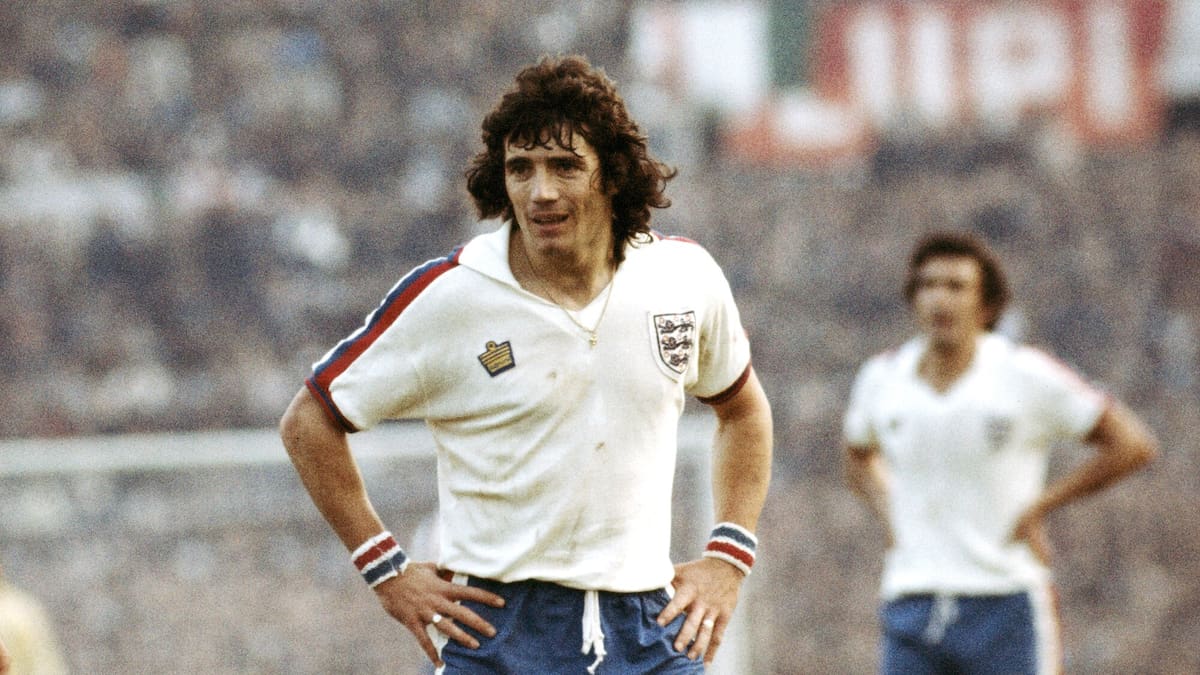
Kevin Keegan: “An inspiration to players who are not blessed with fantastic ability but make the best of it.” Photo / Getty Images
New Zealand got a taste of Keegan’s charisma when he visited in April 1985, just months after retiring as a player at Newcastle the previous year, aged 33.
The man who had captained England at the 1982 World Cup played for Claudelands Rovers – Claudelands Rovers! – who were then in the fourth tier of New Zealand football. I was among the crowd of 4500 at Porritt Stadium as a Claudelands Invitation XI lost 5-3 to a New Zealand XI coached by Kevin Fallon and comprised entirely of All Whites.
Keegan scored twice from the penalty spot but other moments stood out as much for me. His fellow Rovers tried to pass to him as much as possible, but a couple of times, he let the ball run between his legs to a teammate running in behind him.
Wow, I thought, even when he doesn’t touch the ball, he’s brilliant.
Keegan also took coaching sessions at Waikato clubs, including one I attended at Cambridge’s John Kerkhof Park. And I met him as an impressionable teenager at a central Hamilton department store in the days before the Porritt Stadium game, wearing my Tottenham sweatshirt.
“It’s a shame you never played for Tottenham,” I said.
“They’ve had a good season, haven’t they?” he said, neatly sidestepping my comment.
Keegan is the only person I’ve ever asked for an autograph from and I displayed it on my bedroom wall for years, blu-tacked to a poster of his career achievements out of Shoot! magazine.
At the Hamilton store, he walked up behind a bunch of unsuspecting kids watching a video of his most famous goals.
As they watched him score his second goal in Liverpool’s 3-0 win over Newcastle in the 1974 FA Cup final – stretching unmarked at the far post to reach a cross about three metres out from an open goal – he told one of the boys: “You could have scored that.”
That self-deprecation was another reason fans loved him. He played up to the narrative that he lacked natural talent and his success was due to hard work.
Speaking about his European Footballer of the Year awards in a recent interview with the BBC, Keegan said: “You look at the list [of previous winners] and see the players on there right back to Stanley Matthews; George Best won it. I probably am the most ordinary player to have won it twice, in terms of these players I’ve mentioned had incredible ability, but I did it a different way and maybe could be an inspiration to players who are not blessed with fantastic ability but make the best of it.”
Kevin Keegan’s rant about competing with Manchester United in 1995 is an internet favourite.
Keegan’s emotional responses also endeared him to people. His “I will love it” rant as Manchester United ran down Newcastle for the 1995-96 title remains the most famous off-field moment in Premier League history.
He also famously quit as England manager in the Wembley Stadium toilets after losing a World Cup qualifier to Germany in 2000, saying in an interview that night: “I just don’t feel I can quite find that little bit of extra that I think you need at this level to find a winning formula.”
But while he may have lacked tactical acumen, he had a rare ability to connect emotionally with players. Goalkeeper Shay Given recounted how Keegan approached him in the changing room as he donned a garish jersey before a Newcastle game.
“He comes over to me and goes, ‘I’m not sure about that kit, Shay. But you know what? I’m sure about the person wearing it.’ And he just walked off, and I’m like, ‘come on, then’.”
And that ability to motivate, inspire and make people feel special will live on and be remembered as much as his myriad footballing feats.