
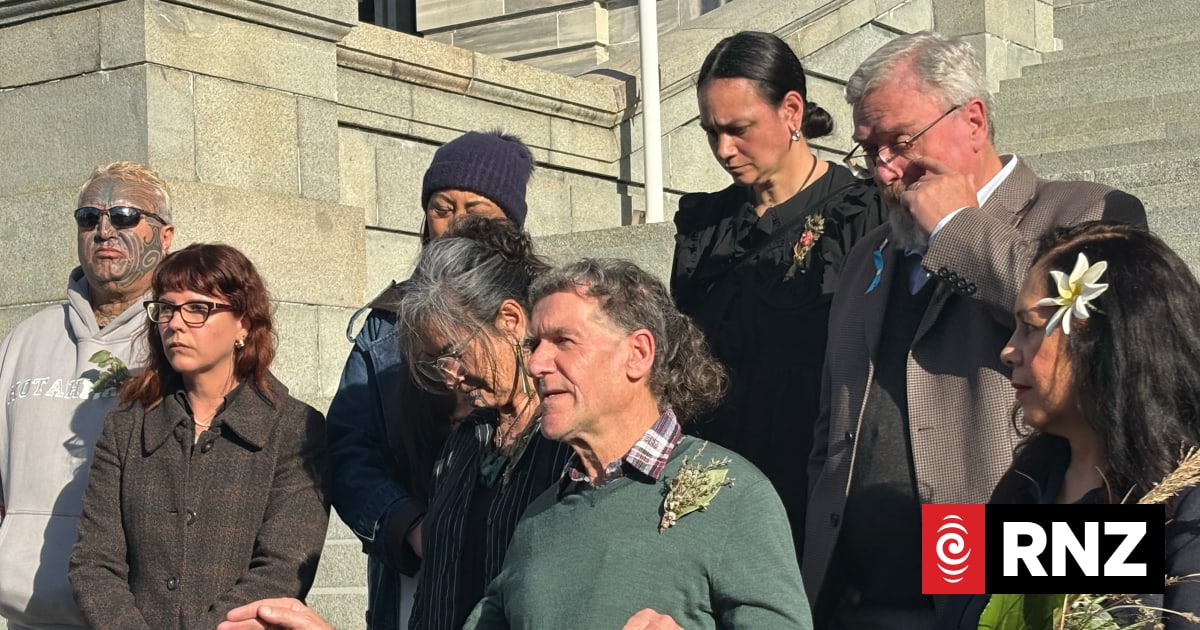
A survivor of abuse in state care says the government’s lack of progress towards preventing further harm is bordering on a crime.
But the minister in charge says the government’s committed to change, and it will take years to make things right.
Survivors gathered outside Parliament on Wednesday to hand ministers and opposition MPs bouquets of flowers gathered from institutions where people were abused.
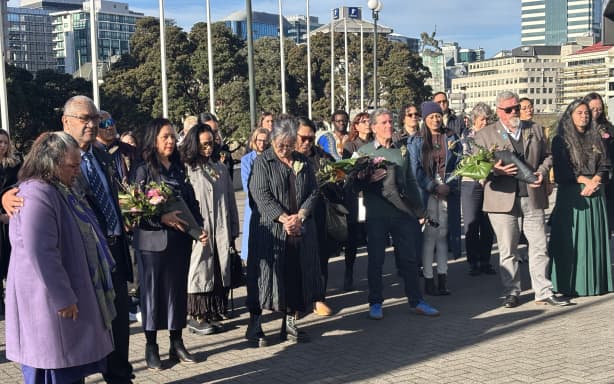
Survivors gathered outside Parliament on Wednesday.
RNZ / Lauren Crimp
The ceremony marked two years since the release of the Abuse in Care Royal Commission of Inquiry’s final report.
It made more than 100 recommendations, but survivors and the Human Rights Commission told politicians only a fraction had been delivered and some had been rejected.
As survivor Keith Wiffin handed a bouquet to the minister responsible for the government’s response, Erica Stanford, he shared a few quiet words with her.
“I told the minister that the Royal Commission’s work, its findings, its recommendations has a legacy,” he told reporters afterwards.
“It’s not going away until justice is delivered.”
Wiffin was disappointed and frustrated about what he believed was slow progress on those recommendations, saying the Royal Commission’s work should have been a catalyst for change, but it had not happened.
“For me, that is bordering on a crime,” he said.
“That is the biggest Royal Commission we’ve had in our country’s history, representing the biggest human rights issue to affect our country.
“Not only is there slow progress and stall around that, things are moving in the wrong direction.”
He pointed to the government’s actions like introducing youth boot camps, and repealing a section of law which bound Oranga Tamariki to the Treaty of Waitangi’s principles.
Wiffin said a redress system should have been implemented by now, and he was concerned that [. https://www.rnz.co.nz/news/community/588539/survivor-angry-and-saddened-as-number-of-young-people-abused-in-care-increases abuse in state institutions continued].
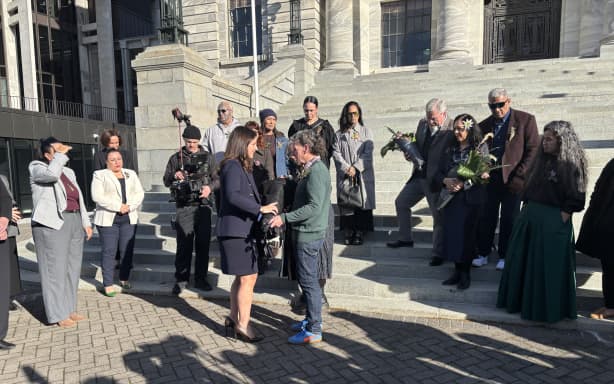
RNZ / Lauren Crimp
‘We stand by our apology’ – Stanford
The minister for the government’s response to the inquiry, Erica Stanford told survivors many of the recommendations required funding and drastic changes to how government departments operated.
She said the government in recent years had committed nearly three quarters of a billion dollars towards compensation, as well as building systems to prevent further abuse.
“I work closely with my Cabinet colleagues to make sure that through each agency we’re changing how we care for people,” she said.
“We stand by our apology. We’re listening. We’re making changes.”
The government’s work continued, but it would take time, she said.
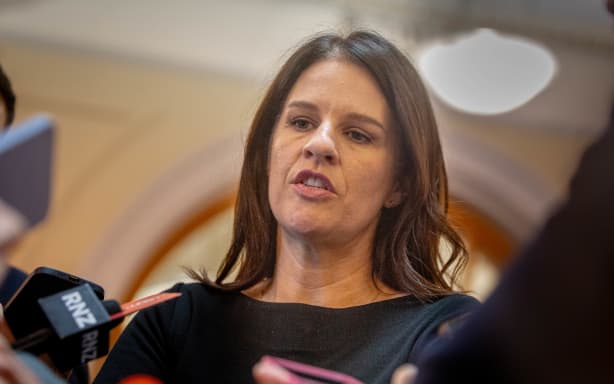
The minister in charge of the government’s response to the inquiry, Erica Stanford told survivors many of the recommendations required drastic changes to how government departments operated.
RNZ / Mark Papalii
“Things can move quite quickly if there’s a will to do it, and that is the secret here, there isn’t that will to do it,” he said.
With the election looming, Wiffin said he would be speaking with opposition parties about how they would approach implementing the inquiry’s recommendations.
Labour’s Willow-Jean Prime and the Greens’ Marama Davidson also spoke to survivors, saying they would honour the government’s promise to prevent further abuse, and to ensure survivors would get justice and redress.
Minister moved to tears
Tears rolled down Children’s Minister Karen Chhour’s face throughout the ceremony, and she told survivors to keep up their advocacy.
Chhour herself is a survivor of abuse.
“I’m eternally grateful for all of those who are brave enough to tell their story,” she said.
“Whilst I myself didn’t tell mine, those who did, did on behalf of myself as well, which I’m eternally grateful for.”
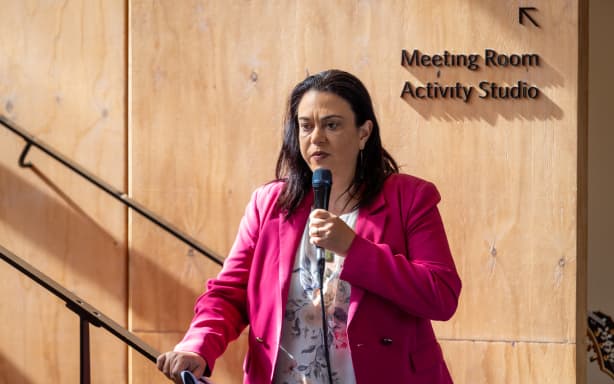
Children’s Minister Karen Chhour
RNZ / Nate McKinnon
Chhour later told reporters the ceremony brought back [ https://www.rnz.co.nz/news/politics/533547/the-full-text-of-christopher-luxon-s-crown-apology-to-abuse-survivors
memories of the government’s apology in 2024].
“I was sitting, watching the stage and listening to that apology, and kind of a bit confused within myself because I was part of the apology, making the apology, but also the one being apologised to,” she said.
“It reminds me each and every day of the burden on my shoulders to, kind of, be that advocate in that space.”
She said law changes would not be a “magic wand”.
“It shouldn’t just sit with the state,” she said.
“Community knows what the issues are within their community, and they’re wanting to step up, and we should be enabling that.”
Chhour said she had been working with iwi and hapū to ensure they can look after their people, the way they want to.
Human Rights Commission urges government to listen to survivors
Human Rights Commission chief executive Meg de Ronde accepted the level of change required would take time.
But she said the government had not listened to survivors who warned policy settings were perpetuating harm.
“Almost 3000 people came forward and they told you their stories of abuse and neglect,” she said.
“They gave many reasons for coming forward, but the most common was they said this abuse and neglect should never happen again to tamariki in Aotearoa, and so we say it is now the government’s turn to carry that responsibility on their shoulders.”
De Ronde said the Royal Commission’s recommendations had offered the government a clear roadmap, but politicians had not committed to it.
“This is not a political choice. This is the right thing to do.”