
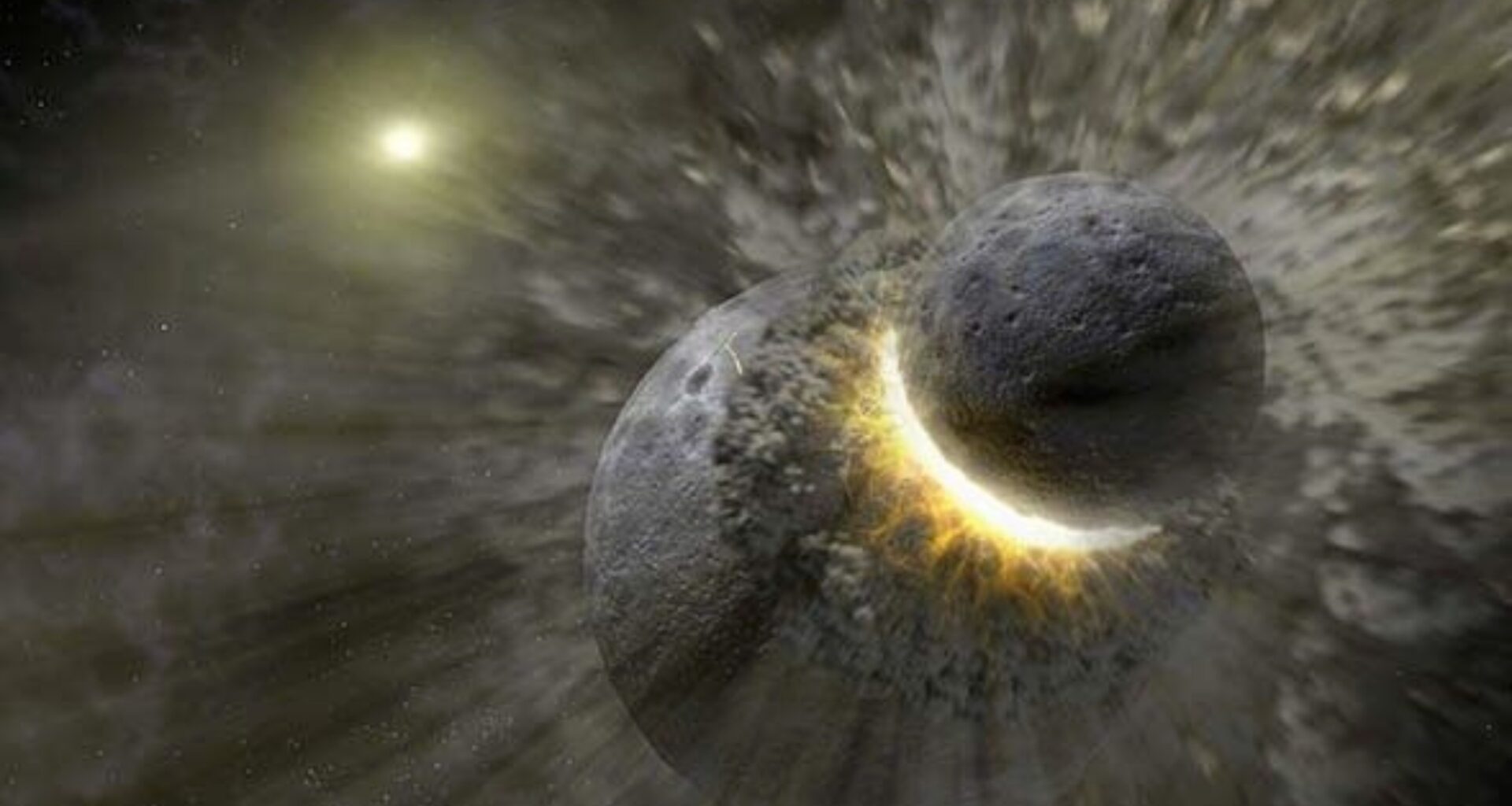
The chondritic meteorites that land on Earth most often are the shattered remains of tiny moons that once circled young, growing planets, according to a new study.
These common stones, called chondrites, account for around 85 percent of all meteorites, and their strange sameness has puzzled scientists for more than a century.

That origin story rewrites where the most common space rocks came from, and ties their birth to the most violent chapter in the solar system’s history.
It also carries real stakes, because these are the same asteroids that humanity may one day need to deflect or mine.
A century-old puzzle
Crack open one of these meteorites and you find it studded with chondrules. These are round beads of rock, most no wider than a fraction of an inch, that were once molten and then frozen solid.
They took shape at the very dawn of the solar system, roughly 4.6 billion years ago.
For more than a century, chondrules have posed two stubborn problems. First, what melted primitive dust into liquid droplets in the cold of space?
Second, why did those droplets end up so tightly packed inside the asteroids that carry them?
Earlier research had shown that the parent bodies came together fast and early in the solar system.
The research did not explain why chondritic meteorites from every direction carry nearly the same heavy dose of chondrules.
Samples from across the asteroid belt
Hal Levison, a planetary scientist at the Southwest Research Institute (SwRI) in Boulder, Colorado, had long been struck by that sameness.
Ordinary chondrites, the most common kind, can be more than half chondrules by volume, and samples from across the asteroid belt repeat the pattern.
“I have always been surprised by how homogeneous the chondritic asteroids seem to be,” said Levison.
His team set out to find a natural way to herd loose droplets into asteroid-sized bodies. That search led them to the era when the planets were still forming.
Born from giant impacts
The team believes the answer lies in the solar system’s messiest stretch, the final act of building the rocky planets.
This was a crowded time. Simulations place it within the first few million years, when the inner solar system was packed with planetary embryos.
These bodies, from Moon-sized to Mars-sized, kept crashing into one another.
When two embryos collide in the model, the impact throws out enormous sheets of melted and solid rock.
Much of it escapes, but a large share stays bound by gravity to the surviving body and settles into a flat, spinning ring of debris around it.
Beads of rock in the ring
That ring is where the puzzle comes apart. The molten droplets scattered into it would cool over hours, not the instants or ages that rival theories struggle with.
An earlier paper had already shown that impacts alone can melt rock into chondrule-sized beads at just that pace.
Inside the ring, the beads clump into ever-larger objects, the same way dust once clumped around the young Sun to build planets.
They grow into asteroid-sized moons orbiting the still-forming embryo, and made almost entirely of debris from the original crash.
Out of the simulations, these moons match real chondritic asteroids in both size and makeup.
“This process parallels the formation of Mars’ moons, Phobos and Deimos,” said Levison, pointing to the two small satellites that circle the red planet.
Moons that broke free
The model’s boldest step is what happens next.
These newly built moons did not stay put, because the early inner solar system was a gravitational free-for-all, with embryos constantly passing close to one another.
During those close passes, the simulations show, a moon could be torn from its host and thrown into its own orbit around the Sun.
Most did not survive as satellites. Between 60 and 95 percent escaped this way, while the rest fell back and merged into the embryo that made them.
Escaped moons become parent asteroids
The escapees, in this picture, became the parent bodies of the chondritic meteorites we collect.
Until this study, no single model had traced them from a planetary collision all the way to an independent asteroid.
This model also explains both how their chondrules formed and why they sit so densely inside.
Their long afterlife slowly ground them down. Over billions of years in the asteroid belt they chipped away at one another.
In addition, the sunlight itself, soaked up and thrown back off their surfaces as heat, slowly spun the smaller ones faster until fragments broke free and drifted toward Earth.
Those fragments are the chondritic meteorites now sitting in museum drawers and collectors’ hands.
“Chondritic asteroids are not leftover random rubble from the solar nebula,” said Kevin Walsh, a co-author on the study.
Asteroid structure could impact deflection
If chondritic asteroids really are wrecked mini-moons, the consequences run well beyond meteorite science.
They are also the most common near-Earth objects, the very population that planetary-defense planners watch most closely.
How an asteroid answers a shove, whether from a spacecraft slammed into it or a nuclear blast, depends on what it is made of and how tightly it holds together.
A body assembled from impact debris and broken moons may be built very differently than one imagined to have grown gently from drifting dust.
That difference could change the sums behind a real deflection test, and the same uncertainty hangs over any plan to mine such asteroids for metal.
Engineers drawing up either kind of mission lean on structural models that this work would revise.
What the finding changes
The model is not the final word. It is a computer simulation showing that the whole sequence is physically possible and fits what chondrites look like, not yet a fingerprint proving it happened.
Material returned from the asteroids Bennu and Ryugu could soon check its predictions against real samples.
What has changed is the origin story itself. The most ordinary rocks that fall from the sky now look like relics of the collisions that assembled the planets, each one a splinter of a lost moon.
Read that way, each chondrite becomes a record of how the rocky planets were made.
“They are escaped satellites – former moons-in-the-making – that carry within them a detailed record of the violent processes that built the terrestrial planets,” said Rogerio Deienno, co-author of the study.
The study is published in the journal Science Advances.
Image Credit: NASA/JPL-Caltech/T. Pyle (SSC)
—–
Like what you read? Subscribe to our newsletter for engaging articles, exclusive content, and the latest updates.
Check us out on EarthSnap, a free app brought to you by Eric Ralls and Earth.com.
—–