
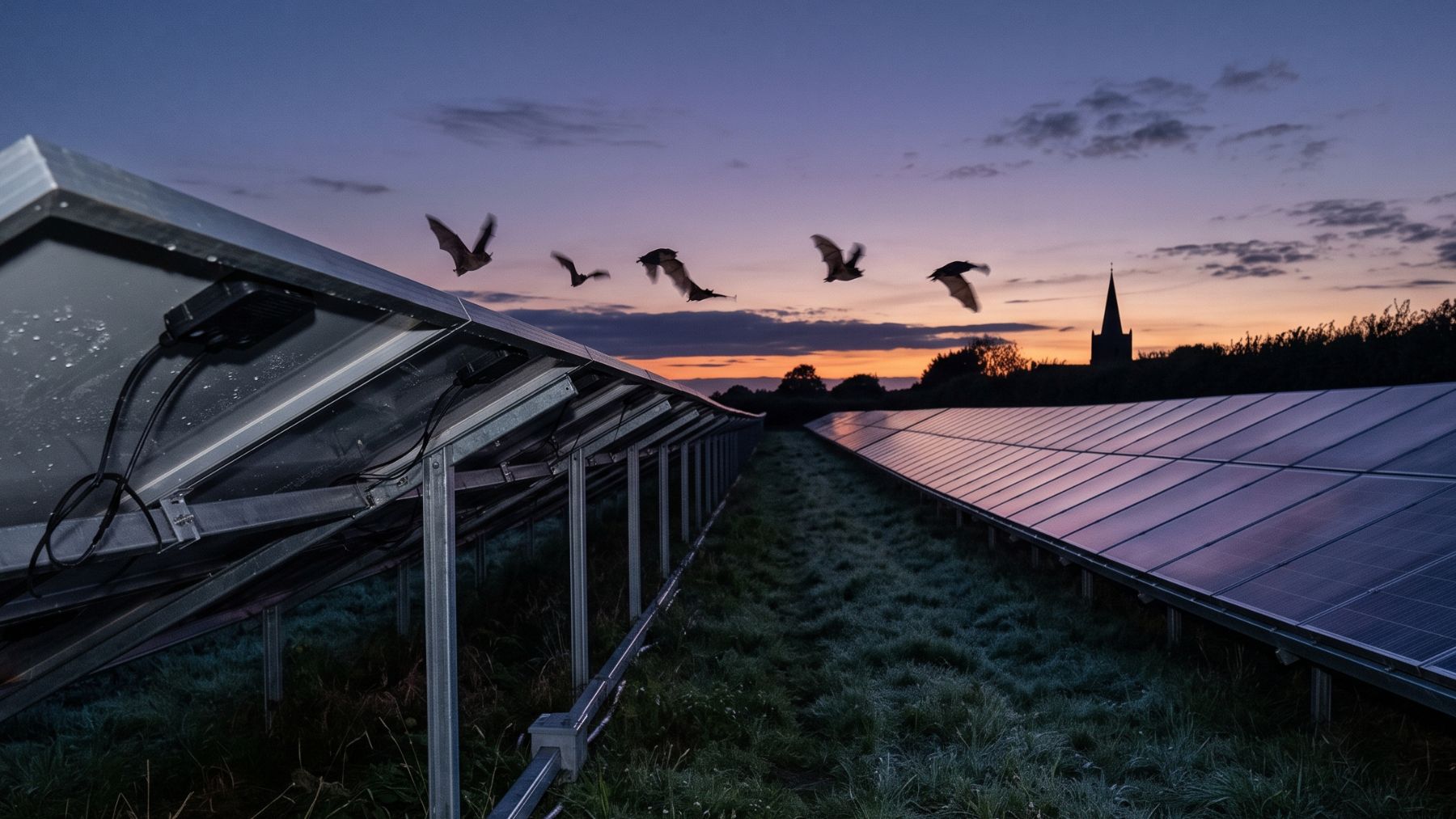
Picture a field of solar panels in the English countryside at dusk.
The last light fades, and small shapes flit above the glass.
They are bats, out hunting insects on the warm evening air.
But over the panels, something about their flight looks wrong.
They dart across the rows faster and straighter than normal.
And most of them refuse to enter the heart of the field.
Animals that see with sound
Bats find their way through the dark using sound.
They send out sharp calls and listen for the echoes.
That echo map lets them hunt insects in total blackness.
It works beautifully, but it has one strange blind spot.
A smooth, flat surface bounces their call straight back.
To a bat, that clean echo means one thing, water.
For millions of years, only calm water gave that signal.
Bats swoop down to such surfaces to drink on the wing.
They skim the top and lap up water without ever landing.
A sheet of glass can send back the very same echo.
A polished solar panel is just as flat and smooth.
Scientists call this a sensory trap.
The bat’s own senses are turned against it.
The clean energy paradox
Solar farms are spreading fast across the world.
Most of the news about them is good for nature.
Foxes den under the panels and birds nest along the rows.
Bees and wildflowers often thrive in the untouched grass.
The shaded ground can even shelter rare plants and insects.
Whole meadows have bloomed in the calm space between rows.
So solar sites are usually seen as friendly to wildlife.
But not every animal reads the panels the same way.
For bats, a wide field of glass can look like a lake.
That raised a simple question for researchers.
Do bats treat a solar farm as water or as ground?
To find out, they went into the fields.
A study across the English countryside
Ecologists set out to measure bats at working solar farms.
The team studied 19 solar sites scattered across England.
These were not lab tests but real farms in the landscape.
At each one, they placed sensitive acoustic detectors.
The devices record the calls bats make as they fly.
Detectors sat at the edges and deep in the panel rows.
Others were set in nearby fields with no panels at all.
That let the team compare bat life on and off the arrays.
They logged night after night of recordings through the season.
Software then sorted the calls by species and by place.
It built a clear picture of where the bats chose to fly.
One species, the common pipistrelle, made up most of the calls.
And its numbers told a stark story.
What the recordings showed
Here is what the detectors actually picked up.
According to one report, bat activity fell sharply over the solar panels.
Along the edges of the fields, calls dropped by about 40 percent.
In the very middle of the panels, the fall was far worse.
There, activity crashed by around 86 percent.
Overall, bat activity was roughly halved at the field boundaries.
Toward the center, it dropped by close to two thirds.
The bats were not dying, they were simply staying away.
The busy field edges still drew a fair share of hunters.
But the open core of glass sat almost deserted at night.
Companion experiments help explain why they flee the glass.
Fooled into seeing water, the bats avoid the panels.
A whole field turns into a hole in their world.
What it means, and how to fix it
A solar farm is meant to help the planet, not harm its wildlife.
For bats, though, a big array can act like a barrier.
It can cut a foraging route or split a feeding ground in two.
Night after night, the animals must detour around the glass.
Bats already face heavy pressure from habitat loss and disease.
A new empty zone in the landscape does not help.
The good news is that the fix may be fairly simple.
Hedges, gaps, and green strips can guide bats around the panels.
Smart layouts could keep flight paths open through a site.
According to one account, the smooth panels mimic the echo of water.
The same tension between clean power and wildlife shows up elsewhere, from a solar farm fox to the seals near an offshore wind farm.
Researchers say the aim is not to stop solar at all.
It is to build the next farms with a little more care.
Solar power can still grow without leaving bats behind.
It just means building with their strange senses in mind, one hedgerow at a time.