
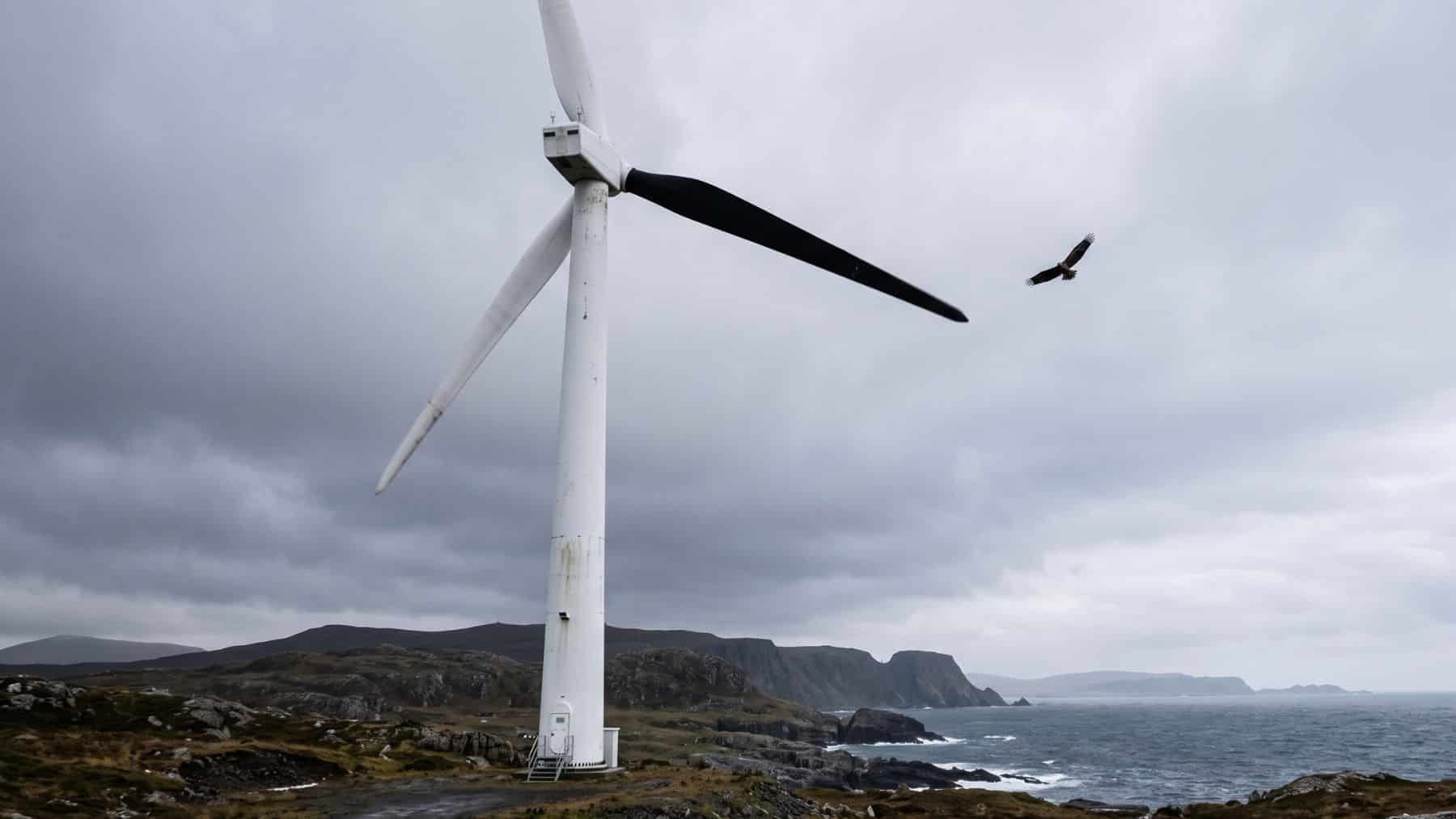
Picture a huge wind turbine turning slowly against a gray sky.
Its long white blades sweep around in a wide, steady arc.
From a distance, the motion looks calm and easy to see.
Yet every year, birds fly straight into those blades.
Eagles and other raptors are hit most often.
And the reason hides in how they see.
A deadly problem in the sky
Wind power is one of our cleanest sources of energy.
But the spinning blades come with a real cost to wildlife.
Large birds of prey are especially at risk.
Eagles, hawks, and vultures all fall to the blades.
They soar for hours while scanning the ground below.
A hunting eagle watches the earth, not the air ahead.
It locks onto a rabbit or a fish far beneath it.
While it stares down, it can miss what lies in its path.
Eagles evolved with no fast moving objects in the open sky.
Nothing in their world ever swept toward them like this.
A turbine blade can be moving shockingly fast at the tip.
The outer edge can whip past at highway speeds.
By the time the bird notices, it is already too late.
For a soaring raptor, the open sky hides a hidden blade.
The result is a silent toll of birds.
The trick the spinning plays
There is a strange reason the blades seem to vanish.
Scientists call the strange effect motion smear.
When a pale blade spins very fast, it blurs into the sky.
The eye can no longer hold it as a solid shape.
A whirling white blade simply fades into the background.
Even an eagle, with its superb eyes, is fooled.
Its sharp vision cannot freeze such rapid motion.
The three blades melt into one faint, ghostly circle.
To the bird, the deadly rotor looks almost like nothing.
So the bird flies toward a gap that is not really there.
The faster the tip moves, the more it disappears.
What looks like empty air is a moving wall.
The blur itself becomes the danger.
A simple idea tested in Norway
Researchers wondered if they could break that blur.
Their idea was almost absurdly simple.
Paint just one of the three blades solid black.
A single dark blade would stand out as it turned.
It would give the bird something clear to see.
They tried it at a wind farm on the island of Smola.
Smola lies off the coast of central Norway.
Its turbines had long been deadly for the local eagles.
The island is home to a strong population of sea eagles.
That made it the perfect place to test the idea.
The team painted a black blade on four of the turbines.
Nearby turbines were left all white for comparison.
Then they watched the site for many years.
They counted every bird they could find.
What the black blade did
Here is what those years of counting revealed.
According to one report, the painted turbines killed about 72 percent fewer birds.
That is a huge drop from just a single can of black paint.
The effect was strongest for large birds of prey.
After the blades were painted, no dead eagles were found.
The white tailed eagle, once a victim, stopped colliding.
Not one of them was found dead after the change.
One black blade had made the whole rotor visible.
The blur was broken, and the danger became clear.
Birds could finally see the sweep and steer around it.
A problem that seemed impossible had a cheap fix.
A little black paint became a life saver.
The wind turbine had turned far less deadly.
Why it is not everywhere yet
If it works so well, then why not paint every one of them?
The answer is that it is not so easy in practice.
Painting a blade high in the air is slow and costly.
Each blade can be dozens of meters long.
Crews must reach it and repaint without harming the turbine.
The Norway study also covered just a handful of turbines.
Scientists want to repeat it at bigger sites first.
They need to know it works with other birds and places.
Some offshore projects have already started testing the idea.
New turbines could even be painted before they go up.
According to one account, the black blade trick is drawing wide interest.
The same push to blend clean power with wildlife shows up elsewhere, from a solar farm fox to the seals near an offshore wind farm.
For the moment, the answer may be one bold stripe of black.
Sometimes the smartest fix is also the simplest one, painted one blade at a time.