
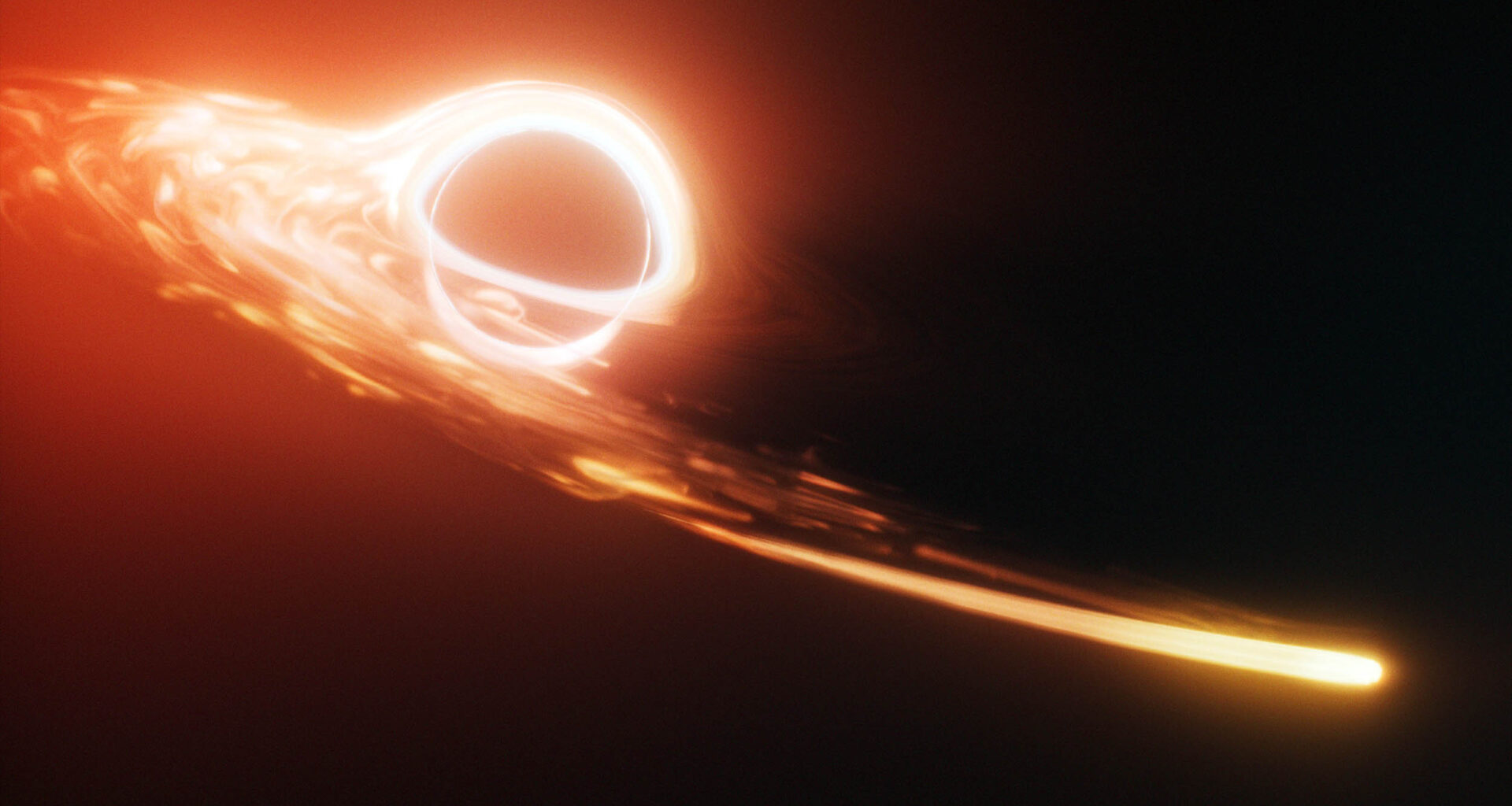
Black holes sit at the center of most galaxies, including our own Milky Way. Some contain millions or even billions of times the mass of the Sun.
They shape the galaxies around them, yet one basic question still puzzles astronomers: How did these giant objects grow so large so early in the history of the universe?

A new study suggests NASA’s Nancy Grace Roman Space Telescope could help answer that question. The observatory, currently on track to launch on August 30, 2026, is expected to spot ancient supermassive black holes that existed as far back as 11 billion years ago.
Those observations could give scientists a much clearer picture of how the first giant black holes formed and changed over time.
Catching black holes in the act
Black holes do not emit light. Typically, scientists identify them by looking at the bright accretion disks that surround them.
Material falling toward a black hole can emit enough light for scientists to determine its location.
Identifying smaller supermassive black holes is more difficult because they attract less material and therefore emit less light.
However, from time to time, a black hole will rip apart a star passing nearby. This creates a burst of light known as a tidal disruption event, or TDE.
For a time, the burst can become brighter than the entire galaxy around it before gradually fading away.
Looking farther back in time
“The Roman Space Telescope is going to be transformative for transient science,” said lead author Mitchell Karmen, a graduate student at Johns Hopkins University.
“Thanks to Roman’s high sensitivity, we can find multiple tidal disruption events out to greater distances and earlier cosmic times than ever before.”
Roman’s High-Latitude Time-Domain Survey will repeatedly observe the same region of space, covering about 18 square degrees of the sky. That’s roughly equal to the area of 90 full moons.
Watching the same locations again and again gives astronomers a better chance of catching short-lived events like tidal disruption events as they happen.
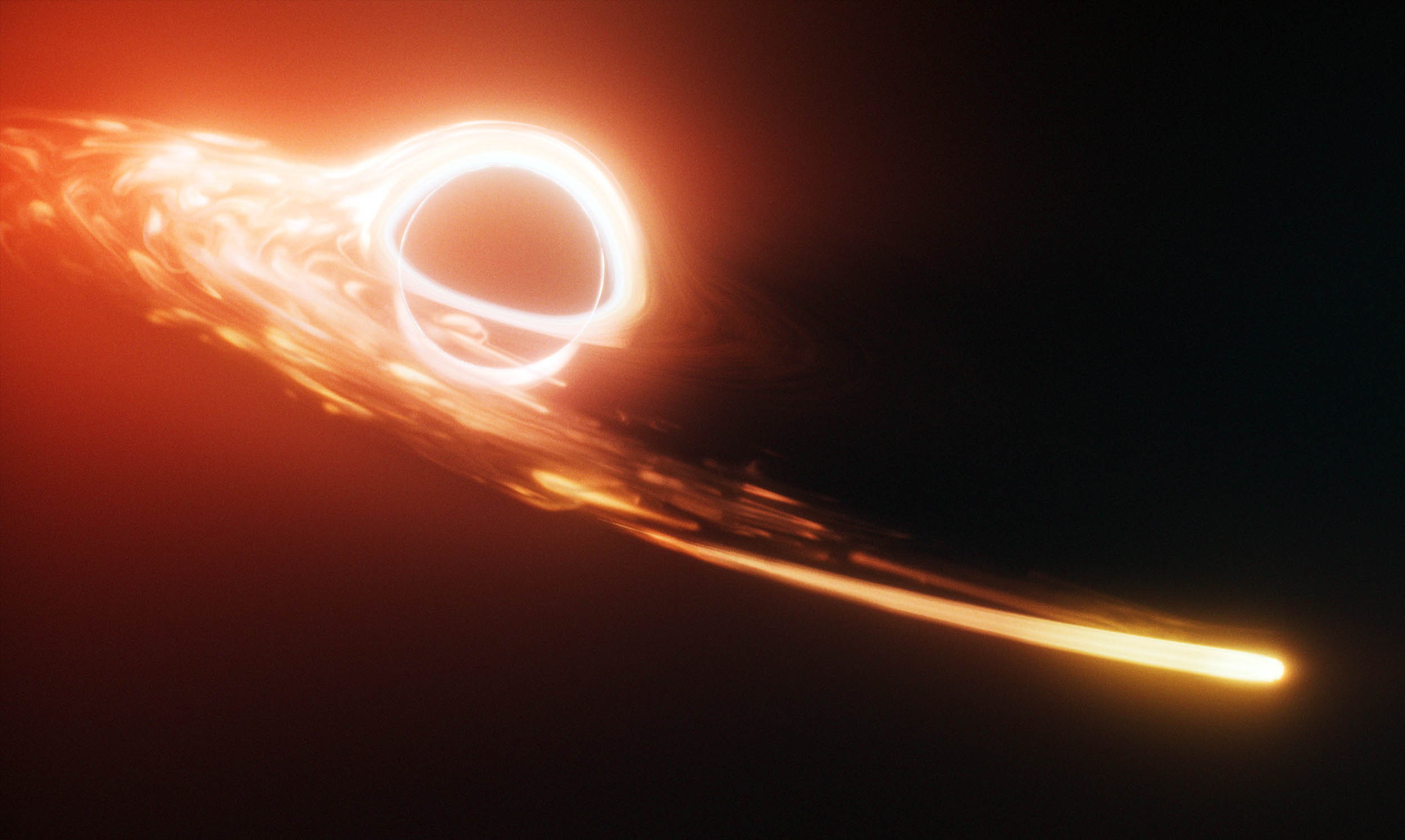 This artist’s concept portrays a Sun-like star being shredded by a supermassive black hole — a phenomenon known as a tidal disruption event. Credit: NASA’s Roman Telescope Mission. Click image to enlarge.Not every black hole shreds stars
Not every black hole produces these dramatic flares. The biggest ones, with more than 1 billion times the Sun’s mass, swallow stars whole before they can be ripped apart.
Smaller supermassive black holes range from about 100,000 to 100 million solar masses. They stretch and tear stars apart first, creating the bright signal astronomers can detect.
Earlier studies suggested tidal disruption events should become less common the farther scientists look into space. Researchers believed the earliest black holes were too small to create them.
The new research paints a more complete picture by accounting for how galaxies evolved over time. That includes galaxy mergers, growing black holes, and changing numbers of stars packed into galactic centers.
Using those factors, the research team predicts that Roman will detect more tidal disruption events caused by black holes as it looks farther into the past. The numbers should continue rising until it reaches “cosmic noon,” about 11 to 12 billion years ago.
That period marks the peak of star formation across the universe. Beyond that point, the number of tidal disruption events is expected to decline again.
Roman and Rubin divide the sky
Roman will observe the universe mainly in near-infrared light. As the universe expands, light traveling across vast distances becomes stretched into longer wavelengths, an effect called cosmological redshift.
That makes Roman especially well suited to detect tidal disruption events whose light has traveled between 8 billion and 11 billion years before reaching Earth.
The Vera C. Rubin Observatory will also play an important role. Because it observes visible light, it will mainly detect closer tidal disruption events.
According to the study, Rubin could discover thousands to tens of thousands of these events every year, while Roman could find up to 100 annually.
Roman’s smaller haul is especially valuable because those events will reveal black holes from a much earlier period in cosmic history.
“Just by counting the number of TDEs as a function of redshift, you can put meaningful constraints on the population of million-solar-mass black holes,” said co-author Suvi Gezari, an associate professor of astronomy at the University of Maryland.
“Roman will be transformative in that it can probe tidal disruption events out to greater distances, so you can look at how the rate of TDEs evolves over time.”
Were black holes born big?
Astronomers have already found enormous black holes that existed surprisingly early after the universe formed. Their size has challenged current theories because there appears to have been very little time for them to grow.
One explanation, known as the light-seed model, proposes that black holes began as the remains of massive stars.
These smaller black holes gradually grew by merging with one another and rapidly pulling in gas. If that idea is correct, young galaxies should commonly contain growing black holes.
The competing heavy-seed model suggests some black holes formed much larger from the start, possibly through the direct collapse of massive gas clouds. In that case, giant black holes would have been much less common in the early universe.
“Tidal disruption events help us probe the population of light supermassive black holes, which can help us discriminate between these models,” Karmen said.
Building a black hole family tree
The number of tidal disruption events that Roman ultimately discovers could reveal how black holes changed over billions of years. The findings could also help scientists determine which formation theory best matches reality.
Researchers also plan to compare Roman’s observations with discoveries from the Rubin Observatory once both telescopes begin regular science operations.
Together, the two facilities will observe different parts of the universe and different wavelengths of light, giving astronomers a broader view than either could provide alone.
“Just like Webb has transformed our understanding of distant, high-redshift galaxies, Roman is poised to transform our understanding of high-redshift transients,” Gezari said.
The full study was published in The Astrophysical Journal.
—–
Like what you read? Subscribe to our newsletter for engaging articles, exclusive content, and the latest updates.
Check us out on EarthSnap, a free app brought to you by Eric Ralls and Earth.com.
—–