
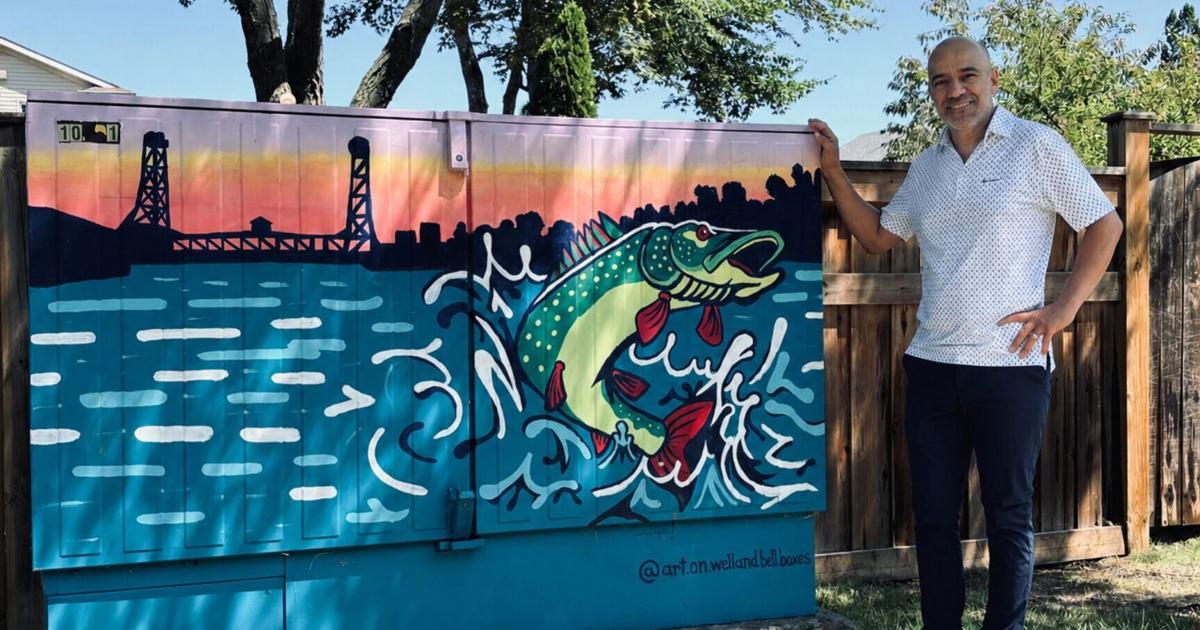
Welland’s largest art gallery isn’t inside a building. It’s hidden in plain sight, and chances are you’ve driven past a dozen of its pieces without noticing.
Forty murals are spread across Welland, painted on nondescript Bell utility boxes that line sidewalks and boulevards throughout the city. Themes range from the Main Street Bridge and the former Welland Canal to roses — a nod to the city’s nickname, the Rose City.
The collection has been growing since 2021, when Aldo Parrotta and his wife, Sylvia, spotted painted Bell boxes while visiting their daughter in Toronto and brought the idea back home to Welland.
“I thought it was a great idea and something that could work very well here. I contacted the person running the Toronto program, Michael Cavanaugh, and worked with his organization during our first year in Welland. After that first year, I took what I had learned and made it our own locally operated program.”
Funding
In 2021, part of the $13,200 in city funding received went to the Toronto organization because Parrotta was working through its program and learning the process. The funding now stays in the city; this year, Art on Welland Bell Boxes, a non-profit organization, received $9,520 through the Community Grant Program.
“The funding allows us to complete approximately 10 to 12 new boxes, depending on how many locations Bell approves. The $9,520 not only pays for the new murals, but also supports the entire program and the continued care of all the boxes painted since 2021,” he said.

Brianna De Paulo’s work can be seen at 310 St. George St. in southwest Welland.
Dave Johnson/Welland Tribune
“For a relatively small investment, the city receives new public art, paid opportunities for local artists, ongoing maintenance of the existing collection and a growing cultural attraction that people can enjoy year after year.”
The funding covers artist payments and all aspects of the program’s operation: locating, preparing and maintaining boxes; photography, video and social media promotion; website hosting; and mapping, cataloguing and record-keeping.
Approvals and locations
Bell manages approvals and authorization involving company equipment, the city provides the funding and Parrotta operates and delivers the program.
“I locate the potential boxes, work with Bell in Ottawa, organize the call for artists, review the applications, prepare and clean the boxes, inspect the locations to make sure they are safe for the artists, co-ordinate the painting period, apply the protective coating and maintain the collection after the work is finished,” said Parrotta. “I always identify more boxes than we actually need, because not every box will be approved. I send the locations to Bell, and they check whether those boxes are suitable for painting.”
James Takeo’s art work on Division Street sits near Welland Central Fire Station.
Dave Johnson/Welland Tribune
He said Bell first looks at whether a box — a standard dark olive green steel telecommunications cabinet filled with cables and equipment — may be removed, replaced, relocated or decommissioned. The company also considers whether road construction, new development or a future subdivision could affect the location. It does not provide any funding, paint or artist supplies.
“We do not want an artist spending days painting a box only to have it removed shortly afterward. Once Bell tells me which boxes are available, I revisit the locations and look at them from the artist’s perspective. I check the condition of the box, the ground around it, traffic, visibility, available space and anything else that could create a safety issue. Artists can suggest a specific box or an area they would like to work in, but I cannot guarantee that location.”
Local artists
Beyond the physical assessment of the boxes, Parrotta said there are also requirements for who can take on the work, including living in the city or having a direct and meaningful family connection to the city.
“The funding comes from the city, so I believe it is important that the opportunity supports artists who are part of, or directly connected to, this community. The program is intended to create opportunities for Welland artists. There is a lot of artistic talent in Welland, and this program is one way to give those artists a paid public opportunity.”
Chris Lagesten’s work sits just north of the Welland Courthouse on the east side of Cross Street.
Dave Johnson/Welland Tribune
When it comes to selecting artists, it is a competitive and curated process, not first-come, first-served. Parrotta enjoys seeing new artists apply because it’s an opportunity for someone to take a step forward and show what they can do.
“I review the applications based on originality, visual strength, the artist’s connection to the theme, whether the design is appropriate for a public setting and whether it can work successfully across the entire utility box,” said Parrotta. “Bell also has rules about what can and cannot appear on its equipment. There cannot be corporate logos, advertising, political messaging, inappropriate language or anything that would not be suitable for a broad public audience.”
There cannot be too much blank space and designs should cover the box as fully as possible because large blank areas can invite tagging and graffiti.
Parrotta said this year’s theme is roses, connecting the program to Welland’s identity as the Rose City, and Bell agreed that it would be a strong direction. The deadline for artists to apply was July 25.
Selected artists are paid for their work, but provide their own exterior latex paint, brushes and other painting supplies. There is no separate material reimbursement. Guidance is provided on the type of exterior paint that should be used and which parts of the box cannot be covered, such as locks, vents, identification markings and operating components.
“After the deadline, I review the applications and designs, contact the selected artists and complete the approval process for the designs and locations.”
Painting period
The painting period is scheduled from Aug. 23 to Sept. 5, and Parrotta will head out ahead of that time to prepare the boxes and make sure the locations are safe and ready to paint.
He will also continue to inspect, clean, coat, document and promote the already completed boxes. Residents contact him directly when they notice something wrong with one of the boxes.
“They may email me and say that a box has been tagged, damaged or needs attention. I then go out, look at it and determine what needs to be done. A large part of the work involves physically travelling throughout Welland to visit the boxes, inspect them, clean them and apply the protective coating, which helps protect the artwork from the weather, ultraviolet exposure, dirt and graffiti. Every completed box is coated twice a year.”
Aldo Parrotta wants to expose local artists’ work to Rose City residents this summer
He said over the years, there have only been three incidents of graffiti, involving two boxes — one of which was tagged twice.
“That is a fairly low number considering how accessible they are. When appropriate, I may contact the original artist to assist with repairs. When the issue involves Bell’s equipment rather than the painted surface, I contact Bell.”
When artists finish their work and the protective coating is applied, Parrotta photographs and films each mural, updates the inventory and website — artonwellandbellboxes.ca — and creates promotional content. He also tracks artist information, submitted designs, location records and maintenance history.
“There is a lot of valuable information being gathered through this program. Over time, it creates a record of the artists who have participated and the large-format public artwork they have completed.”
Parrotta said artists retain the copyright to their original designs and can reproduce the artwork, create prints or sell reproductions if they choose. Art on Welland Bell Boxes, the city and Bell may photograph and share the finished murals for maps, promotion, social media, media coverage, documentation and reporting.
“The artist should be credited whenever the artwork is shared,” he said.
Looking ahead
With five years of murals spread across the city, the question is how much further can the program grow and whether funding will follow.
“I intend to continue growing it every year, but it depends on the city’s annual Community Grant Program approval, the amount of funding available, the number of suitable boxes I can locate and Bell’s final authorization. There is no guaranteed multi-year funding agreement at this point.”
Daniel Kozina’s horses are on Ross Street just north of East Main Street.
Dave Johnson/Welland Tribune
Parrotta said the program has developed a strong record and the community response has been positive, with people continuing to look forward to seeing the new artwork each year.
“For me, the program has always been about much more than making a metal utility box look better. It supports and pays local artists, gives emerging artists a chance to complete a large-format public artwork, and brings original artwork directly into Welland’s neighbourhoods, where people can enjoy it without paying admission or entering a building. It also generates positive photography, video, media coverage and social media content about Welland.”
He said it also encourages people to explore the city, creates conversation and builds neighbourhood pride.
“The collection has really become Welland’s largest outdoor art gallery. It is also creating a roster of local artists who have proven they can complete this type of large outdoor project. That information could become very useful in the future. If the city, a local business or another organization is looking for someone to complete a mural or outdoor public-art project, we are building a record of artists who already have that experience.”
The work impacts the wider community, he added.
“People tell us which murals are their favourites. They photograph them, share them online and return to see the new additions. Residents also contact me when they see that something is wrong with a mural. To me, that shows community ownership. People are noticing the boxes, they care about the artwork, and they want it looked after.”
Oleksii Kryvoruchko’s work sits on Maple Avenue by Prince Charles Drive South.
Dave Johnson/Welland Tribune
Though no formal study has been conducted, Parrotta said there’s no question the murals make a modest but real contribution to cultural tourism and local economic activity.
“When we promote the new artwork in August and September, especially during the good weather, people travel throughout Welland to see the boxes. We have heard from people in other parts of Niagara who have come here to see the artwork, follow the mural map, bicycle between locations, take photographs and share their visits online,” he said. “While they are here, they may stop at a coffee shop, have lunch, visit another local business or explore a part of Welland they would not otherwise have visited.”