
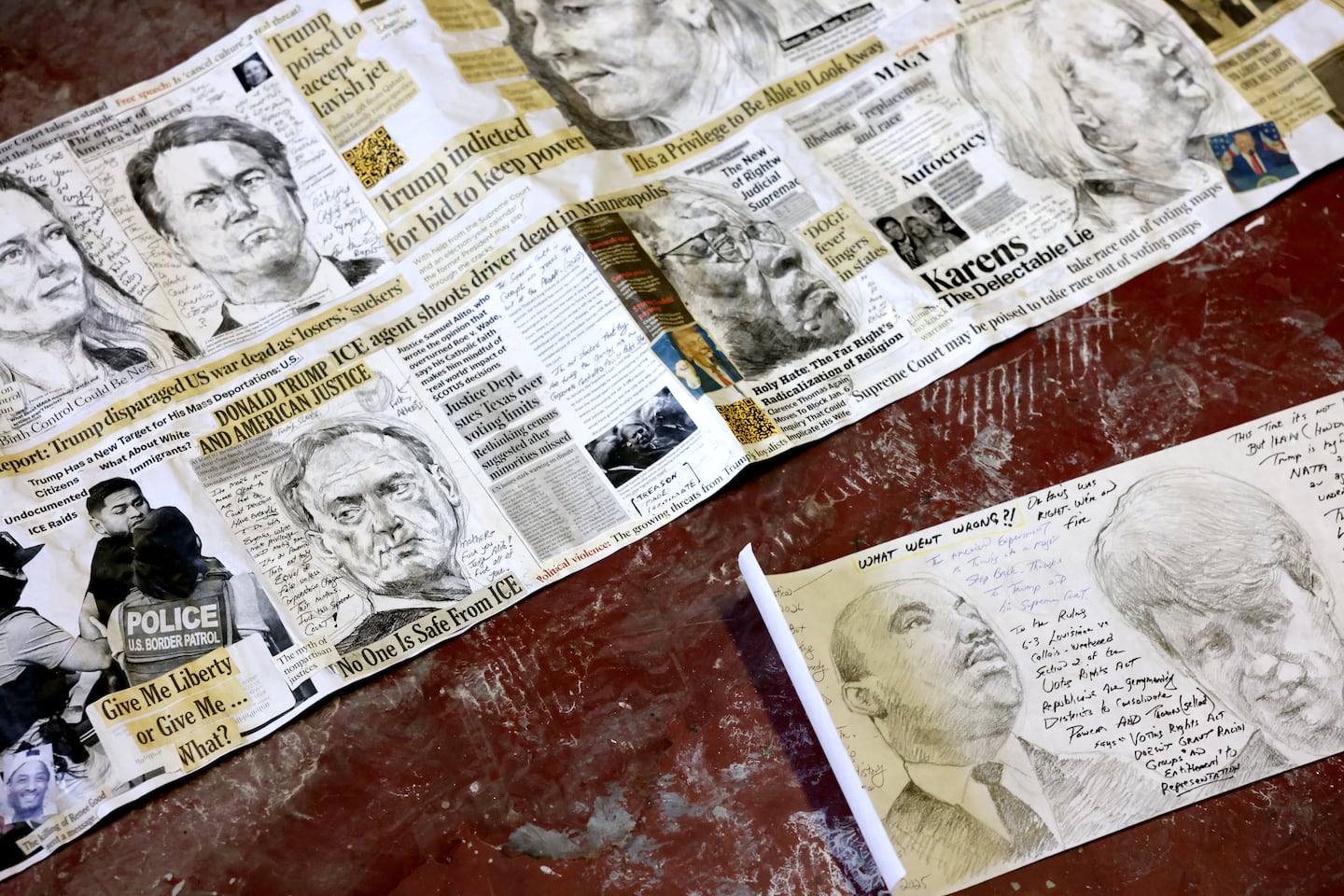
The Institute of Contemporary Art wraps up “Say It Loud: AAMARP, 1977 to Now,” a showcase of decades’ worth of work from Boston’s cornerstone institution of the Black Arts Movement, on Aug. 2. But at least one part of it will go on — and on, and on — as it has for more than 20 years: Shea Justice’s “Scroll of Justice,” a mile-and-a-half-long — and counting — fusion of drawing, text, and collage that’s been a daily practice for the artist since 2001.
The ICA presents only a snippet, and barely teases at its voluminous arc. Even so, it’s magnetic: Justice’s highly accomplished classical figure drawing sits in rough tension with the fractious politics of multiple eras of American life stacked back to back. But it’s one thing to see a tiny portion, and quite another to watch as Justice, now 55, unrolls one of his many scrolls right in front of you. He indulged me with that privileged viewing on a couple of recent occasions, in May and in July, and the experience was dizzying, a maelstrom of livid despair captured in his sharply frank, observational style.
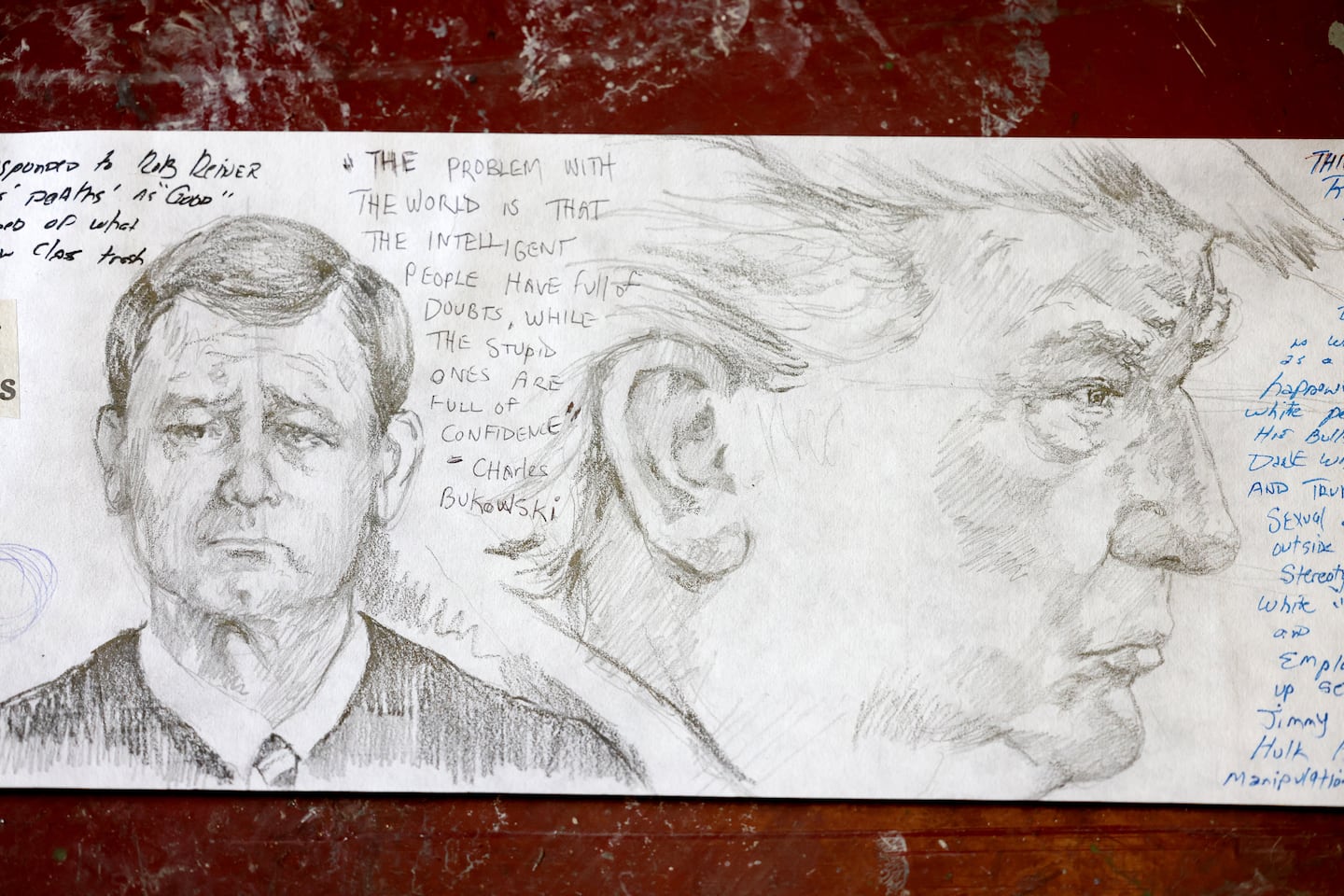 A detail of Boston artist Shea Justice’s work, “Scroll of Justice.”
Jessica Rinaldi/Globe Staff
There no way to begin to account for all his scrolls contain; at minimum, they’re a record, visual and otherwise, created day by day, of an unraveling of American life: 9/11 and the Iraq War — the scrolls began, officially, when the United States invaded Afghanistan — the fall of George W. Bush, the rise of Barack Obama, the chaotic onslaught of the Trump years; the most recent I saw considered with great suspicion the mysterious disappearance of Senator Mitch McConnell (a passage on the death of Senator Lindsey Graham is in progress).
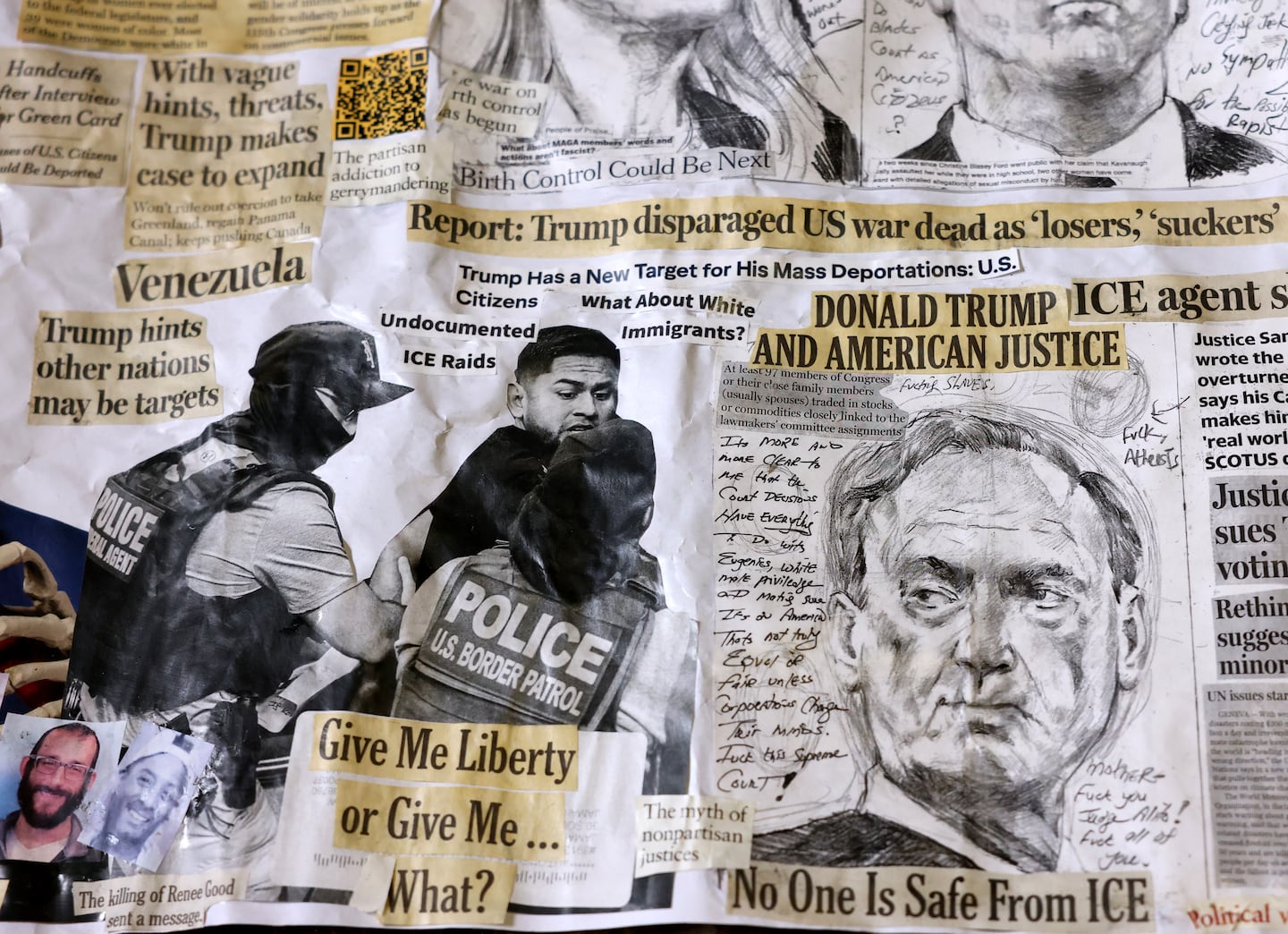
But they’re so much more than a simple account. His figures embed on pages filled with headlines clipped from newspapers and magazines; they swim in a torrent of his handwritten thoughts, a torrent of stream of consciousness indignation. Justice weaves his daily journal with historical reference points that recur, underpinning the immediate and topical with contextual echoes. They come at you in waves; in their hundreds of yards of torment, the scrolls conjure American political history at its most profane; they also make plain how all that history imposes on the here and now.
 Detail of Boston artist Shea Justice’s “Scroll of Justice” on July 21, 2026.Jessica Rinaldi/Globe Staff
I was struck, in one passage, to find a likeness of Martin Luther King Jr., chin lifted in noble contemplation, alongside Bobby Kennedy (senior) and then, Kevin Roberts, the director of the Heritage Foundation and architect of its Project 2025 — for those with short memories, the de facto blueprint for the second Trump administration’s demolition of American culture as we know it, and the advances of the civil rights era most severely. Justice draws a line, if you’ll pardon the phrase: From the height of American ambitions for equality and justice to its immolation, in the hastily sketched portraits of three men. Hovering above them in black Sharpie is Justice’s frank thinking in block letters: “WHAT WENT WRONG?”
Justice is often given to far saltier language in the furious script that often surrounds his images; his righteous fury centers on the abuse of power — an abuse that he, as a Black man growing up in the post-civil rights malaise of the 1970s, still feels acutely. But the trio of portraits is just one moment among countless others where perspective intrudes on fact, infusing the scrolls with Justice’s unfiltered view. It helps make clear the project’s purpose: To create a record, yes, but like any diaristic urge, to purge demons from the author’s mind by spewing them out into the world.
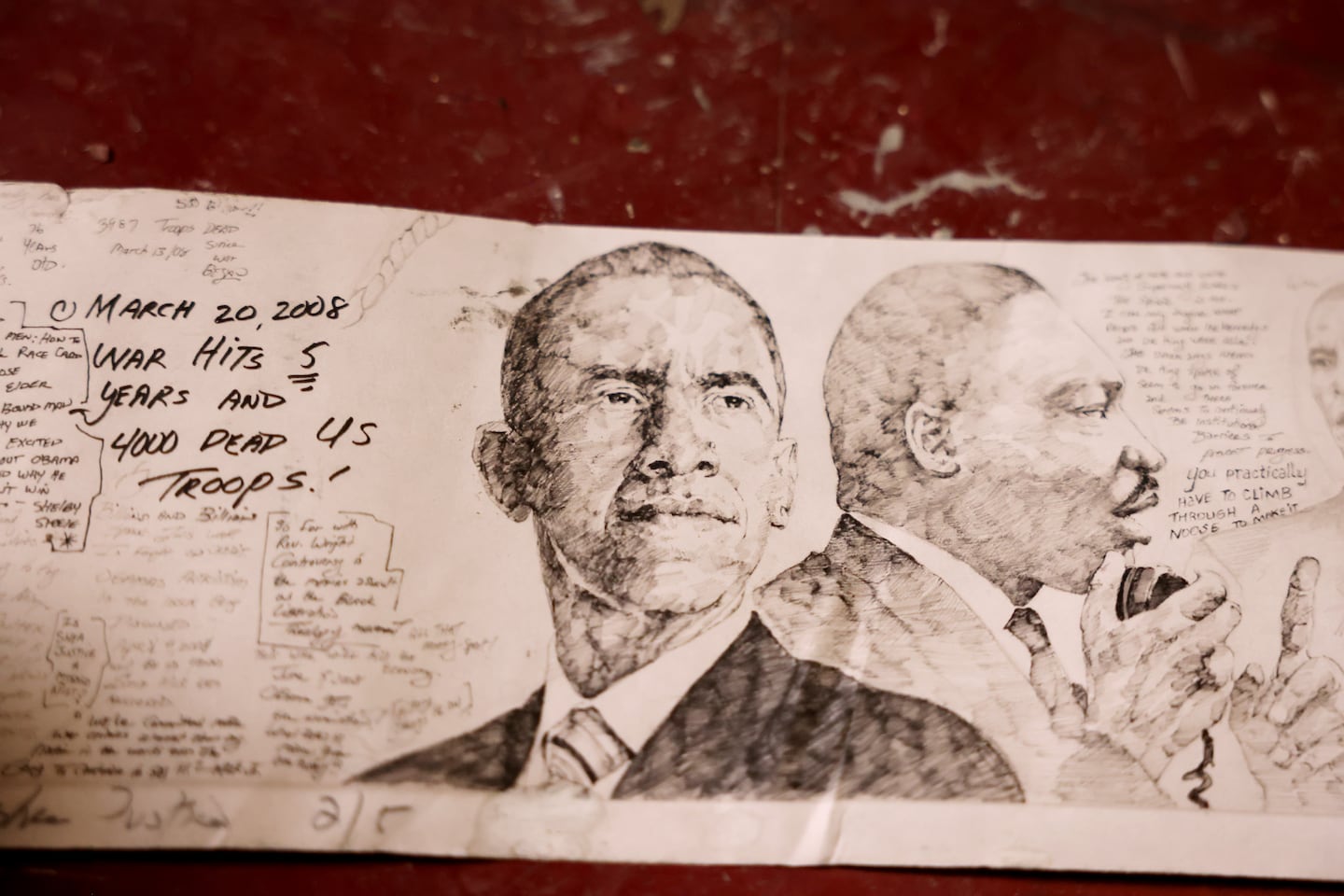 A detail from Justice’s “Scroll of Justice” in Jamaica Plain on July 21, 2026. Jessica Rinaldi/Globe Staff
Justice’s influences are many: from classical figure drawing honed as an undergraduate at Boston University to generations of sharp political caricature that’s at least as old as the printed page itself to the superhero comics he grew up with. But I found myself in mind of much deeper lineage: Francisco Goya’s “The Disasters of War,” say, a catalog of visual protest against the intense violence of the Dos de Mayo uprising of 1808, when Spanish civilians rose up against the French occupation of Madrid. I thought, too, of Art Spiegelman’s “Maus,” a series of graphic novels in the 1980s that depicted the author’s grandparents’ time in Auschwitz; in his rough-hewn style, he portrayed them as mice, and the Nazis as cats.
Justice is rarely diverted into the fantastical (a slightly demonic George W. Bush appears in one of them), but there’s nonetheless a common purpose that binds them. Justice tucks neatly into the tradition of leveraging the power and presence of image to fasten attention to abomination when the mountains of talk and text are simply numbing.
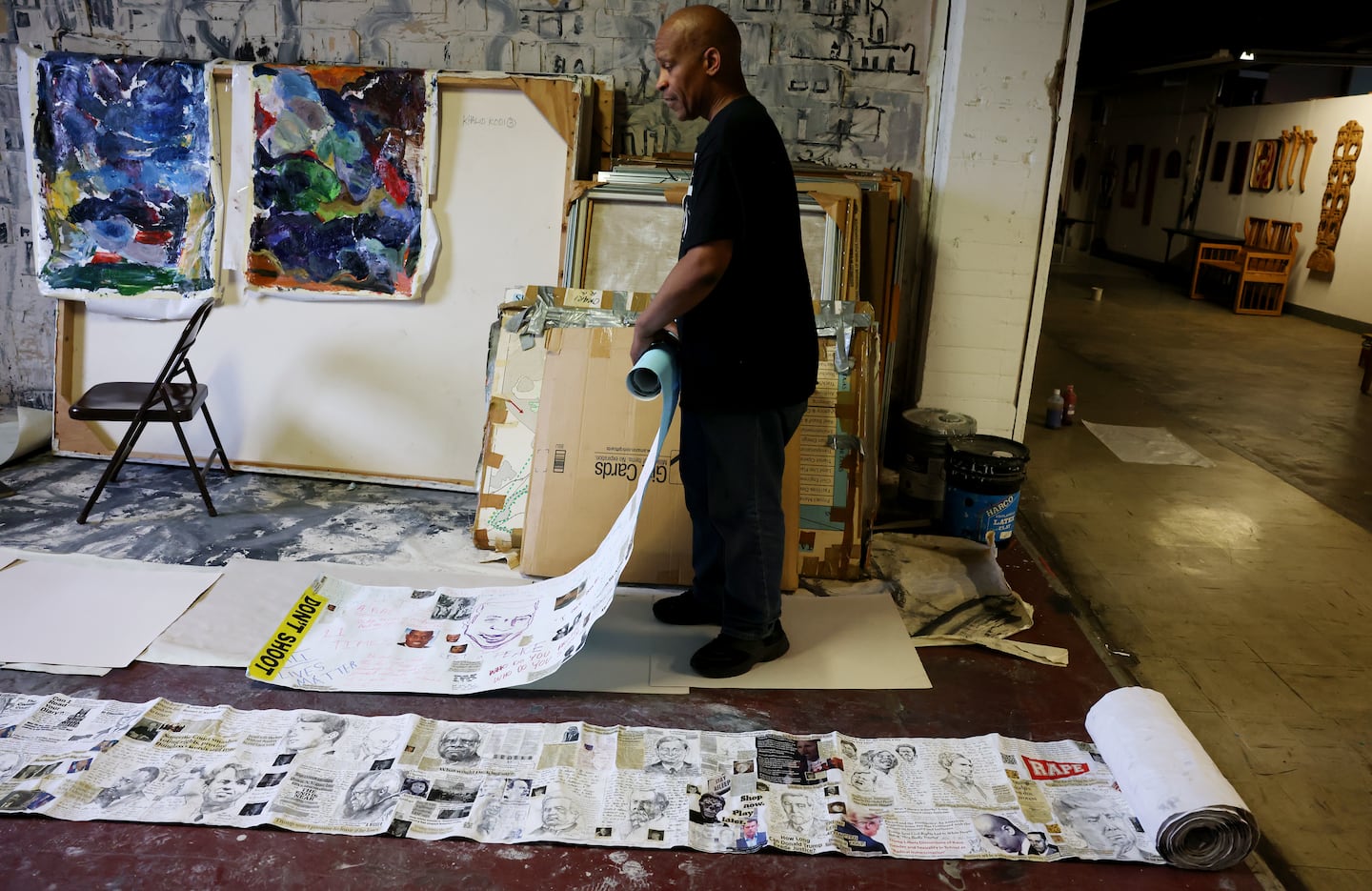 Shea Justice rolls up part of his “Scroll of Justice” in Jamaica Plain.Jessica Rinaldi/Globe Staff
And there is the catharsis. The scrolls’ profanity and unvarnished rage are very much at odds with the thoughtful, affable presence that Justice presents in person. He’s wry, forthright and charming, eloquent, and intimidatingly well-read; his work is where he allows himself to be his most raw.
The scrolls track back to Justice’s time as a student at Boston University in the late ’80s, when he ordered rolls of paper as stock art supplies that he never got around to using. Then Afghanistan happened, and the firehose of information began; he started compiling the torrent of the day-to-day in a linear fashion.
When he was a master’s student at the Art Institute of Boston in 2012, one of Justice’s professors urged him to make it his thesis project. Scroll #8 officially became that thesis, though it was neither its beginning nor its end. In a way, Justice has been creating the scrolls in his head since he was a child; growing up visiting his grandparents in Virginia, his grandfather was an antique dealer with a keen interest in politics. He remembers a glass case filled with generations’ worth of campaign buttons in the foyer. “That’s where I first heard about Spiro Agnew,” he said, “and learned how to pronounce Richard Milhouse Nixon.”
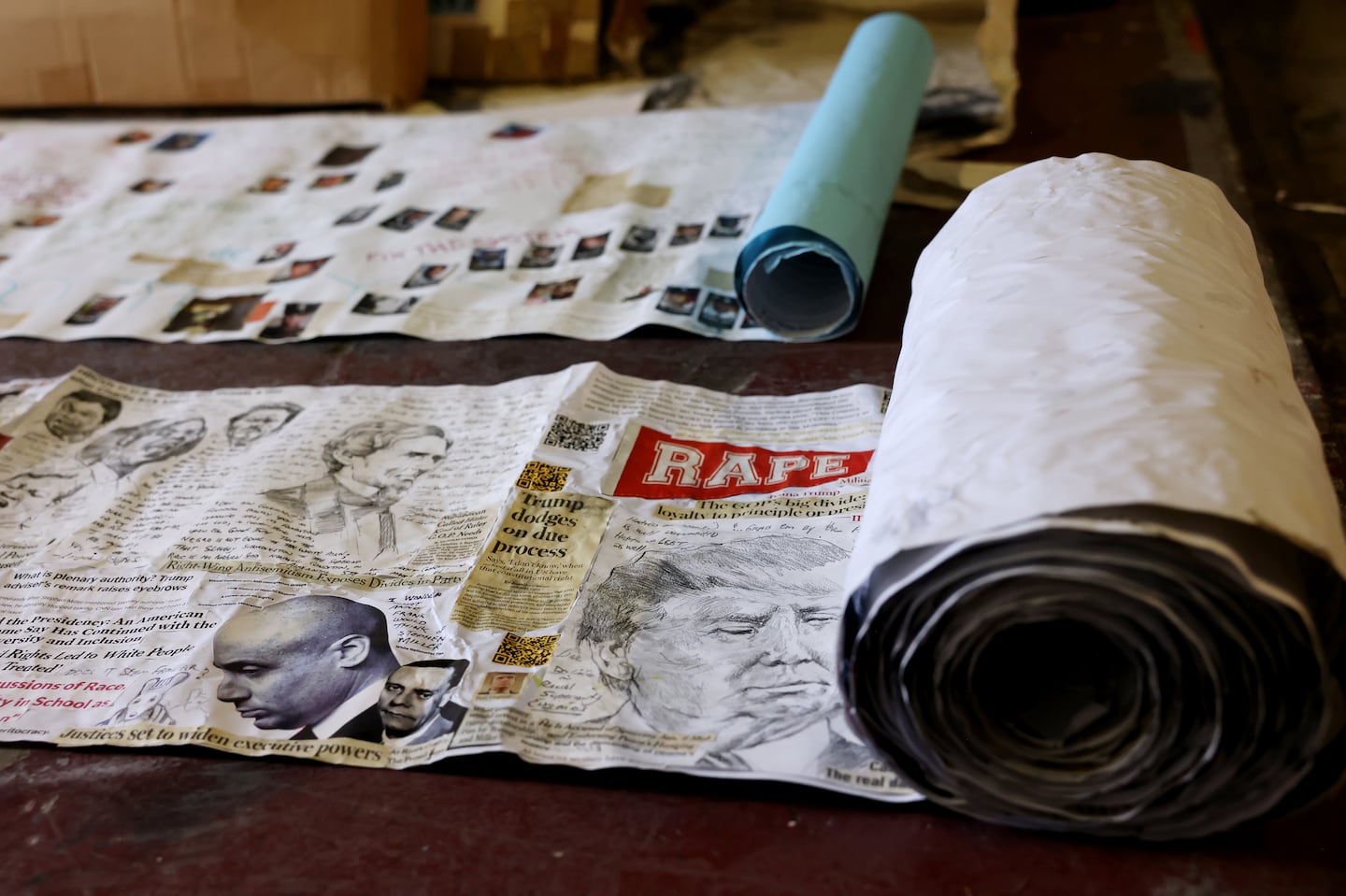 Shea Justice’s partly unrolled “Scroll of Justice.”Jessica Rinaldi/Globe Staff
Activist politics have informed both his art and his life. The scrolls are intense, plaintive, scornful; at the same time, they’re loyal to fact, distilling decades of news reports into information concentrate, heavy with Justice’s particular disdains. He expends reams on Trump-appointed Supreme Court justices Brett Kavanagh and Amy Coney Barrett; he draws them clearly, fairly, their likenesses even flattering. But he surrounds them with clippings that torque their viewing toward clear disfavor (“The Coming Coup” reads a headline pasted next to Barrett’s stoic likeness).
The scrolls also include moments of levity and distraction, some necessary sanity preservation (the Patriots and Red Sox roll in and out, on occasion; so do superheroes and professional wrestlers, a longtime Justice family fascination). But he strays rarely from his path of political indignation largely because there’s no want for material. In this apex moment of divisive fervor, the scrolls have untold chapters left to unfurl.
Murray Whyte can be reached at murray.whyte@globe.com. Follow him @TheMurrayWhyte.