
Mars was a rehearsal, not a destination. Here is what a spacecraft built for a metal asteroid came away with after aiming everything it had at the Red Planet.
Before you take a brand-new camera on the trip of a lifetime, you photograph the dog. The fence. The neighbor’s mailbox.

None of them matter. What matters is learning where the settings live before you are standing in front of the thing you flew all that way to see.
NASA just pulled off an enormous version of that. The practice subject was a planet.
Mars as a stunt double
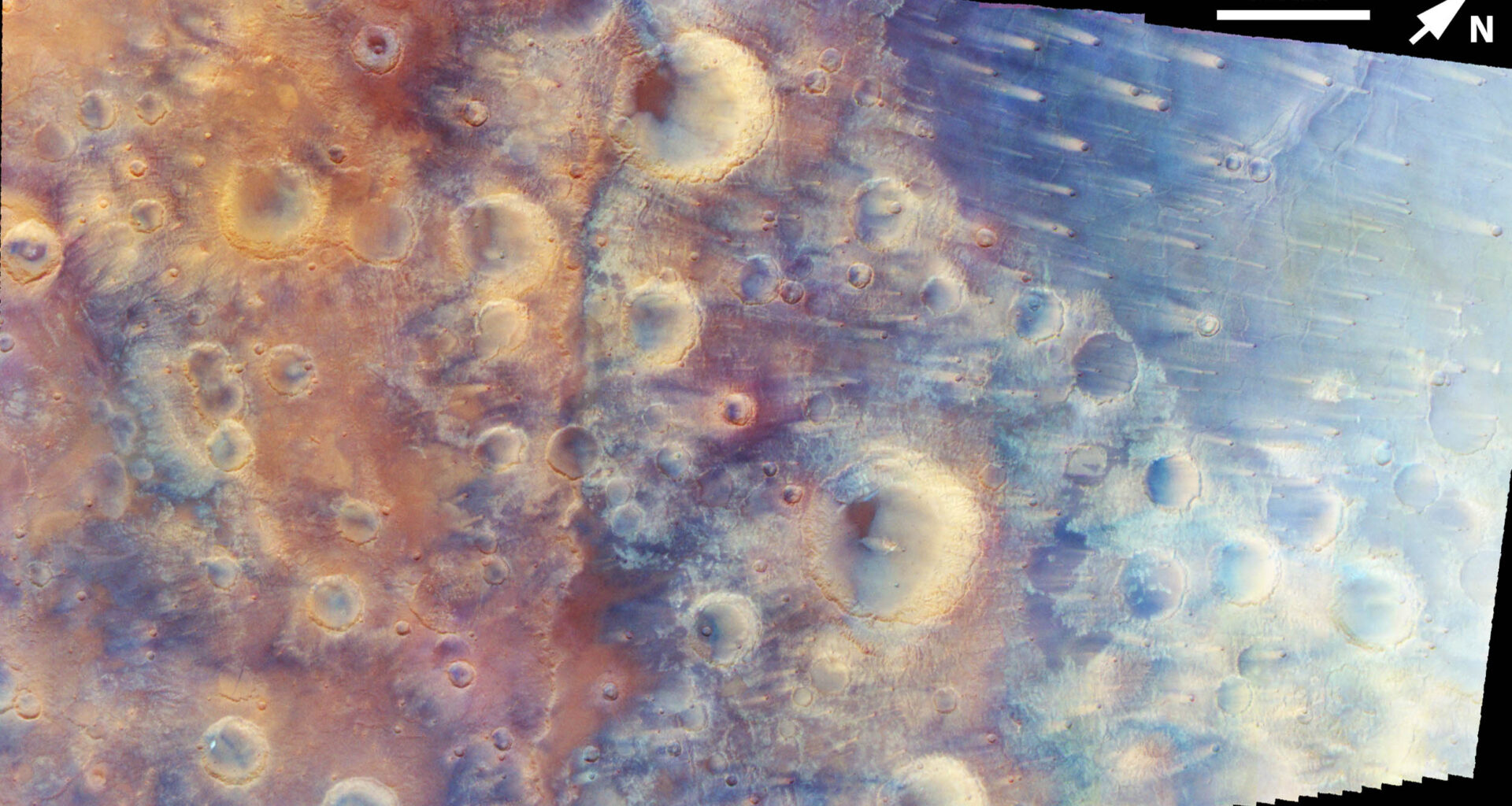
On May 15, NASA’s Psyche spacecraft swept past Mars at roughly 12,300 mph (about 19,800 km/h), closing to within 2,864 miles (4,609 kilometers) of the surface.
It was not there for Mars. It was there to steal speed.
A gravity assist bends a spacecraft’s path and adds velocity without burning a drop of fuel, and Mars did the heavy lifting.
Still, the team had a month of approach time and a planet filling the view. So they switched everything on.
“But if all our instruments are powered up, and we can do important testing and calibration of the science instruments, that would be the icing on the cake,” Lindy Elkins-Tanton said a week before closest approach. She leads the mission and directs the Space Sciences Laboratory at the University of California, Berkeley.
Worth being plain: none of this is a peer-reviewed study, and there is no paper behind it. It is instrument checkout data, downlinked in the weeks after the encounter and described in a July 17 release from NASA’s Jet Propulsion Laboratory.
Neutrons leaking off Mars
The gamma-ray and neutron spectrometer will eventually tell scientists which chemical elements sit on the asteroid’s surface. It works by eavesdropping on a collision.
Cosmic rays, the high-energy particles that pour in from deep space, hammer any world without much atmosphere to shield it. The surface soaks up that energy and throws part of it back as neutrons and gamma rays, and every element leaves a different fingerprint in what escapes.
Read the fingerprints, read the recipe.
From that distance, Mars was too far away for its gamma rays to register. Nobody expected them to. The neutrons were the real question mark.
They showed up. David Lawrence, who leads the spectrometer science at the Johns Hopkins Applied Physics Laboratory in Laurel, Maryland, said the count rate climbed near closest approach, close to what the team had predicted. “It was very gratifying to see,” he said.
A prediction that lands is not a discovery. It is better than that right now: proof the instrument will behave when the target counts.
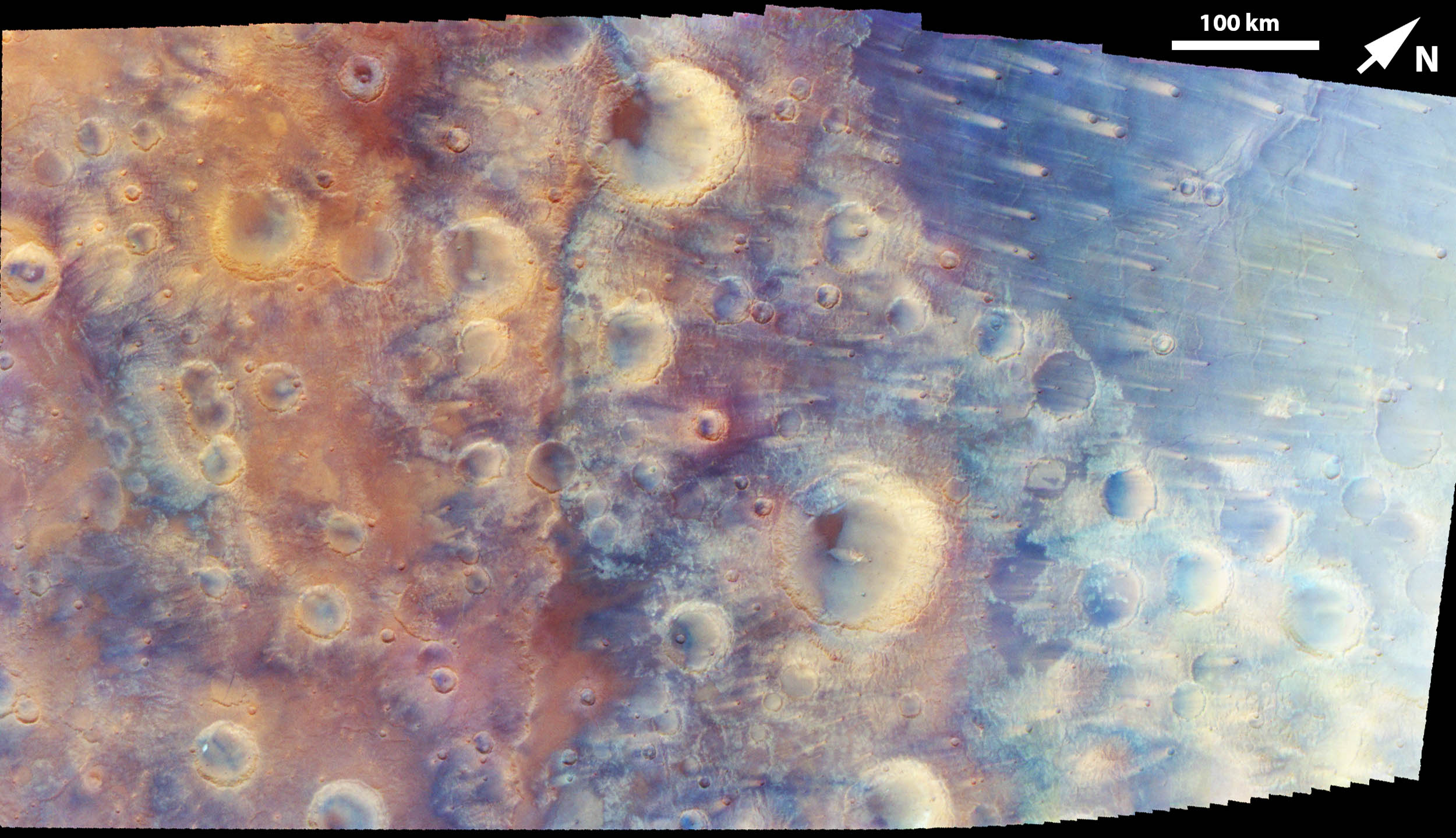 Enhanced-color view of cratered Martian terrain, reddish-brown fading into dusty blue, with pale streaks running across the blue ground. Credit: NASA. Click image to enlarge.Magnetometer meets its first planet
Here is the piece that is easy to skip past. Psyche launched in October 2023, and its magnetometer has run for most of the trip, measuring the magnetic field the solar wind drags along, including the occasional coronal mass ejection washing over the spacecraft.
In nearly three years of flight, though, it had never measured the magnetic field of an actual world. Mars was the first.
What it caught was the bow shock, the region where the fast-moving solar wind stacks up and slows against a planet’s magnetic resistance, the way water piles ahead of a boat.
And that is the strange part. Mars has very little resistance left to offer.
Its dynamo, the churning liquid metal in the deep interior that generates a global field, shut down billions of years ago. Mars once ran a field strong enough to leave a permanent imprint in its oldest rocks. What survives is that fossil record plus a weak field the solar wind induces as it streams past.
Ben Weiss, Psyche’s deputy principal investigator and magnetometry lead at MIT, said the pass proved out the instrument under fast-changing conditions while “revealing the fascinating physics of planetary magnetism.”
A world whose magnetic engine quit. Not a bad rehearsal for what is waiting at the asteroid.
Phobos and Deimos as practice
The multispectral imager is two identical cameras shooting through different filters, built to map the asteroid’s geology. Mars handed them a month of steadily closer targets.
Because of the angle the spacecraft came in at, the planet first appeared as a thin bright crescent, sunlight scattering through all that suspended dust. Then it filled the frame.
Close approach caught windblown craters, the south polar cap, which stretches more than 430 miles (700 kilometers) across, and the battered double ring of Huygens crater. NASA has stitched a month of those frames into a time-lapse of the entire encounter.
“The imager performed brilliantly, delivering some rarely seen views of the Red Planet,” said Jim Bell, the imager lead at Arizona State University in Tempe.
But the sneakiest test had nothing to do with the planet. From a long way out, the team picked Phobos and Deimos, the two small lumpy moons of Mars, out of the dark.
That was a drill. When Psyche arrives at its asteroid, the same cameras will sweep the surrounding space hunting for moonlets, and nobody knows whether there are any to find.
What is asteroid Psyche made of?
That question is the entire reason this spacecraft exists. Psyche the asteroid is unusually dense and unusually metallic, and the leading idea holds that it is the exposed nickel-iron core of a planetesimal, a failed building block of a rocky planet.
If that holds up, it is the closest look anyone will get at a planetary core. Nobody is drilling 1,800 miles down to Earth’s.
The idea may not survive contact. Psyche could instead be a consolidated metal-rich body, metal grains laced through rock, which would point to a very different history of heating and impacts. The uncertainty runs deep enough that people have spent years arguing over what the asteroid is even worth.
Settling that takes an orbiter parked there for years, not one fast pass.
The Mars data has limits worth naming too. JPL says the instruments added a few new insights about the planet without specifying what they were, so there is nothing yet for anyone to check.
Elkins-Tanton was blunter in July: the team was not anticipating big discoveries at a world already picked over by orbiters and rovers, including Perseverance, though Psyche’s odd vantage point added to the pile.
Summer 2029 rendezvous
Psyche is now pointed at the main asteroid belt. Bob Mase, the project manager at JPL, said the spacecraft flew exactly the trajectory the team needed to line up a rendezvous with the asteroid in the summer of 2029.
The spacecraft is healthy. Its solar-electric propulsion system, which sips xenon gas and builds speed slowly across years instead of in bursts, is set to resume sustained thrusting later this fall.
So the practice shots are filed, and every instrument came back working.
None of which reveals a thing about the asteroid. Psyche is still a smudge of light in a telescope, a shape astronomers have been guessing at since 1852.
The subject the camera was built for has not sat for its picture yet.
—–
Like what you read? Subscribe to our newsletter for engaging articles, exclusive content, and the latest updates.
Check us out on EarthSnap, a free app brought to you by Eric Ralls and Earth.com.
—–