
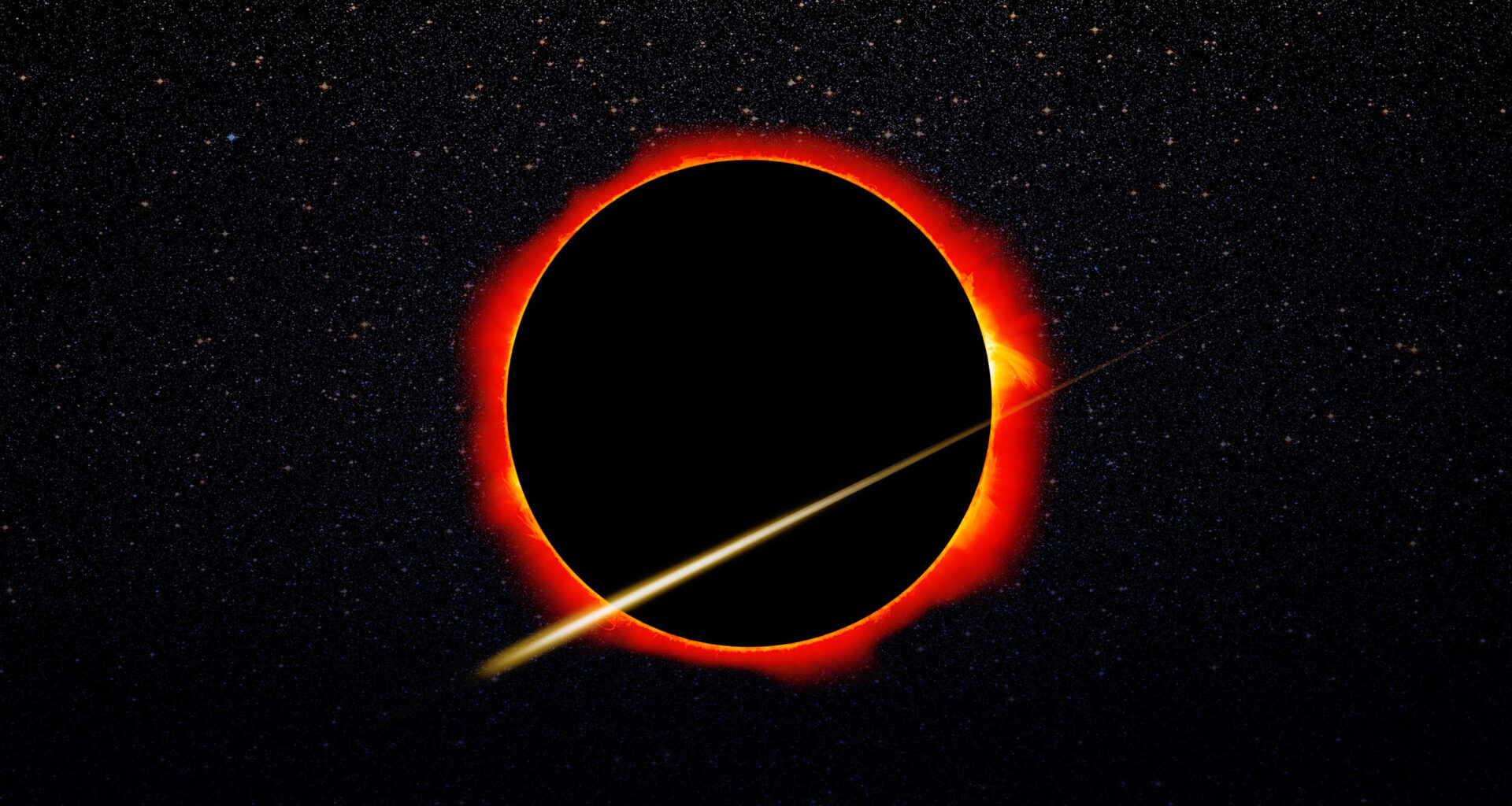
For about two minutes on the afternoon of Wednesday, August 12, the Moon’s shadow will sweep across the Denmark Strait between Greenland and Iceland, briefly plunging the Sun into darkness.
Moments later, the Moon itself will vanish.

A total solar eclipse can only occur during a new moon, when the Moon passes directly between Earth and the Sun with its sunlit side facing away from us.
So, every totality comes bundled with dark, moonless nights on either side of it.
This year, that bonus coincides with the Perseids, the northern summer’s most popular meteor shower, on a peak night skywatchers have anticipated for years.
Totality crosses several countries
The path of totality starts in far northern Siberia, close to the North Pole, then runs south through the Arctic and the North Atlantic.
The path crosses western Iceland, including Reykjavík, before reaching northern Spain – with a small corner of Portugal squeezed inside the band.
The Moon will be barely a day past its closest approach to Earth, so its disk looks big enough to cover the Sun outright instead of leaving a ring of light behind.
Your location determines how long totality lasts. Near the North Pole, totality lasts 1 minute 54 seconds. Along the Greenland coast, it stretches to 2 minutes 6 seconds.
The longest stretch anywhere, 2 minutes 18 seconds, falls over open water in the Denmark Strait, which is a cruel joke on anyone who wants to stand on solid ground.
In Reykjavík, the partial phase opens at 4:47 p.m. local time, and totality lasts from 5:48 to 5:49 p.m.
Spain’s first totality since 1905
Spain gets the finale, and it gets it low in the sky. Totality begins at 8:28 p.m. in León, 8:29 p.m. in Zaragoza, and 8:32 p.m. in Valencia – with the Sun just a few degrees above the western horizon.
This is a rare and beautiful way to experience an eclipse, with the Moon’s black disk hanging in a sunset-colored sky.
It is also mainland Spain’s first total solar eclipse since August 30, 1905, which is why eclipse chasers have been circling this date for a decade.
Position matters even inside the band. Observers near the centerline get up to 1 minute 50 seconds. Drift toward the edge and you get roughly 20 seconds.
Mid-August weather in inland northern Spain is generally favorable, but a clear sky is never guaranteed.
The shadow makes its last landfall over the Balearic Islands and leaves Earth at 18:34 universal time, right at sunset.
Partial eclipse over northern states
The United States will see only a modest partial eclipse, visible across the northern tier from Alaska to North Carolina, as well as across most of Canada.
Alaska gets the best view in the United States. The Moon covers 37 percent of the Sun over Fairbanks and 28 percent over Anchorage during the morning.
For the East Coast, it is more of a lunchtime curiosity. Bangor, Maine, gets the deepest view, with the Moon covering about 24 percent of the Sun around 1:53 p.m.
Boston reaches 16 percent, New York 9 percent, and Washington just 4 percent.
NASA’s eclipse guidance describes it as the Moon taking a small bite out of the solar disk, which is about right.
Near totality across Europe
Europe gets a different afternoon. London reaches 91 percent coverage and Dublin 94 percent in the early evening, while Madrid and Barcelona sit at 99 percent – just slightly outside the band.
Across much of mainland Europe and northwestern Africa, the Sun will set while still partly eclipsed, creating a flattened, bitten sunset worth stepping outside to see.
For most Americans, the daytime half of August 12 is a livestream. The event at home arrives after dark.
Perseids peak with no moonlight
The Perseids run from July 17 to August 24 this year and reach their peak on the night of August 12 into 13.
Earth is plowing through debris shed by comet 109P/Swift-Tuttle, and that night we pass nearest the dense core of the stream.
Swift-Tuttle is a monster as comets go. Its nucleus measures about 16 miles (26 kilometers) across, roughly twice the width of the asteroid tied to the dinosaurs’ extinction.
It is not coming for us. It last swung through the inner solar system in 1992 on a 133-year orbit, and its next visit is not due until 2125.
Grit from a monster comet
The rocks and dirt it sheds hits our atmosphere at 37 miles per second (59 kilometers per second), and that speed is why Perseids look the way they do.
They are bright, sometimes tinged with color, and prone to leaving glowing trains that hang in the air for a second after the meteor itself is gone.
Here is what makes 2026 different. Most Perseids are faint, and August moonlight often washes them out. This year, however, the Moon is new, leaving the sky as dark as it can be. The American Meteor Society rates viewing conditions as optimum.
From a rural site, expect 30 to 50 meteors an hour at maximum, and up to 100 under exceptionally dark skies.
The predicted peak instant is 14:53 universal time on August 13, so midnight to dawn on the 13th is your window.
Can Spain deliver both shows?
The best place to catch both the August 12 eclipse and the Perseid peak is northern Spain.
Totality sweeps through around 8:30 p.m., and the Sun sets soon afterward. By late evening, the sky has grown properly dark.
Meanwhile, the shower’s radiant, the point from which the meteors appear to stream, climbs the northeastern sky toward its highest point before dawn.
One patch of Spanish countryside covers both jobs.
Not dark enough in Iceland
Iceland is the harder bet. Reykjavík’s minute of totality happens in broad afternoon daylight. More importantly, at that latitude, a mid-August night never becomes fully dark. It only fades into a long twilight that hides the fainter meteors, even with no Moon in the sky.
Skywatchers will still pick up the bright ones and the occasional fireball – just not the full count.
The two events also run on completely different clocks. Totality is a stopwatch event that demands you stand inside a narrow band. The Perseids unfold over hours and reward anyone lying under a dark northern sky.
Treat them as two separate outings that happen to share a calendar square. And if you are inside the band, there’s a chance that a stray Perseid could slip past during totality itself.
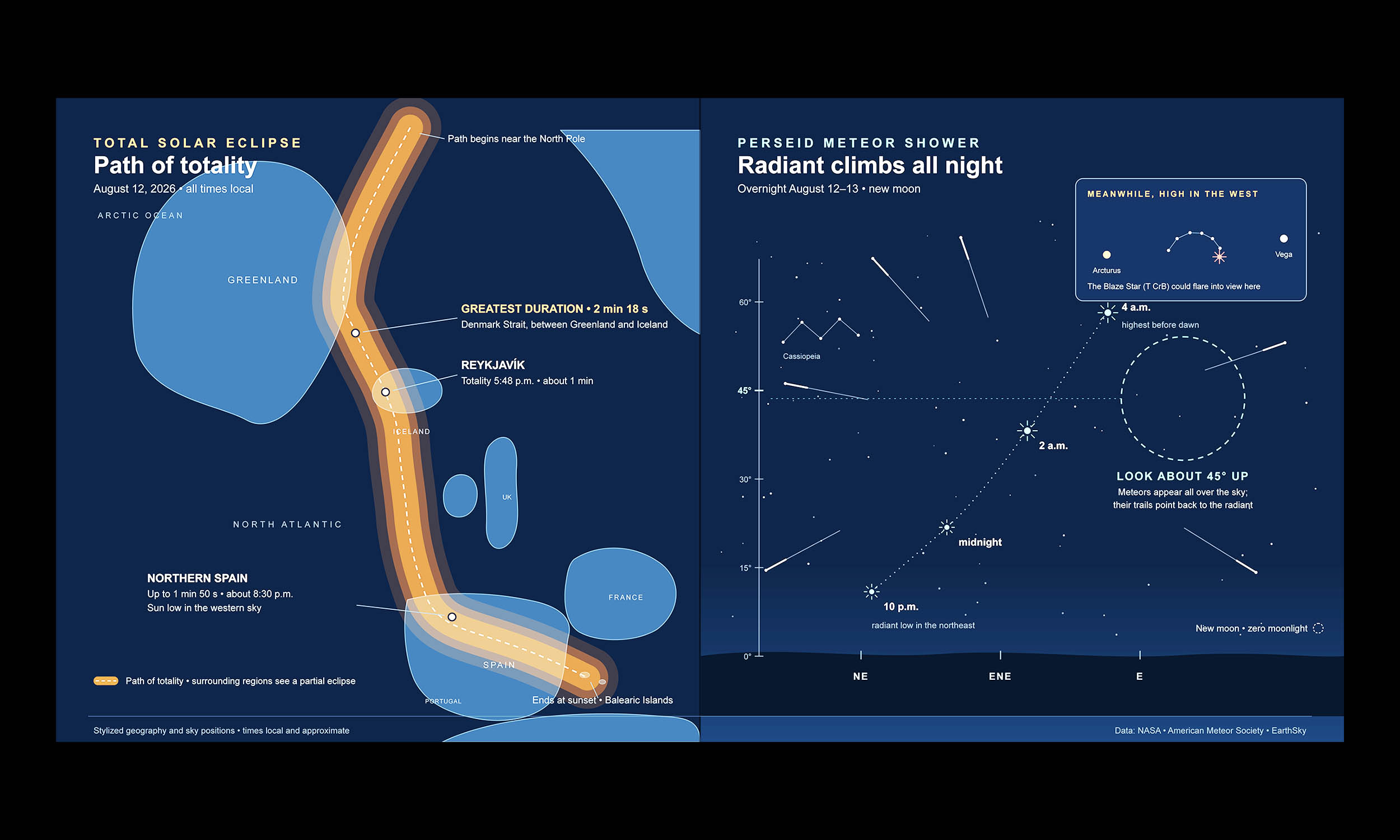 Left, the path of the August 12, 2026 total solar eclipse over Greenland, Iceland, and Spain with totality durations; right, where Perseid meteors will appear from late evening to dawn. Geography and sky positions are stylized. The radiant altitudes are drawn for mid-northern latitudes. Credit: NASA. Click image to enlarge.Eclipse glasses and a lawn chair
You need certified eclipse glasses that meet the ISO 12312-2 safety standard for every partial phase, whether you are in Spain, in Iceland, or watching that small bite over Maine.
Regular sunglasses are not safe, no matter how dark they look. Also, never aim a camera, telescope, or binoculars at the Sun while wearing eclipse glasses. The optics concentrate enough light to burn through the filter and injure your eyes.
The single exception comes during totality, when the Moon covers the Sun completely and bare eyes are safe for those few seconds. The instant the first sliver of Sun returns, the glasses go back on.
No glasses? Punch a pinhole in an index card and project the crescent Sun onto the pavement, or stand under a leafy tree and let the gaps in the canopy scatter dozens of tiny eclipses across the shade.
The meteors ask for nothing but darkness. Find a safe rural spot away from streetlights, because the darker your sky, the more meteors you will see.
Give your eyes a screen-free half hour to adjust and lie back with as much sky in view as you can manage.
Perseids sometimes show up as early as 10 p.m. The real show begins in the pre-dawn hours.
Blaze Star is overdue
Keep one more thing in the corner of your eye. T Coronae Borealis, nicknamed the Blaze Star, is a dim pair of stars about 3,000 light-years away that could flare into naked-eye view without warning. This only occurs roughly once every 80 years.
It is known as a recurrent nova. A white dwarf siphons gas off a companion red giant until the stolen fuel detonates on the dwarf’s surface, the star survives the blast, and the cycle starts over. The last eruption occurred on February 9, 1946.
Astronomers first expected the next eruption in 2024. Then, Jean Schneider of Paris Observatory argued in a 2024 paper published in Research Notes of the American Astronomical Society that the statistically most likely date June 25, 2026.
That day came and went, and the star remained quietly at about 10th magnitude.
Sky & Telescope points to February 8, 2027 as the next likely window. So, it may skip this year entirely.
Where the nova will appear
Just in case, the stage takes two minutes to learn: Corona Borealis, the Northern Crown, is a small semicircle of stars between orange Arcturus and blue-white Vega, right beside the Keystone of Hercules.
If the nova fires, it should shine about as bright as Alphecca, the crown’s brightest star, and you can track its brightness through the AAVSO in the meantime.
The smartest thing you can do on the night of the 12th is exactly what you had planned anyway. Lie down, look up, and enjoy the Perseids after the eclipse.
If T Coronae Borealis erupts that night, somebody will become the first person in 80 years to see it burst into view. It might as well be someone in a lawn chair.
—–
NASA Science, “Total Solar Eclipse on August 12, 2026“; American Meteor Society, Meteor Shower Calendar 2026–2027, EarthSky eclipse and Perseid guides, Sky & Telescope, “Waiting for the Blaze Star”
—–
Like what you read? Subscribe to our newsletter for engaging articles, exclusive content, and the latest updates.
Check us out on EarthSnap, a free app brought to you by Eric Ralls and Earth.com.
—–