
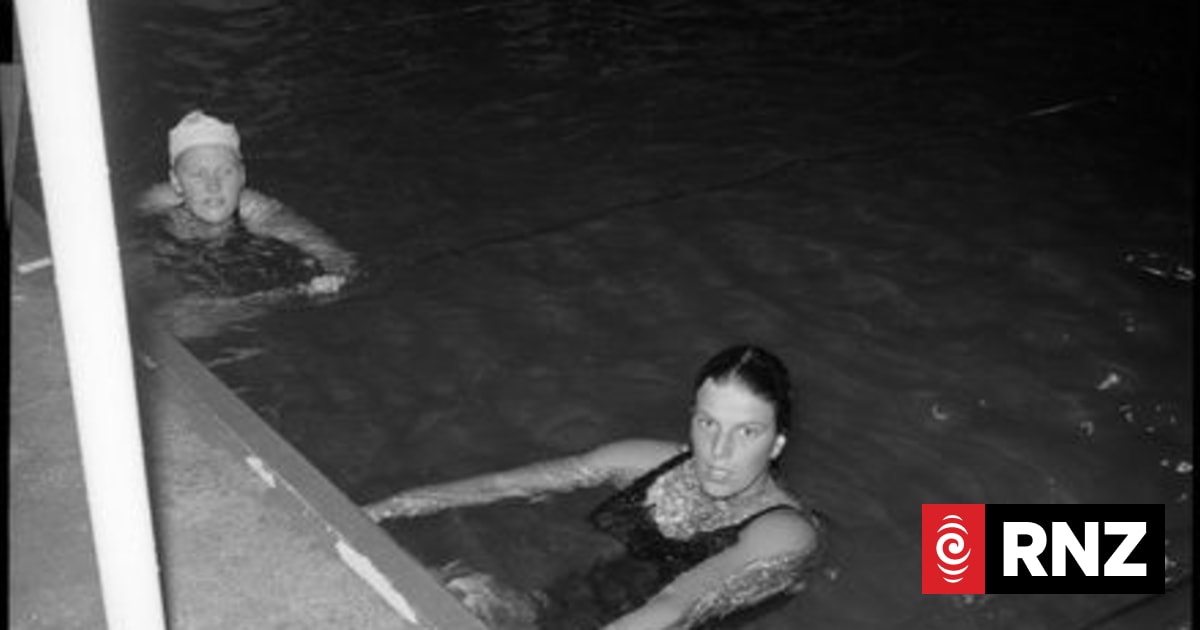
A New Zealand school girl was taking on the world’s best, and against the odds it seemed like she had won gold.
That school girl was Vivien Boyd – Vivien Haddon as she was then – and the finish in the 1962 Commonwealth Games 100-metre breaststroke swimming final in Perth was as close as it gets.
But what happened next still rankles, even after six decades.
Six decades on swimmer reflects on stolen win
Checkpoint
A split decision
Perth in 1962 seems like a lifetime ago.
It was a new world for Vivien Boyd – a long way from Palmerston North’s Freyberg High School, where she was a student, and the city’s outdoor municipal baths, in which she trained.
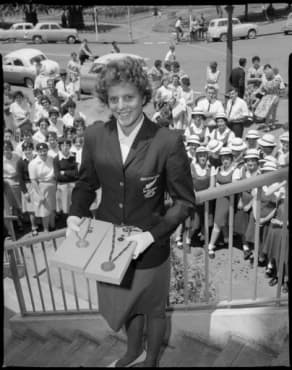
Vivien Boyd showed off her 1962 games medals at a civic reception in Palmerston North.
Manawatū Standard Archive / Manawatū Heritage
Although it was not quite straight out of the classroom into the swimming pool. The swimmers trained in Tauranga ahead of the games, so Boyd did her school studies from there.
She loved the sprint races, as her speed and grit powered her on.
But she was up against quality swimmers, including Olympic medalist Anita Lonsbrough.
In the 200-metre breaststroke, Vivien won bronze.
“And then I swam the 100m against her and was awarded the silver medal, unfortunately, for me,” Boyd told RNZ from her Brisbane home. She has lived in Australia for more than 40 years.
“But anyway, that was the way it was. The judges couldn’t make up their mind who won. They took half an hour to make up their mind.
“It was a bit of a controversy because everybody thought I had won.”
Boyd said footage from the race showed she was home first, not Lonsbrough.
Timekeeping technology was in use, but it was only on trial so could not decide the official result.
“I’ve read that it gave me four hundredths or two hundredths, whichever, you can pick whichever one you like but, yes, I did win it…
“Two judges awarded me the win. Two judges gave Anita Lonsbrough the win. The final judge couldn’t make up his mind.
“He took half an hour to make a decision, so he went with the Olympic champion.”
Boyd said Lonsbrough showed her experience too, by celebrating when she hit the end of the pool. Boyd finished the race quietly.
The agonising half-hour wait for the result was spent chatting with Australian swimming legend Dawn Fraser.
“She sat with me because I knew her and was telling me to take a loss.
“I was absolutely fine because I had only just turned 17 and it was my first big international meet.
“I’d only been swimming breaststroke for about 18 months, so I was happy to get anything,” Boyd said.
“I think they actually only had a certain amount of gold medals and they didn’t have any spares. That’s my theory.”
Keys to the city
Looking back, Boyd said a shared gold medal would have been fair, and she was disappointed New Zealand officials did not protest on her behalf.

Vivien Boyd moved to Australia more than 40 years ago, but regularly returns to New Zealand.
Supplied
On her return to Palmerston North she was feted, although she said she did not like attention and did not deal with it well.
“I never like to be noticed very much. You’d pick up the paper every morning and your name’s front page and photo’s front page, because it was such a big thing back then. It did attract a lot of attention in Palmerston North,” she said.
“I can remember standing there in the middle of The Square, under the new clock tower, and people standing around and the mayor handing me the keys of the city, which I still have.”
Boyd regularly returns to New Zealand, and in the late 1990s Palmerston North tried to put right the unfair result from Perth, as former city council public affairs manager Malcolm Hopwood remembers.
“I got the guys at the council to build and design a dinner plate version of the gold medal that she should have won back in 1962,” he said.
“She came back for the opening of the covered pool at Freyberg High School. She swam a length and I presented the gold medal to her – our gold medal tour on behalf of the city.”
In 1966 in Jamaica Boyd won bronze again in the 200-metre breaststroke, before retiring. She had also competed at the 1964 Olympics.
She made a comeback in the early 1970s and won national titles, but that was it for big competitions.
Limited training to take on the world
Boyd’s from a sporty family – one brother Gerald Haddon was a squash champion and first-class cricketer, and other brother Malcolm Haddon a national title-winning sailor.
Boyd’s youngest son Sean Boyd continued that tradition, representing Australia at water polo during the Sydney Olympics in 2000. Boyd fondly remembers watching on.
Now, she can look back on her own achievements with fondness too. She’s also looking forward to getting back into the pool again after a knee injury.
“I’m pretty happy with what I achieved. I was a very active, sporty person,” she said.
The way she trained would be impossible to imagine now.
“I used to swim three months a year and was expected to go to the Olympics on three months of training. The other side of the world – they just swim all year and have competitions in Europe all the time.
“Things have changed and it’s so much more competitive and better for the kids today. They just have it all.
“They wouldn’t have dived into the water in the morning when it had those little black swimming beetles and things in the pool. And the temperature of the water was probably about 12 or 15 degrees.”
Times have changed for the Commonwealth Games too – they are no longer the patriotic celebration of empire seen in Perth.
They were still important though, Boyd said.
“The Commonwealth Games were a wonderful thing.
“A lot of people want to say they’re not valid now, but I believe they are because they bring the Commonwealth together.
“They bring all those swimmers that haven’t had the chance at big competitions to have that experience. I just think it’s an amazing.
“I’d hate to see it not happening.”
Before this year’s games, New Zealand had won 179 gold medals dating back to 1930. For Boyd, that tally is one less than it should be.