
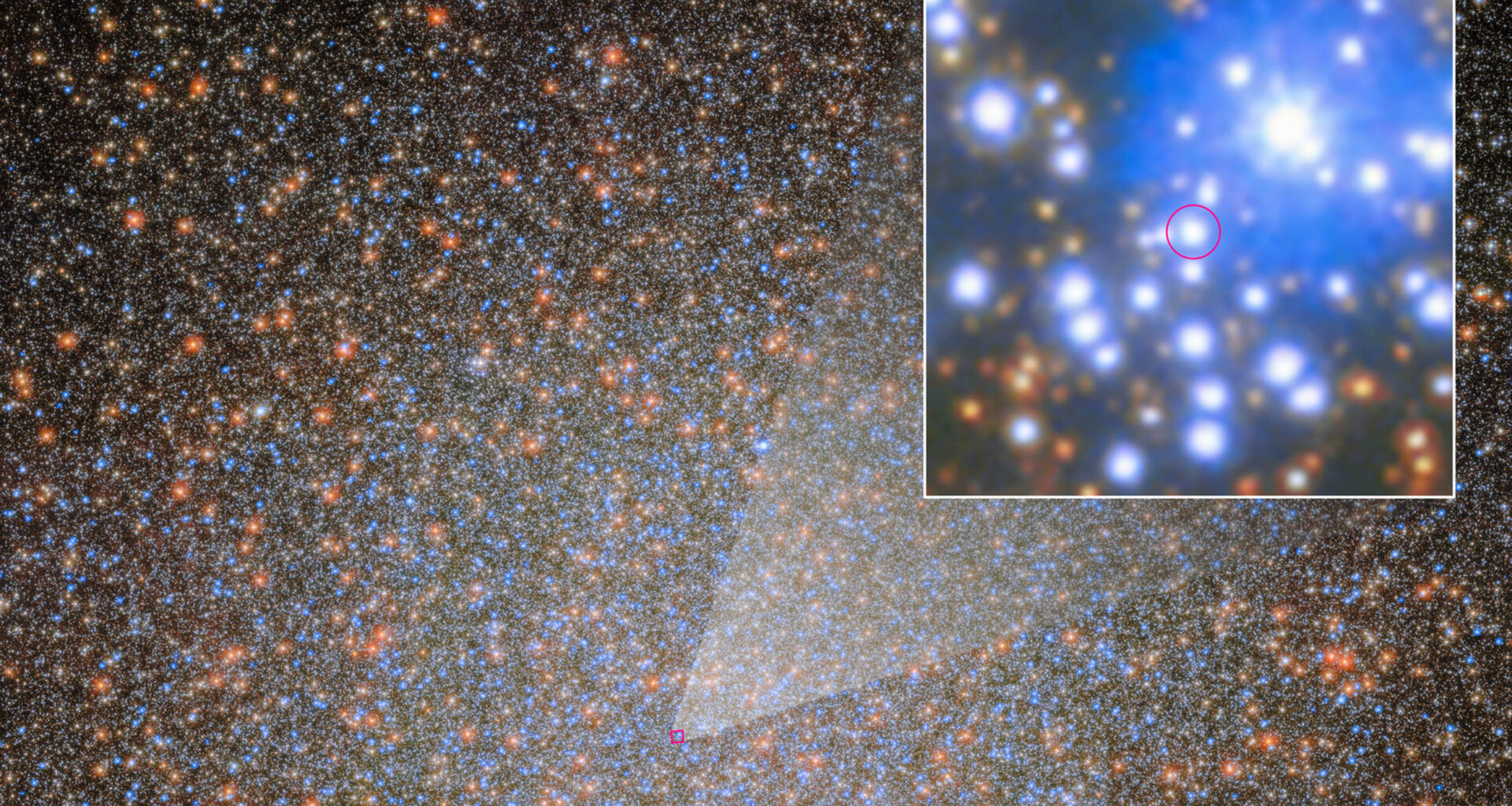
Astronomers have long known that something was missing from Omega Centauri.
Omega Centauri is one of the largest globular clusters in the Milky Way, expected to contain hundreds, if not thousands, of black holes.

Computer models predicted thousands of them. Yet when scientists searched, they found almost nothing. Scientists may now be closer to solving that mystery.
Using more than 20 years of data tracking the motion of a single star, scientists discovered the first known black hole within the Omega Centauri Cluster.
The discovery not only fills a missing piece of the cluster’s story but also gives scientists fresh clues about how black holes form and survive in crowded groups of stars.
A crowded cluster
Omega Centauri sits about 18,000 light-years from Earth and contains roughly 10 million stars held together by gravity.
It has long fascinated astronomers because it is much bigger and more complex than a typical globular cluster.
Some researchers even think it could be the leftover core of a small galaxy that was absorbed by the Milky Way billions of years ago.
Scientists had already found evidence that an intermediate-mass black hole might exist near the cluster’s center.
Even so, computer models suggested Omega Centauri should also contain around 10,000 smaller stellar-mass black holes.
Those expected objects stayed hidden despite years of searches using techniques that looked for radio waves, X-rays, or tiny changes in the motion of nearby stars.
How to find the invisible
This time, researchers tried something else. They relied on astrometry, a method that measures incredibly small changes in a star’s position over time.
Instead of looking for light coming from a black hole, they searched for the gravitational pull it exerts on a nearby star.
They examined more than 20 years of archived observations from NASA’s Hubble Space Telescope and combined them with newer data from NASA’s James Webb Space Telescope.
They found a star orbiting an unseen companion that could only be a black hole.
Some surprising features
The newly identified black hole has been named oMEGACat BH-2. First, it has a lower mass than scientists expected for a black hole formed in an environment like Omega Centauri.
Second, it forms a binary system with the longest orbital period ever measured between a black hole and its companion star.
“With Hubble and Webb data, we were able to see the motion of the visible main sequence star that is part of this binary, which is about 18,000 light-years away in the dense environment of Omega Centauri,” said Matthew Whitaker of the University of Utah.
“The precision of these measurements is incredible, down to a fraction of a pixel on Hubble and Webb’s detectors. It would not have been possible to find this black hole without these two space telescopes.”
Ruling out a neutron star
Earlier work by another research group had suggested the unseen object might be a neutron star, which is the dense leftover core of a collapsed massive star.
The new analysis included Hubble observations collected between 2002 and 2023, along with Webb’s near-infrared measurements.
This allowed scientists to determine the companion’s mass much more accurately.
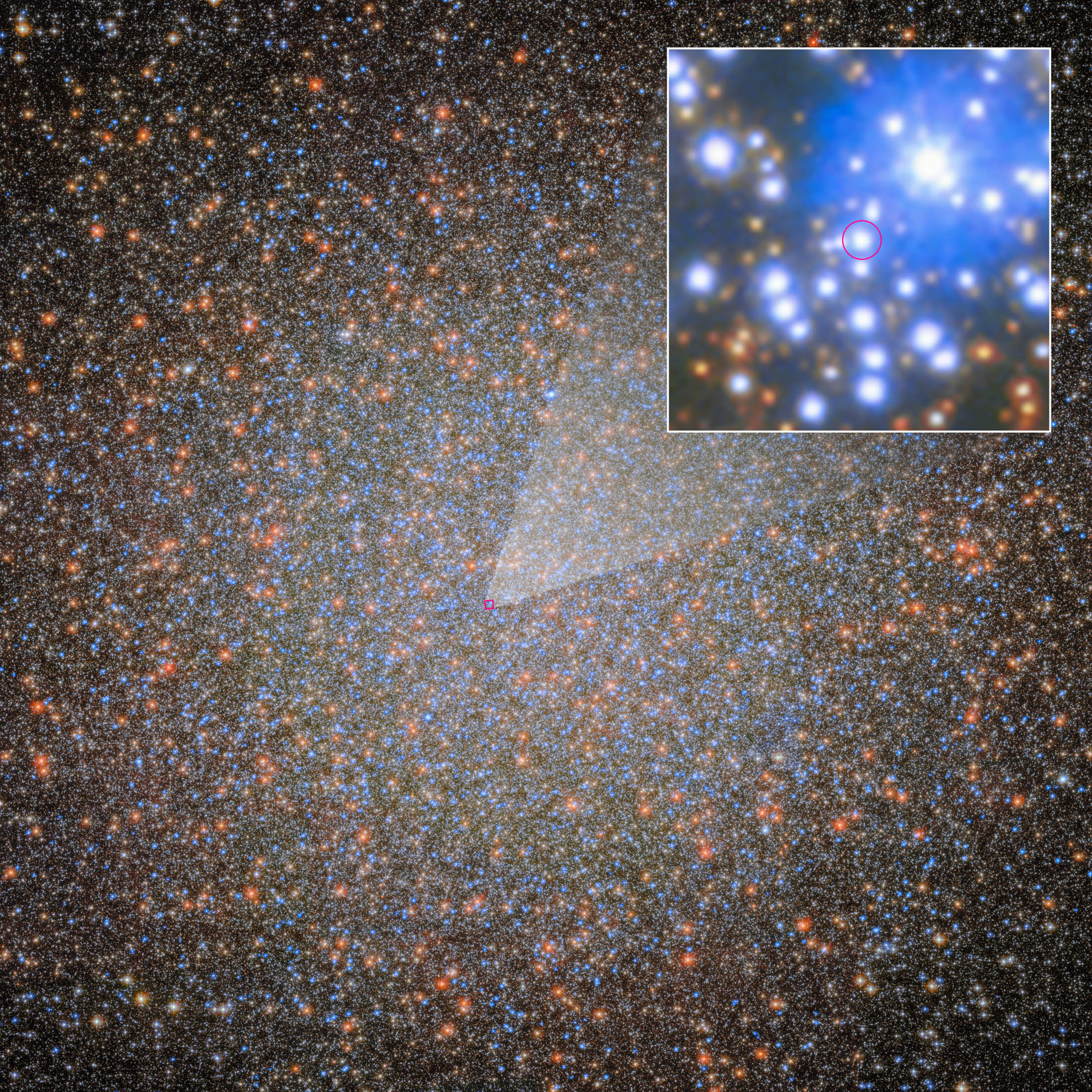 Omega Centauri’s first stellar-mass black hole has a visible star companion that is shown in greater detail. They used 20-plus years of data from NASA’s Hubble and recent data from Webb Telescope to make the discovery. Credit: ESA, NASA, Maximilian Häberle (MPIA), Joseph DePasquale (STScI). Click image to enlarge.A new mystery to solve
“While we already knew that the star was 0.78 solar masses, we can now calculate the black hole’s mass, which is 4.46 solar masses and therefore too heavy to be a neutron star. However, its mass is much lower than would be expected in a metal-poor environment like Omega Centauri. This is surprising and exciting,” said Anil Seth of the University of Utah.
“We now know that a metal-poor star is able to form a black hole like this, and we need to figure out how that happens. This detection is providing some data to those who do that kind of modeling.”
The discovery suggests scientists still have more to learn about how stars with very low amounts of heavy elements collapse into black holes.
A record-breaking orbit
The researchers found that the star circles oMEGACat BH-2 once every 94 years. That is the longest orbital period ever recorded for a black hole binary system.
The unusually wide orbit hints that the pair probably did not form together. Instead, the black hole and the star likely met after each had already formed inside the crowded cluster.
Calculations suggest the system will survive for less than a billion years before close encounters with neighboring stars pull it apart. Omega Centauri is about 12 billion years old.
Cosmic collisions in space
Black holes inside globular clusters are more than scientific curiosities. They can interact with one another, form binary systems, and sometimes merge.
Those violent mergers produce gravitational waves, ripples in space-time first detected in 2015, giving astronomers an entirely new way to study the universe.
“It’s important to understand black hole populations in globular clusters because there’s uncertainty about their physics and formation,” said Seth.
“More specifically, understanding the process of forming black holes and then dynamically forming binaries is vital, because it affects our ability to interpret and understand gravitational wave events.”
“Environments like Omega Centauri are the primary places where we think binaries are merging and creating these waves.”
Only the beginning
Finding one hidden black hole suggests many more may still be hiding inside Omega Centauri and other globular clusters.
The same techniques that uncovered oMEGACat BH-2 could help reveal a population that has remained out of reach for decades.
“With Hubble and Webb, we can continue to look at Omega Centauri and expand our search for similar systems within other clusters,” said Whitaker.
“We’re also very excited for the launch of NASA’s Nancy Grace Roman Space Telescope because it will image the crowded galactic bulge, including the galactic center, very regularly with Hubble-like resolution and with a much wider field of view.”
“We’re hoping we’ll be able to find black hole binary systems like this one because of the regular cadence of Roman’s observations.”
This study was published in IOPScience.
—–
Like what you read? Subscribe to our newsletter for engaging articles, exclusive content, and the latest updates.
Check us out on EarthSnap, a free app brought to you by Eric Ralls and Earth.com.
—–