
Agency
27/07/2026
581 views
1 likes
With a passion for both space systems engineering and emerging technologies, Ilja Skrypnyk’s journey at the European Space Agency showcases the breadth of opportunities offered through the Junior Professional (JP) Programme. In this interview, Ilja shares how the JP experience allowed him to explore multiple domains, build a strong international network and grow both professionally and personally while contributing to ESA’s mission. If you’re looking to combine technical excellence with real impact in a dynamic international environment, the ESA Junior Professional Programme is a unique opportunity to launch your career – and there’s just one day left to apply!
What was your educational and professional background before joining the JP Programme?
I studied Aerospace Engineering for my Master’s at the Technische Universität Berlin, focusing on a broad understanding of all things space, which is a pretty good background for systems engineering activities. I also had the pleasure of doing some hands-on work during my studies on several CubeSat missions at a startup, and in general my university had a big focus on project work and practical experience, which I think was quite useful to see beyond academic problems and learn how to solve “real problems”.
After graduation, I used this background to first work as a trainee at the Concurrent Design Facility (CDF) in ESTEC, after which I went back to TU Berlin as a lecturer at the Chair of Space Technology. The lecturing ended up being a bit of a “secret hack” since it really lends itself well to good communication and presentation skills, and overall teaching is actually a phenomenal way to learn. I think all those things just gave me the right profile to come back to ESA as a JP, and it’s been a pleasure and an honour to have been selected and to have come back.
Can you describe your role as a Junior Professional at ESA and the main projects you worked on?
Being in the Directorate of Technology, Engineering and Quality, our responsibility is to support the rest of the agency in many different ways. For example, I’ve worked at the CDF once again for a few years, facilitating early design studies like supporting the Enceladus and Titan Definition Study, where I investigated the power and mechanical aspects of a lander probe. In this job, I also supported some projects and contracts with industry, for example we had a series of contracts in Czechia, directly supporting the Czech delegation in several mission studies and selecting the most promising candidates. That job really was a pleasure, being in direct contact with industry, meeting people face to face and just cooperating to achieve the best possible mission.
After a few years at the CDF, I moved to the AI & Data Science Team as part of an internal reorganisation. When I was choosing what to study, I was quite indecisive between computer science and engineering. Engineering won, but switching to this new team was a bit like trying out this other passion that was laying dormant all these years. It’s truly incredible just how much we do at the agency, and that there are all these opportunities to work on so many facets of space. Since joining this new team (and spending a lot of time learning new technologies and skills), I have been working on several proof-of-concept prototype software using Large Language Models that directly support the work we do inside the agency.
Something that has been consistent since I’ve started, though, is that I have continued teaching! I deliver both internal training courses to my colleagues and courses to students at ESA Academy. I find this really rewarding, as it always gives you a bit of a “reflection point” to realise just how much you yourself have grown, and teaching gives immediate positive feedback when you can make a positive impact on someone’s knowledge and career.
What was the most exciting or rewarding part of your work during the programme?
Honestly, it’s just the pride I feel for being part of this international endeavour. My university professor would always say that even when the world was experiencing a lot of tension, space was the one place where we would cooperate and collectively dream of what could be. I feel that every day I am at work, starting with seeing the flags of our Member States by the gatehouse, but also by cooperating with so many different people from so many different places. To me that feels most rewarding, being able to add myself to this collective of such talented and passionate individuals. Everyone at ESA is so nice and loves their work so much – it’s almost impossible to resist being swept up by this enthusiasm.
How did being part of the JP Programme help you grow professionally and personally?
The JP Programme is a bit of a “best of both worlds” programme: on one side, you are a full employee, doing meaningful and real tasks, delivering real value and making an actual contribution; but on the other hand, it is understood that you are junior and that gives you a bit of a cushion to learn and make mistakes. So throughout the JP Programme, I’ve done more things than I can list here, and every step along the way I have learned things from communicating more effectively with colleagues, cooperating more effectively with our industrial partners, as well as all sorts of technical skills. Probably the thing that stands out to me the most, however, is the absurdly large network I have been able to build over the years. Again, the agency is so full of passionate and competent people, so whenever one has a question, it is easy to find someone who is excited to share and teach, and I’ve found that incredibly useful for all the things I have been working on.
What kind of mobility, training and development opportunities did you take advantage of during the programme?
Besides the extensive internal training catalogue and one-on-one meetings with colleagues where I could ask all sorts of questions, the biggest element of mobility and development was for sure the rotation as part of the JP Programme. I went to ESRIN, our facility in Frascati, close to Rome. This is where I was able to start really experimenting with artificial intelligence for data science and natural language processing. Once again, this was also an opportunity to meet many new people and learn new skills. I can hardly imagine any other employer or programme where the organisation would invest this much in their workforce.
What was it like working with experts in your field and being part of an international team at ESA?
Everyone works a bit differently, and it helps being able to distinguish differences in communication between different cultures. This can be daunting at times, and sometimes misunderstandings can happen, but once again almost everyone I have met at ESA is just primarily enthusiastic, and you can kind of bond over that. You end up learning how everyone else communicates and create a kind of “international culture” that includes elements from everyone. It is difficult to describe, but to summarise it briefly: it is fun, you learn a lot, and the international culture is very welcoming and inviting.
What has been your most memorable experience at ESA so far?
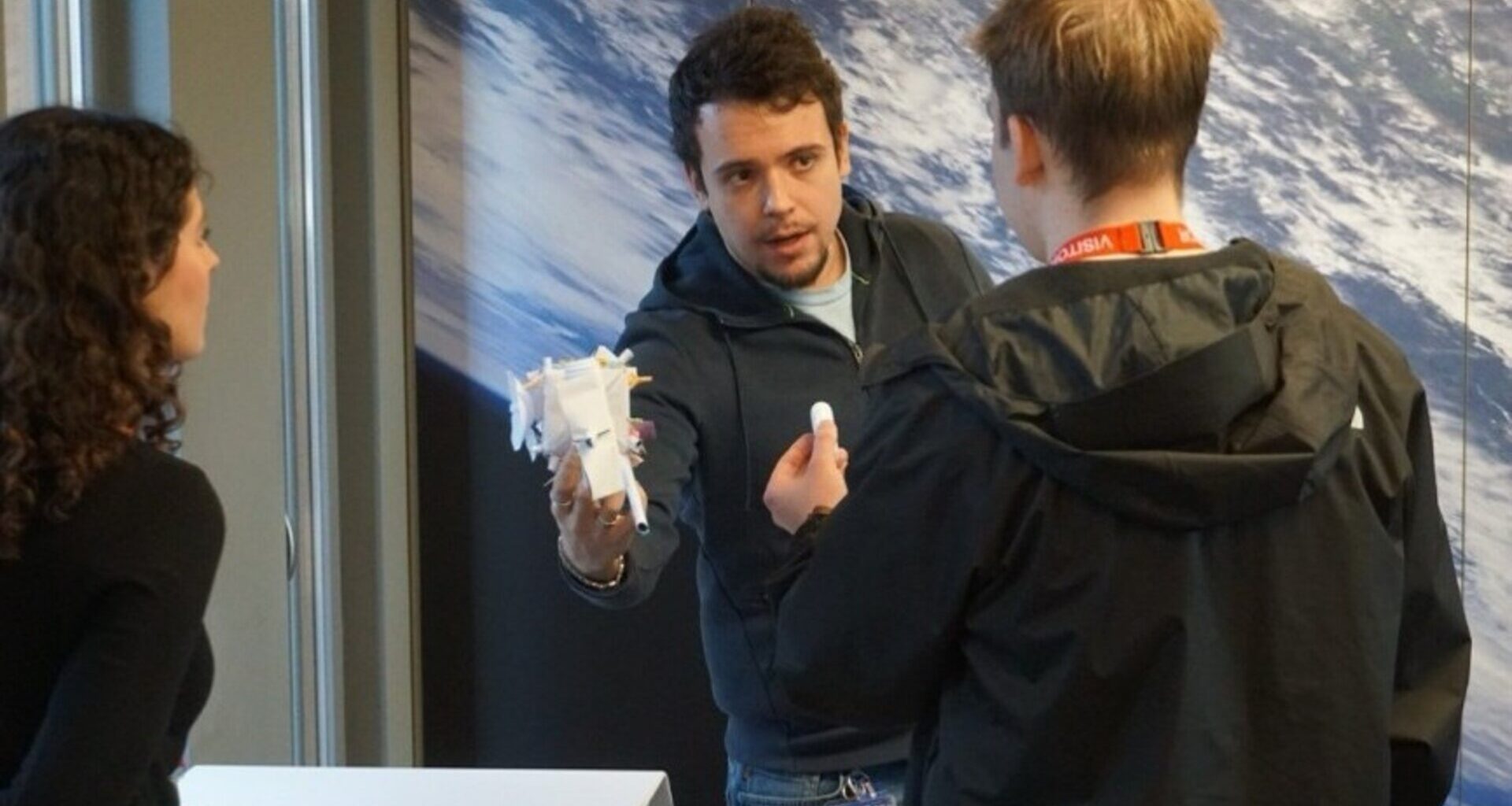
Outside of work, I enjoy playing videogames. I find them a fascinating medium with a lot of potential for storytelling and art, just like theatre, movies or books are interesting mediums. In 2023 I was able to support the Talent Acquisition team in representing ESA at Gamescom in Cologne, which is the largest video-game focused convention in the world. It was a surreal experience, being able to bring my two passions together. Working this career booth has been one of the most memorable and enjoyable moments of my career. Once the doors to the convention opened, we basically had nonstop visitors to the booth until they closed. People were so curious, and you could see in so many of them how cool they thought we and our jobs were. That really leaves a mark on you, when you meet so many people who feel this way about you and your employer. Since we are tax funded, we have a responsibility to our Member States and their citizens to do good and deliver – and meeting all these people face to face was just a strong reminder of all the good that we do and all the good that we can do. Being able to represent the agency in this capacity was such an incredible honour – I am very thankful I was allowed to do this, and despite how exhausting it was I would do it again in a heartbeat.
How do you feel the programme prepared you for the next steps in your career at ESA?
I would say the rotation and switching teams as part of our internal reorganisation gave me such an incredibly large network and taught me so many skills – but most importantly it showed me just how much is possible within ESA when you bring the right ideas and tap into your network.
Switching from space systems engineering to AI & data science has also allowed me to bridge these two fields, and my goal is to focus more and more on supporting all of my colleagues in space engineering and related roles by applying my newfound AI & data science skills for both internal trainings and tools that I can provide. Without all the opportunities and learning facilitated by the JP Programme, I am not sure it would have manifested quite as easily and quite so effectively. Who knows what the future will bring, but I feel well equipped to handle whatever comes next, and I know that I will be able to capitalise on opportunities and meet any challenge that comes.
What advice would you give to someone considering applying for the JP Programme?
Do it, absolutely do it. This is one of the best employers in Europe, in my opinion, and the JP Programme is a phenomenal programme that helps you get onboarded at the agency, learn a bunch of new skills and work on exciting projects that have a real, meaningful impact for Europe and the world at large.
If you had to describe the ESA Junior Professional experience in three words, what would they be?
Amazing people & projects
Ready to step into the space sector?
The ESA Junior Professional Programme offers a unique opportunity to launch your career at the heart of Europe’s space activities, working alongside leading experts, contributing to real missions and building a strong international network. Whether your passion lies in engineering, science or beyond, ESA provides a dynamic environment where you can grow, learn and make a tangible impact. Don’t miss the chance to be part of something bigger.
Apply to the JP Programme or explore the wide range of opportunities ESA has to offer.
Like