
Earth’s earliest history has largely been erased by plate tectonics and erosion, but Mars has kept some of it intact.
Researchers have found evidence that rocks around Jezero Crater preserve signs of asteroid impacts dating back more than 3.9 billion years.

NASA’s Perseverance rover discovered the evidence while exploring the edge of Jezero Crater, a place that has already attracted attention for signs that it once held a lake.
This latest finding reaches even farther back in time. The rocks being studied formed before the crater itself existed, making them some of the oldest terrain ever examined by a Mars rover.
From the dawn of Mars
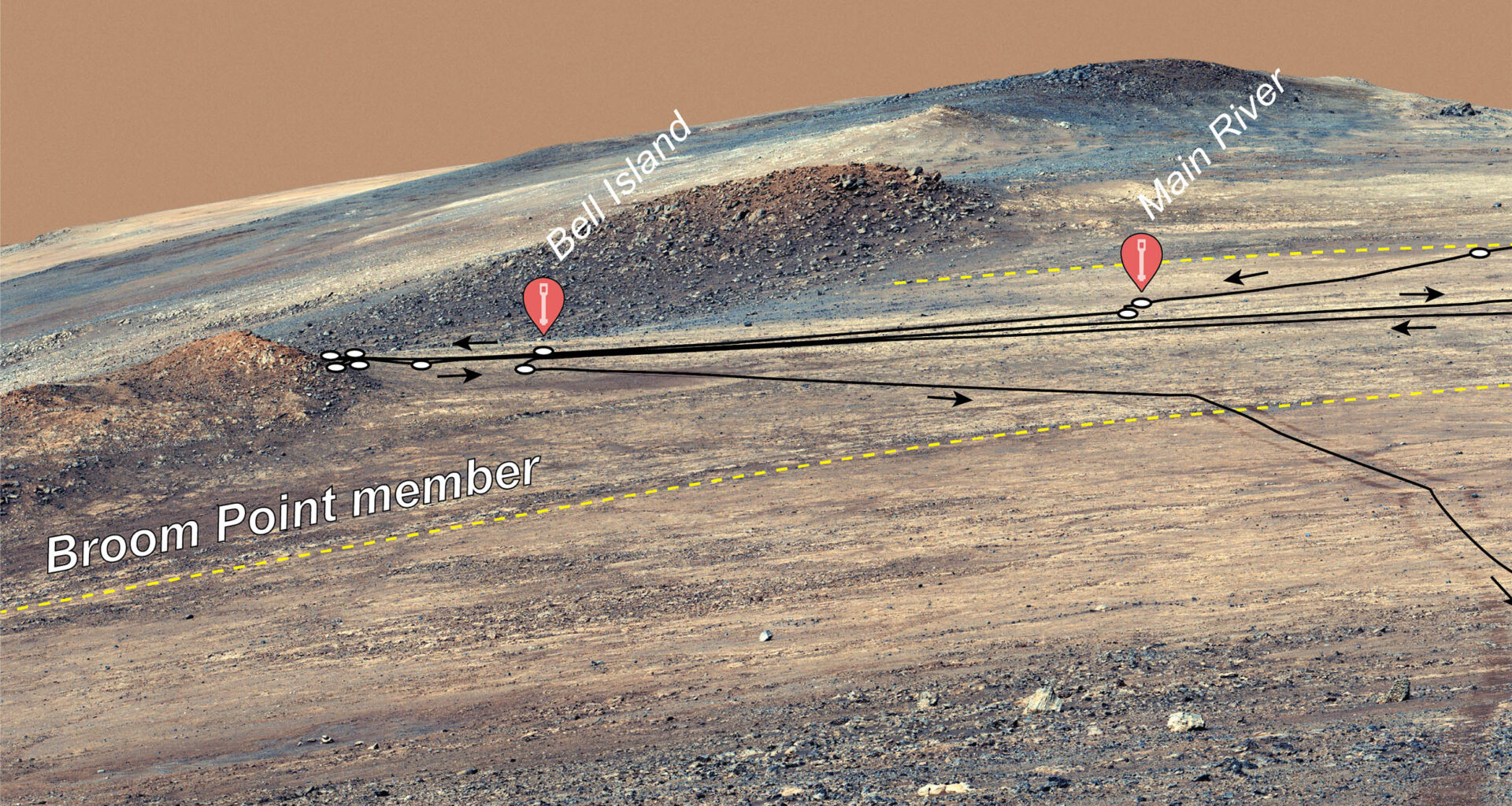
The newly studied formation is known as the Broom Point member. It is a stack of rock about 245 feet (75 meters) thick that preserves a series of repeating layers created over a long period of time.
The research shows that these residual layers were not produced by a single event.
Instead, they were built up as debris from asteroid impacts that fell across the region during one of the most violent periods in the solar system’s history.
Ken Farley at Caltech in Pasadena, California, said, “Since leaving the crater, Perseverance has been exploring a brand-new frontier, both geographically and geologically – a chapter of Martian time that predates the crater itself.”
“On Earth, our earliest geologic history has been fundamentally broken up, deformed, and erased by plate tectonics. Because Mars lacks plate tectonics to recycle its crust, this ancient record remains intact, giving us a rare glimpse into a geological time period that doesn’t exist on our own planet.”
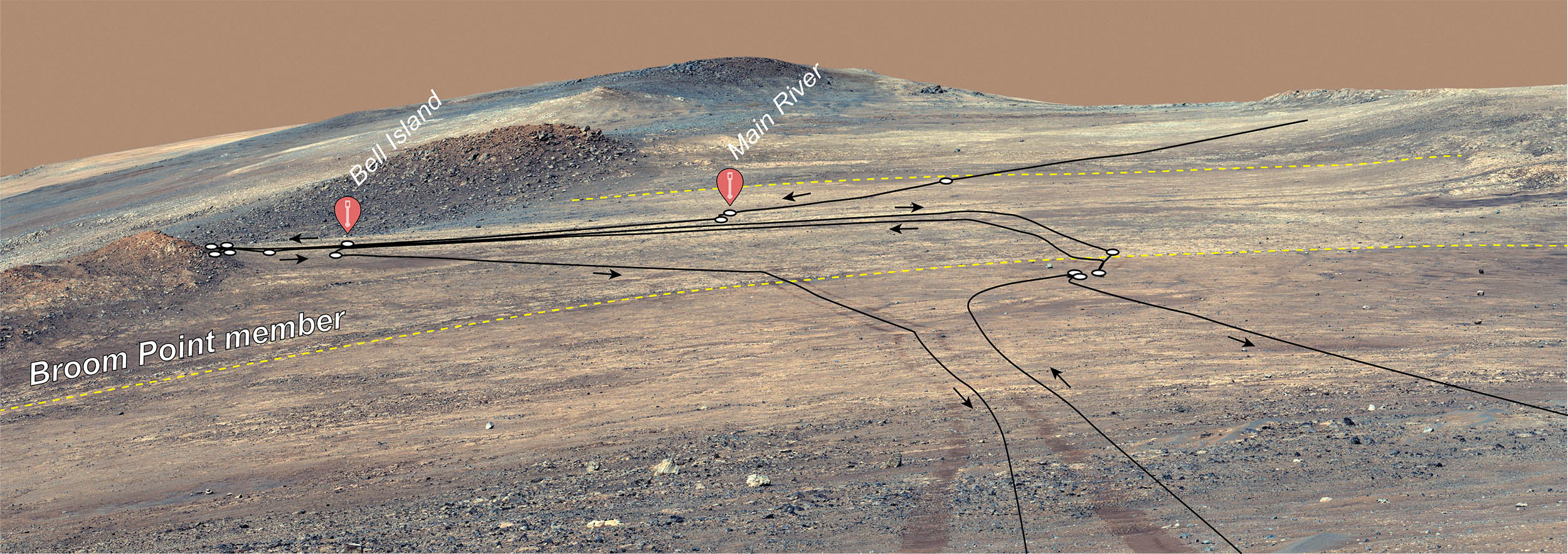 The bright-colored rocks exposed across the slope, running from middle left to middle right of the image, belong to a formation the science team calls the “Broom Point member,” a 245-foot-thick (75-meter-thick) stack of ancient rock. . Credit: NASA/JPL. Click image to enlarge.Clues from early Mars
After descending the western rim of Jezero Crater in early 2025, Perseverance examined Broom Point with its onboard science instruments.
The rover identified six different rock types, including breccias made of broken rock fragments mixed with layers of fine rock dust.
Some of the rock fragments contain small cavities left behind by gas bubbles, showing they were once molten.
Scientists also found many tiny, dark, glassy beads scattered throughout the layers.
Volcanoes can produce similar beads, but not usually in such large numbers. That makes asteroid impacts the most likely explanation.
The largest beads are comparable in size to material thrown into the air by the Chicxulub impact that contributed to the extinction of the dinosaurs on Earth about 66 million years ago.
Shaped by collisions
The repeating pattern of rock types tells scientists that impacts happened over and over instead of during a single catastrophe. Each event added another layer to the growing rock sequence.
Alex Jones at Imperial College London said, “The different rock layers are a record of variable-sized impacts occurring at different distances from where this rock sequence was accumulating. Some large impacts took place very far away, some small impacts nearby. Their debris all ended up landing here, constructing this thick section of rock.”
Some layers also appear to have formed from fast-moving debris flows traveling close to the ground.
On Earth, similar flows can happen when extremely hot material crashes into water or ice, creating large amounts of steam in an instant.
That raises the possibility that water or ice may have played a role as these Martian rocks formed.
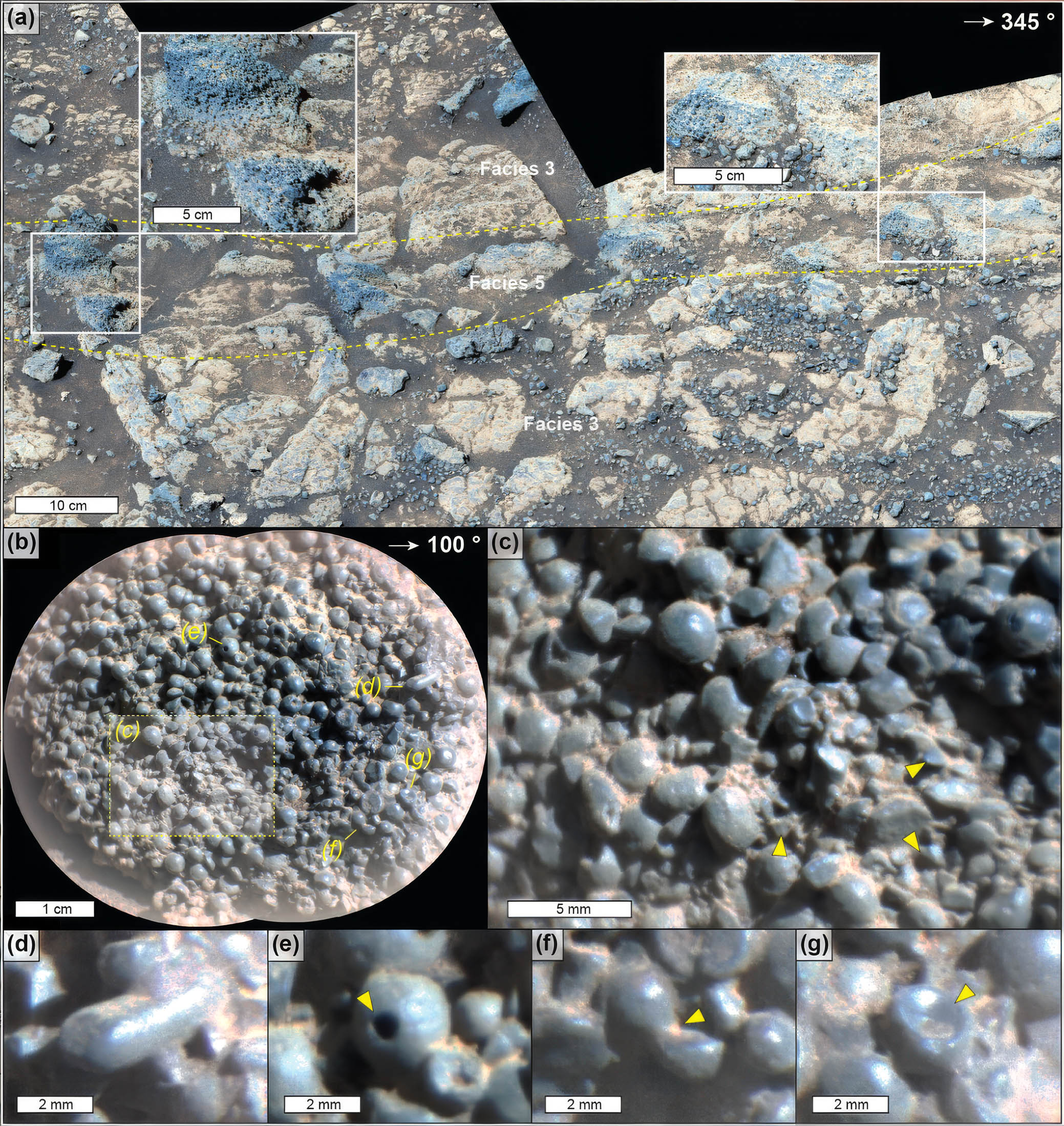 Images of Facies 5, a well-sorted, framework-supported spherule-bearing layer in the Broom Point stratigraphy. This points to repeated asteroid impacts at Jezero Crater on Mars. Credit: NASA/JPL-Caltech/ASU/MSSS/L. Mehall. Click image to enlarge.Impact altered everything
Scientists noticed that several rock layers now stand at angles greater than 80 degrees, making them nearly vertical. The impact that formed Jezero Crater cannot fully explain such steep tilts.
Instead, researchers believe Mars experienced two major asteroid strikes separated by time.
The first created the Isidis Basin, a massive impact basin about 1,200 miles (1,930 kilometers) across. That collision likely tipped and disturbed the originally flat rock layers.
Later, another asteroid struck the region, creating Jezero Crater, which spans about 28 miles (45 kilometers). That second impact broke apart and lifted the tilted rocks into the formations visible today.
Unlocking Mars’ timeline
To better understand when these events happened, the Perseverance team collected two rock core samples named Bell Island and Main River.
If a future mission returns those samples to Earth, scientists could determine the ages of the rocks with precise laboratory instruments.
Those measurements could also help researchers estimate how often asteroids struck not only early Mars but also the young Earth.
Most evidence from Earth’s earliest history disappeared long ago because plate tectonics constantly reshapes the planet’s surface.
Mars, with its much older and less disturbed crust, has preserved that record.
Jones said, “During this violent era, it wasn’t rain or snow falling from the sky, but an almost constant barrage of molten rock droplets and pulverized dust kicked up by asteroid impacts. If we can pin down the ages of these layers, it would be like reading a cosmic weather report from 4 billion years ago.”
This study was published by AGU.
—–
Like what you read? Subscribe to our newsletter for engaging articles, exclusive content, and the latest updates.
Check us out on EarthSnap, a free app brought to you by Eric Ralls and Earth.com.
—–