
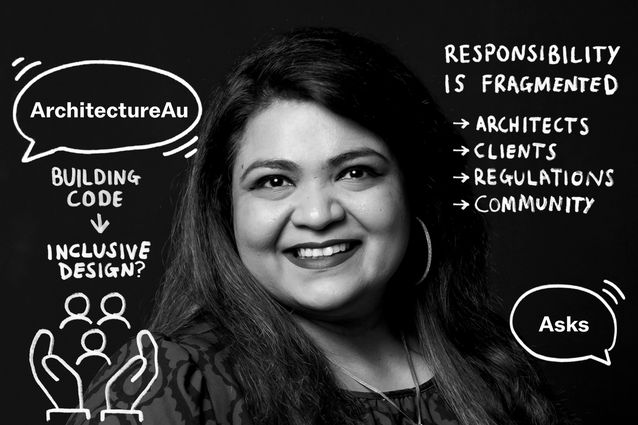
Increasingly, the built environment industry is aspiring to create places with a sense of belonging for diverse occupants, responding to specific religious, cultural and social needs as far ranging as neurodiversity through to impaired mobility. Yet, whether a design is made genuinely inclusive is still largely driven by architects’ and their clients’ values. Does Australia’s building code need clear standards for the design of inclusive environments, alongside those for fire safety, structural integrity, accessibility and environmental performance?
Australia’s building code is a powerful document. It doesn’t just regulate construction – it defines what we consider essential. Safety, health, amenity and accessibility are treated as non‑negotiable. Belonging, however, is treated as optional.
Right now, whether a building supports neurodivergent users, accommodates cultural or religious practices, or recognises bodies and identities beyond a narrow norm is largely left to the values of architects and their clients. That means inclusion is uneven, fragile and too-often absent. Good intentions are doing the work that policy refuses to do.
I don’t think belonging should sit outside regulation. If the built environment actively shapes who feels welcome, who feels surveilled and who feels excluded, then inclusive design is not just a social issue – it’s a public one. Public responsibilities require standards.
This doesn’t mean the building code should attempt to codify culture or prescribe identity; but it can set clear minimum expectations: requirements for sensory modulation and retreat in public buildings; spatial flexibility that allows for different cultural and social uses; dignified facilities for diverse bodies; and, critically, mandated engagement with affected communities as part of the design process. These are just some of the options that can be put into place.
Some needs will always require architectural judgement and contextual research – and that’s as it should be; but when belonging relies solely on discretion, it becomes a privilege rather than a right – and hence an option.
If we believe safety and accessibility are worth regulating, then the conditions that allow people to feel they belong should be regulated too. The question isn’t whether we can codify inclusive design – it’s why we’ve been willing not to.
– Pragya Gupta is a senior associate at Gray Puksand and a registered architect with Asia-Pacific experience across commercial, education, hospitality, senior living and infrastructure projects. She advocates for equity and inclusion, leading Gray Puksand’s Diversity, Equity and Inclusion group, and founding Wine and Shine and Multicultural Association of Property Professionals Inc. to support women and multicultural professionals across the built sector.
This article is one of four responses to the same question: “Our building code ensures occupants’ safety, amenity, health and accessibility – what about their sense of belonging?” Read Justine Clark’s response to the same question here, Allen Kong’s here. Stay tuned for a response from Angelo Candalepas.