
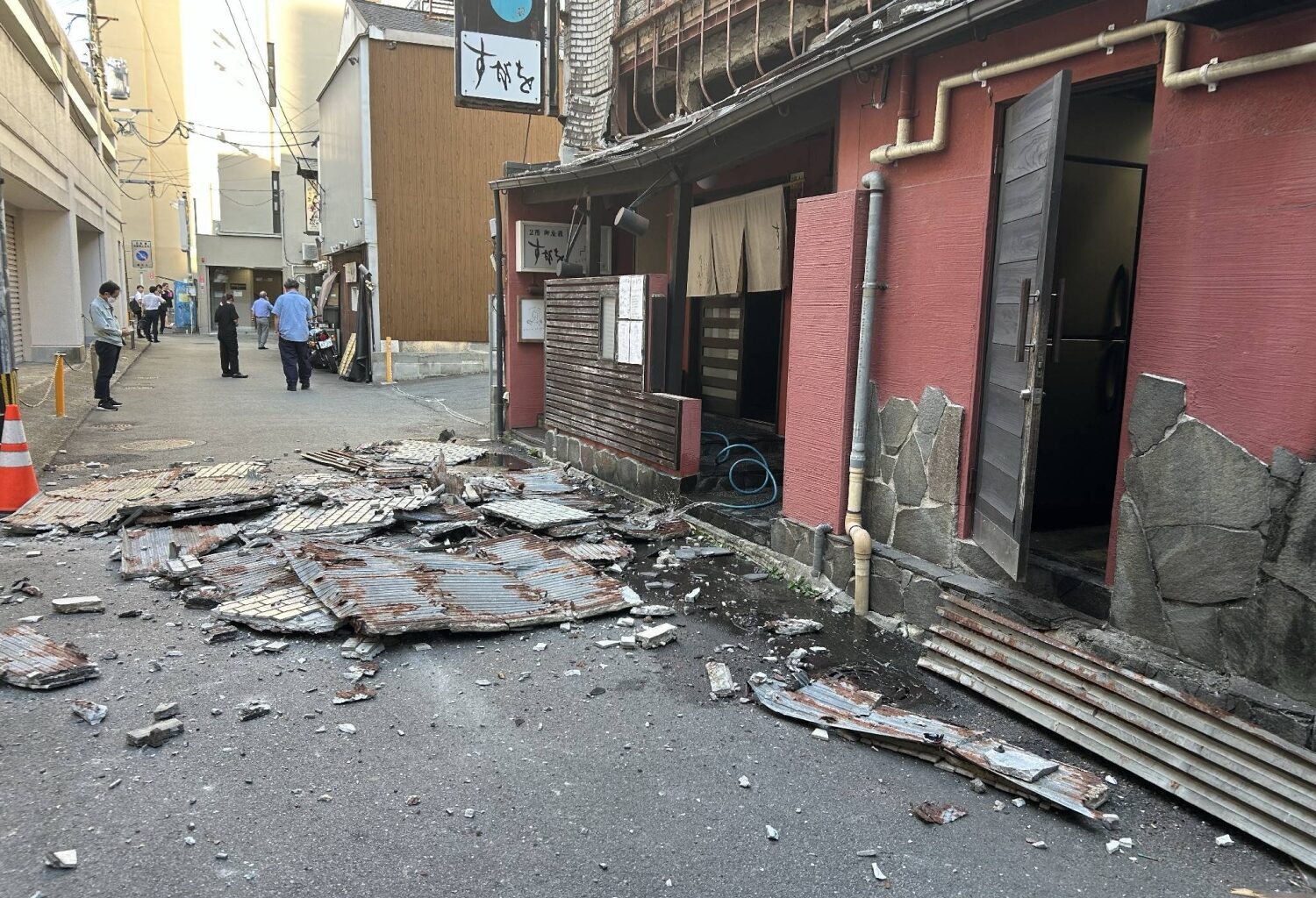
A magnitude 7.1 earthquake struck Kumamoto Prefecture in the Kyushu region on Tuesday at 4:35 p.m., registering up to shindo 7, the highest level on the Japanese seismic intensity scale.
An aftershock of up to a weak 5 hit the same area about 30 minutes later as authorities urged residents to remain vigilant for more large quakes.
Footage on NHK showed several collapsed buildings near the epicenter of the quake. The fire department in the city of Uki reported to the broadcaster that it had received many emergency calls as numerous fires broke out in the city.
The weather agency issued a tsunami advisory for coastal areas of the Ariake and Yatsushiro seas, urging people to stay away from the coast.
At a hastily organized news conference, the government’s top spokesman warned that tsunami waves of approximately 1 meter were expected. Chief Cabinet Secretary Minoru Kihara also said that no abnormalities had been detected at the country’s nuclear power plants, including the Sendai facility in Satsumasendai, Kagoshima Prefecture.
The first tsunami wave was believed to have arrived in those seas shortly after the quake. More waves were expected to arrive at any point.
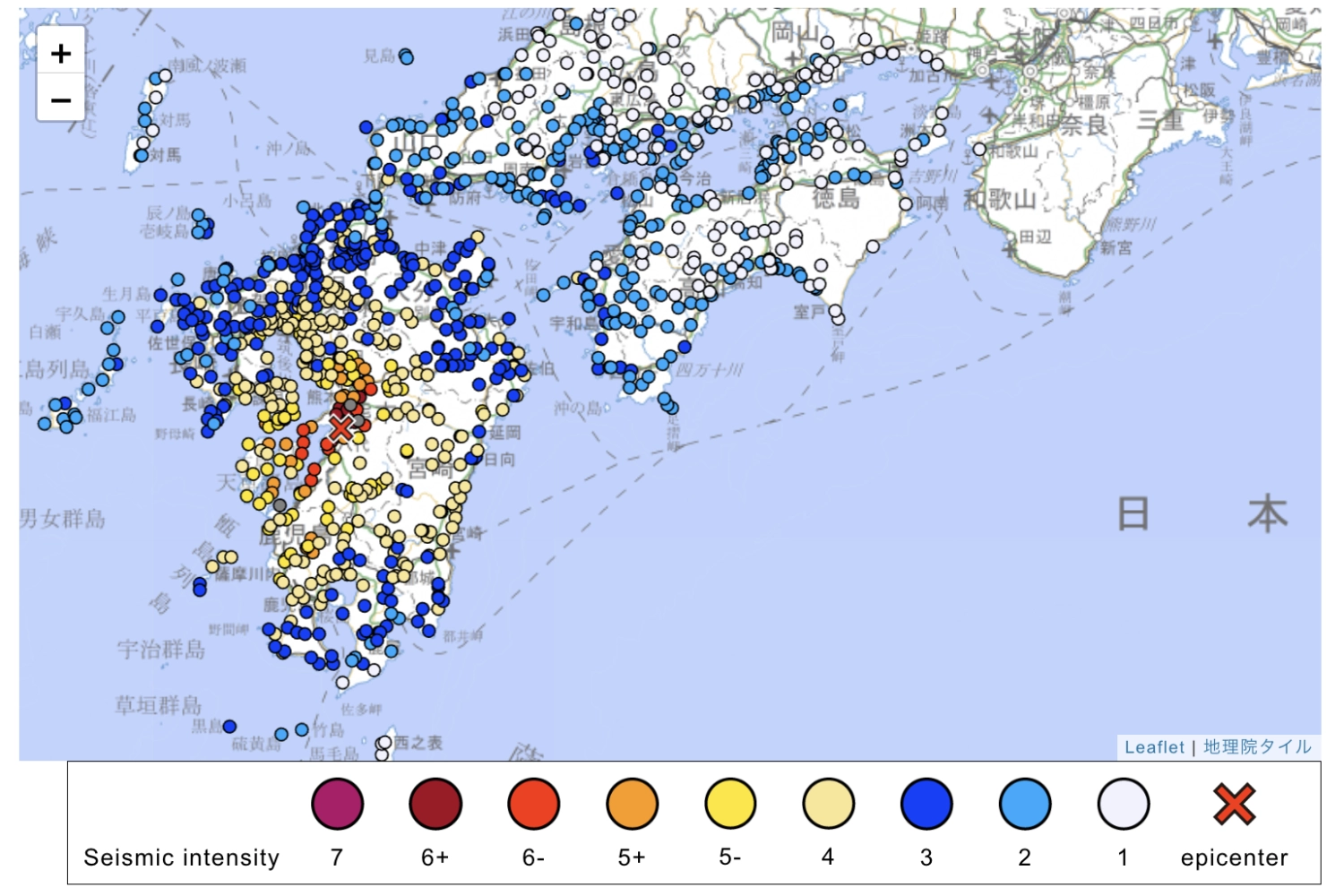
The epicenter and seismic intensity of Tuesday’s earthquake is shown on a weather agency map.
| Japan Meteorological Agency
A rare shindo 7 was observed in the cities of Uki and Hikawa. At that level, people cannot stay standing and may be thrown into the air, while unsecured pieces of furniture are likely to topple over or be tossed up in the air. Reinforced concrete walls may collapse.
A strong 6 on the shindo scale was observed in the cities of Yatsuhiro, Uto and the towns of Mashiki and Misato, as well as the city of Kumamoto’s Minami Ward.
In a post to X, Prime Minister Sanae Takaichi urged those in the quake-hit areas “to remain vigilant for the possibility of another earthquake of similar magnitude,” adding that the government was working to assess the extent of damage “as quickly as possible.”
Other cities in Kumamoto, as well as the neighboring prefectures of Nagasaki, Kagoshima, Fukuoka, Saga and Miyazaki, also felt strong shaking of a lower 5 or stronger on the Japanese scale.
The quake’s epicenter was in the city of Uki, just south of the city of Kumamoto, at a depth of 10 kilometers.
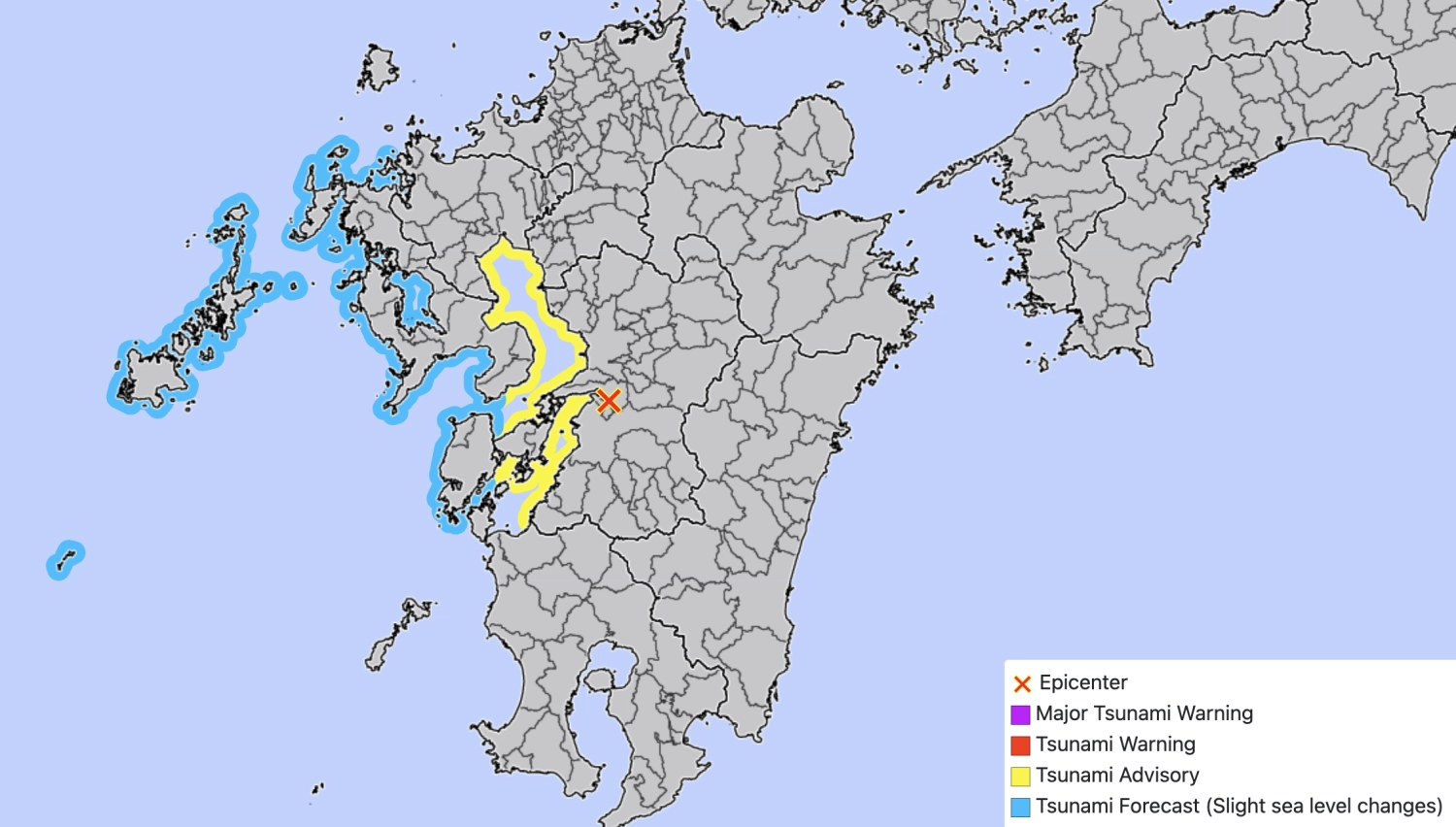
A tsunami advisory was issued for the Ariake and Yatsushiro sea areas, shown in yellow on a weather agency map.
| Japan Meteorological Agency
Electricity was out for about 48,300 households in Kumamoto Prefecture, according to Kyushu Electric. The company is asking people not to touch severed electricity lines, and notify them of any abnormalities.
The quake comes just over 10 years after two separate earthquakes rocked the city of Kumamoto in April 2016, leaving 278 people dead and injuring another 2,800.
Kumamoto Castle sustained heavy damage in the quakes and restoration work is not due to be completed until 2052.
This is a developing story. Updates to follow.
More information: