
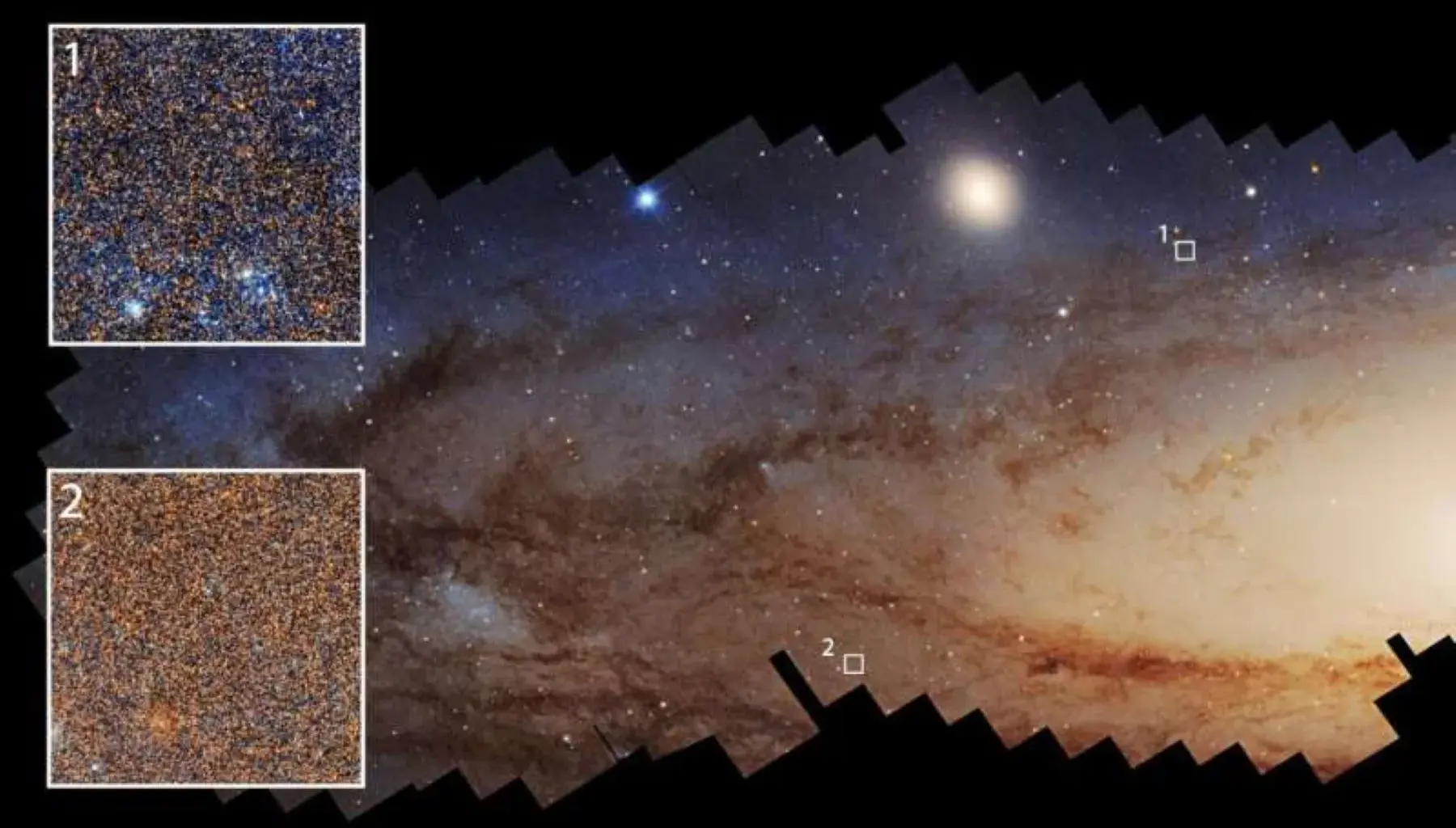
The Andromeda galaxy, our Milky Way’s nearest big neighbor, gives astronomers a close-up view of another galaxy. Using NASA’s Hubble Space Telescope, scientists mapped two-thirds of Andromeda’s disk in sharp detail, measuring about 200 million stars. From this massive dataset, they discovered that star formation there has been steadily declining for the past 500 million years, with a sharper drop in just the last 40 million.
“We need to measure the individual stars because they are the fossil record of the galaxy’s formation. Hubble is the only telescope that can give you high enough spatial resolution over a large enough area to be able to do that in Andromeda,” said Ben Williams, an astronomer at the University of Washington and a co-author of the study.
Massive stars burn hot and blue but live fast and die young, while smaller stars glow red and endure much longer. That means regions with recent star birth shine bluer, while older areas look redder. To trace Andromeda’s history, the team divided its images into thousands of squares, each about 300 light-years wide, and mapped the star formation in each.
They found that the galaxy had a dramatic burst of star birth about 2 billion years ago, likely triggered by a galactic encounter, but since then activity has steadily faded. About 500 million years ago, Andromeda was still forming stars at roughly one Sun’s mass per year. By 40 million years ago, that rate had halved, and today it has dropped even further, to just one-fifth of a solar mass annually.
Most-detailed radio image of Andromeda galaxy to date
The team looked at whether Andromeda’s slowdown in star birth was spread evenly across the galaxy or focused in certain regions. They found most recent activity clustered in a star-forming ring about 32,000 light-years from the center, and it’s the fading of this ring that drives much of the overall decline. Rather than running out of raw material, the galaxy seems to be naturally winding down from its earlier burst of activity.
As lead author Tobin Wainer put it, “It’s just like after running a marathon, you need to take a breather.”
The team also explored whether Andromeda’s slowdown in star birth might be linked to its small companion galaxy, M32. Although M32 appears only about 16,000 light-years away in the sky, its true 3D position is uncertain, leaving astronomers unsure if or when it has interacted with Andromeda.
“One of the major motivations for this program was to probe potential interactions between M32 and Andromeda’s disk,” explained co-author Zhuo Chen.
Using Survey data from the Panchromatic Hubble Andromeda Southern Treasury, the researchers studied star formation near M32. They found that activity there dropped compared with other regions, beginning around 60 million years ago. That timing could help pin down when M32 last brushed against Andromeda’s disk.
Milky Way may not collide with Andromeda
“We can’t explicitly say that we are seeing a decrease in star formation because of M32. But it’s right there, and it’s definitely the most likely suspect,” said Wainer.
The team will keep digging into Hubble’s rich archive and add ground-based data to sharpen the picture of Andromeda’s past.
“There’s strong scientific value in this archival data,” said Raja GuhaThakurta of UC Santa Cruz. “Andromeda matters because it’s close enough to study in detail, yet big enough to give us a global view.”
That global view will expand even further with NASA’s Nancy Grace Roman Space Telescope, launching as early as August 30. Roman’s wide field of view, 100 times larger than Hubble’s, will capture the entire disk of Andromeda and its surrounding halo in near-infrared light, measuring hundreds of millions of stars and opening the door to groundbreaking discoveries.
Journal Reference:
Tobin M. Wainer et al, The Panchromatic Hubble Andromeda Southern Treasury (PHAST). II. The Spatially Resolved Recent Star Formation History in M31, The Astrophysical Journal (2026). DOI: 10.3847/1538-4357/ae6db9