Mapped: The World’s Top Innovation Clusters
See visuals like this from many other data creators on our Voronoi app. Download the app for free on iOS or Android and discover data-driven charts from a variety of trusted sources.
Key Takeaways:
China hosts 24 of the world’s top 100 innovation clusters, surpassing the U.S. (22) for the largest number of leading hubs.
The world’s top 10 innovation clusters generate nearly 40% of global patent filings, showing how concentrated global innovation has become.
Just 33 economies account for all 100 leading clusters, which together represent roughly 70% of global patent applications and venture capital activity.
Innovation is often discussed at the national level, but breakthrough technologies tend to emerge from smaller geographic hubs where researchers, startups, investors, and established companies interact closely.
Using data from the World Intellectual Property Organization’s (WIPO) Global Innovation Index 2025, this graphic ranks the world’s top innovation clusters based on scientific publications, international patent filings, and venture capital activity.
The rankings highlight where research, capital, and entrepreneurship are combining to create the world’s most influential innovation ecosystems.
Where Are the World’s Top Innovation Clusters?
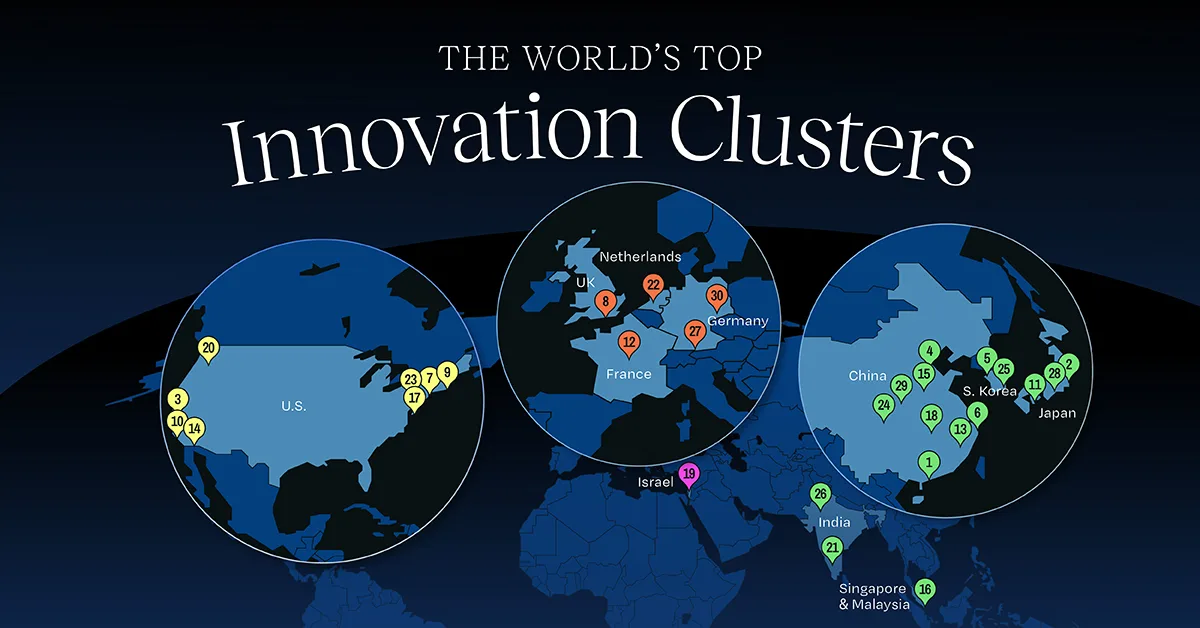
The table below shows the world’s leading innovation clusters according to WIPO’s 2025 rankings.
RankInnovation ClusterCountry
1Shenzhen–Hong Kong–Guangzhou🇨🇳 🇭🇰 China / Hong Kong
2Tokyo–Yokohama🇯🇵 Japan
3San Jose–San Francisco🇺🇸 United States
4Beijing🇨🇳 China
5Seoul🇰🇷 South Korea
6Shanghai–Suzhou🇨🇳 China
7New York City🇺🇸 United States
8London🇬🇧 United Kingdom
9Boston–Cambridge🇺🇸 United States
10Los Angeles🇺🇸 United States
11Osaka–Kobe–Kyoto🇯🇵 Japan
12Paris🇫🇷 France
13Hangzhou🇨🇳 China
14San Diego🇺🇸 United States
15Nanjing🇨🇳 China
16Singapore🇸🇬 🇲🇾 Singapore / Malaysia
17Washington–Baltimore🇺🇸 United States
18Wuhan🇨🇳 China
19Tel Aviv–Jerusalem🇮🇱 Israel
20Seattle🇺🇸 United States
21Bengaluru🇮🇳 India
22Amsterdam–Rotterdam🇳🇱 Netherlands
23Philadelphia🇺🇸 United States
24Chengdu🇨🇳 China
25Daejeon🇰🇷 South Korea
26Delhi🇮🇳 India
27Munich🇩🇪 Germany
28Nagoya🇯🇵 Japan
29Xi’an🇨🇳 China
30Berlin🇩🇪 Germany
31Chicago🇺🇸 United States
32Stockholm🇸🇪 Sweden
33Toronto🇨🇦 Canada
34Qingdao🇨🇳 China
35Denver🇺🇸 United States
36Sydney🇦🇺 Australia
37Austin🇺🇸 United States
38Houston🇺🇸 United States
39Hefei🇨🇳 China
40Zürich🇨🇭 Switzerland
41Taipei–Hsinchu🇹🇼 Taiwan*
42Copenhagen🇩🇰 Denmark
43Cologne🇩🇪 Germany
44Changsha🇨🇳 China
45Barcelona🇪🇸 Spain
46Mumbai🇮🇳 India
47Madrid🇪🇸 Spain
48Moscow🇷🇺 Russia
49São Paulo🇧🇷 Brazil
50Tianjin🇨🇳 China
51Minneapolis🇺🇸 United States
52Melbourne🇦🇺 Australia
53Raleigh🇺🇸 United States
54Stuttgart🇩🇪 Germany
55Brussels–Antwerp🇧🇪 Belgium
56Milan🇮🇹 Italy
57Chongqing🇨🇳 China
58Istanbul🇹🇷 Turkey
59Atlanta🇺🇸 United States
60Helsinki🇫🇮 Finland
61Dallas🇺🇸 United States
62Montréal🇨🇦 Canada
63Tehran🇮🇷 Iran
64Frankfurt am Main🇩🇪 Germany
65Eindhoven🇳🇱 Netherlands
66Vancouver🇨🇦 Canada
67Miami🇺🇸 United States
68Jinan🇨🇳 China
69Cambridge🇬🇧 United Kingdom
70Harbin🇨🇳 China
71Dublin🇮🇪 Ireland
72Changchun🇨🇳 China
73Portland🇺🇸 United States
74Vienna🇦🇹 Austria
75Shenyang🇨🇳 China
76Pittsburgh🇺🇸 United States
77Oxford🇬🇧 United Kingdom
78Phoenix🇺🇸 United States
79Mexico City🇲🇽 Mexico
80Zhengzhou🇨🇳 China
81Xiamen🇨🇳 China
82Rome🇮🇹 Italy
83Cairo🇪🇬 Egypt
84Chennai🇮🇳 India
85Oslo🇳🇴 Norway
86Kuala Lumpur🇲🇾 Malaysia
87Heidelberg–Mannheim🇩🇪 Germany
88Dalian🇨🇳 China
89Warsaw🇵🇱 Poland
90Lyon🇫🇷 France
91Hamburg🇩🇪 Germany
92Salt Lake City🇺🇸 United States
93Ningbo🇨🇳 China
94Manchester🇬🇧 United Kingdom
95Busan🇰🇷 South Korea
96Ann Arbor🇺🇸 United States
97Göteborg🇸🇪 Sweden
98Macau–Zhuhai🇨🇳 China
99Ningde🇨🇳 China
100Zhenjiang🇨🇳 China
China and the U.S. dominate the rankings, while innovation hotspots in Japan, South Korea, Europe, and India also feature prominently.
Shenzhen–Hong Kong–Guangzhou claims the top spot globally, followed by Tokyo–Yokohama and Silicon Valley’s San Jose–San Francisco corridor.
Unlike city rankings, WIPO’s clusters often span multiple metropolitan areas and even national borders. The organization uses a bottom-up methodology that identifies regions with dense concentrations of inventors and scientific authors, rather than relying on political boundaries. As a result, clusters often represent entire innovation ecosystems rather than individual cities.
The Concentration of Innovation
Innovation clusters emerge because talent, capital, and institutions tend to reinforce one another. Leading research universities attract scientists, successful startups attract investors, and large technology firms create opportunities for commercialization. Over time, these advantages compound.
This dynamic helps explain why a handful of regions consistently dominate global innovation. Silicon Valley benefits from world-class universities, deep venture capital markets, and a culture of entrepreneurship. Similarly, China’s leading clusters have been supported by sustained investment in research, advanced manufacturing, and technology commercialization.
The concentration of innovation has become an increasingly important factor in global economic competition. Recent analysis from Foreign Affairs argues that technological leadership is now a central pillar of geopolitical power, while research from CSIS highlights how government-supported R&D ecosystems can accelerate innovation capacity.
China’s Rise Reshapes the Innovation Map
One of the most notable trends in recent years has been the rapid rise of Chinese innovation clusters. Shenzhen–Hong Kong–Guangzhou now ranks as the world’s leading cluster, while Beijing and Shanghai–Suzhou also place among the global elite. China hosts more top-100 clusters than any other economy.
At the same time, the U.S. remains a dominant force in commercialization and venture capital. New York, Los Angeles, Boston, Seattle, and Silicon Valley continue to rank among the world’s most influential innovation ecosystems. In areas such as artificial intelligence innovation, American clusters continue to attract a disproportionate share of global investment and entrepreneurial activity.
Learn More on the Voronoi App 
To see how innovation leadership has evolved over centuries, and what today’s leading clusters might signal about the future, check out Long Waves: The History of Innovation Cycles on the Voronoi app.