
Back to Article List
The planet Mercury reaches magnitude 1.0 in the early-morning sky — see if you can catch it shortly before sunrise.
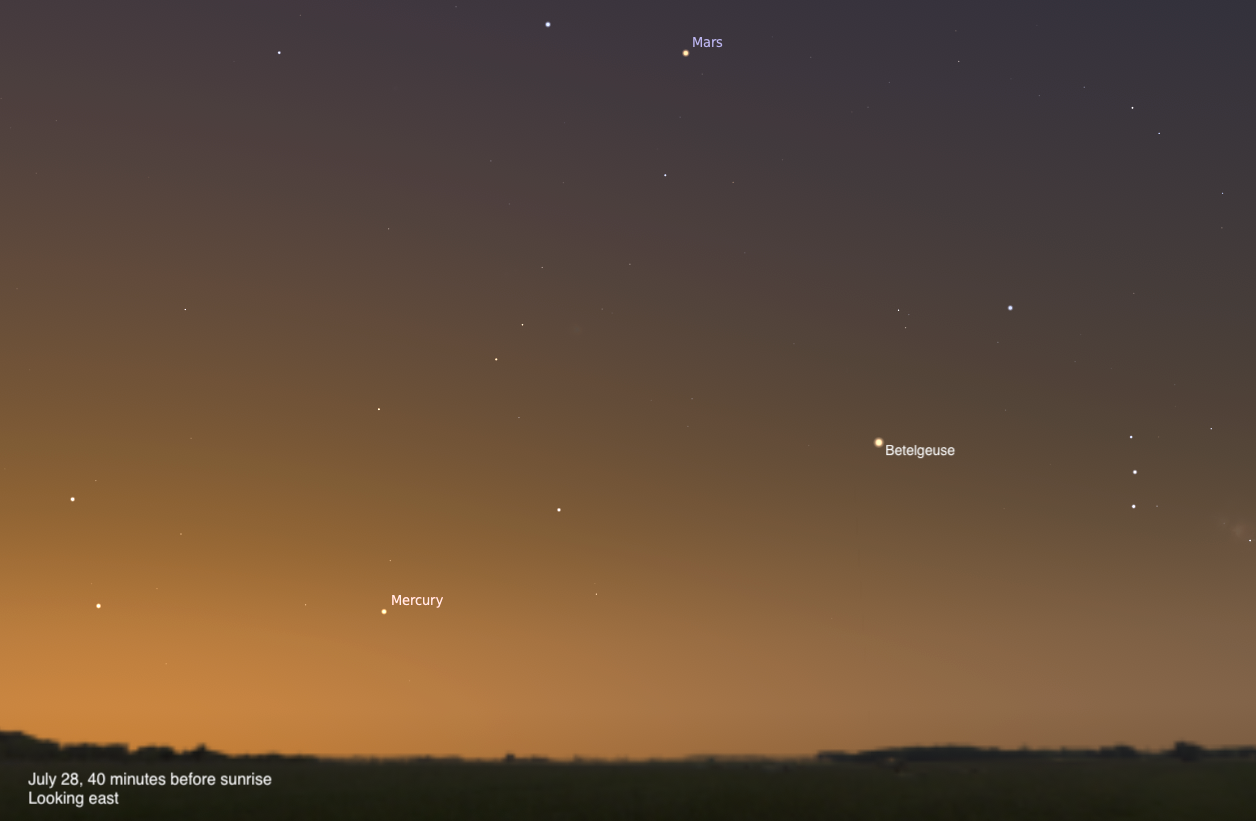
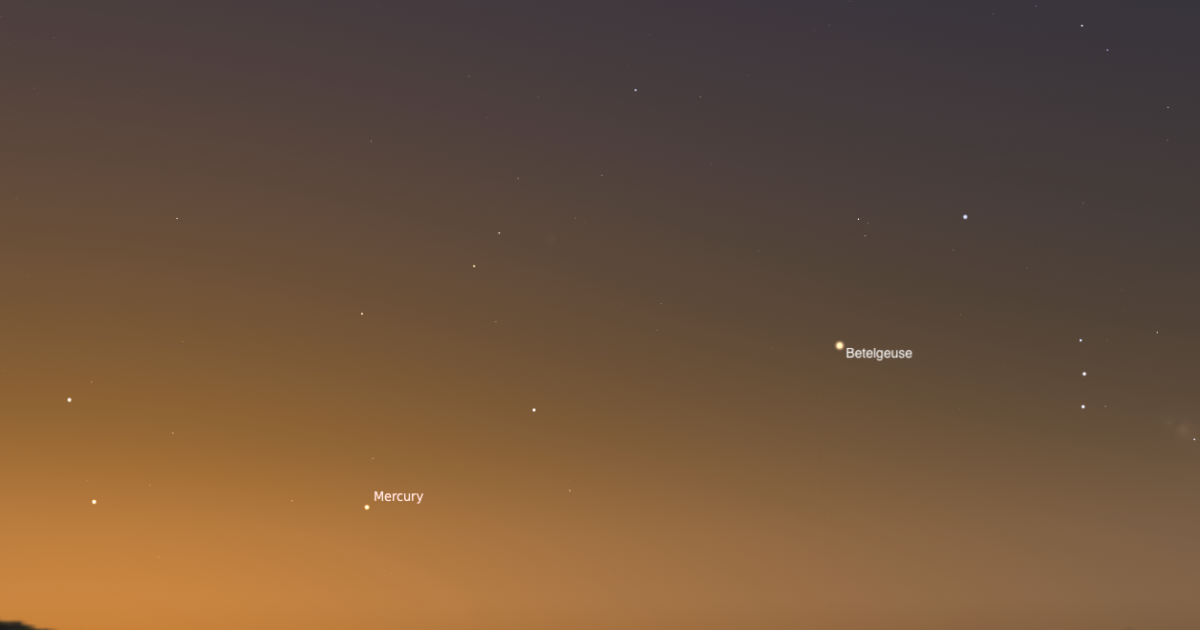
Look for Mercury, now magnitude 1.0, low on the horizon about 40 minutes before sunrise, as dawn begins to brighten the sky. Credit: Stellarium
Looking for a sky event this week? Check out our full Sky This Week column.
July 27: Saturn stands still
Mercury has reached magnitude 1.0 in the early-morning sky. Rising a little over an hour before the Sun, it reaches some 6° above the horizon 40 minutes ahead of sunrise. You’ll find it low on the eastern horizon, left of the fading stars of Orion the Hunter and far below and to the left of Mars in Taurus. The Red Planet, which shines a tad fainter at magnitude 1.3, will fade out of view first and may be harder to find in a broader swath of sky, while Mercury’s location just above the horizon will help in your search. If you use binoculars or a telescope to view the small planet, make sure you put them away well ahead of sunrise from your specific location, which may differ from the time given below.
Sunrise: 5:55 A.M.
Sunset: 8:17 P.M.
Moonrise: 8:06 P.M.
Moonset: 4:40 A.M.
Moon Phase: Full
*Times for sunrise, sunset, moonrise, and moonset are given in local time from 40° N 90° W. The Moon’s illumination is given at 10 P.M. local time from the same location.
Alison Klesman is senior editor of Astronomy magazine. She holds a Ph.D. in astronomy and has studied a variety of topics, from minor planets to supermassive black holes.