
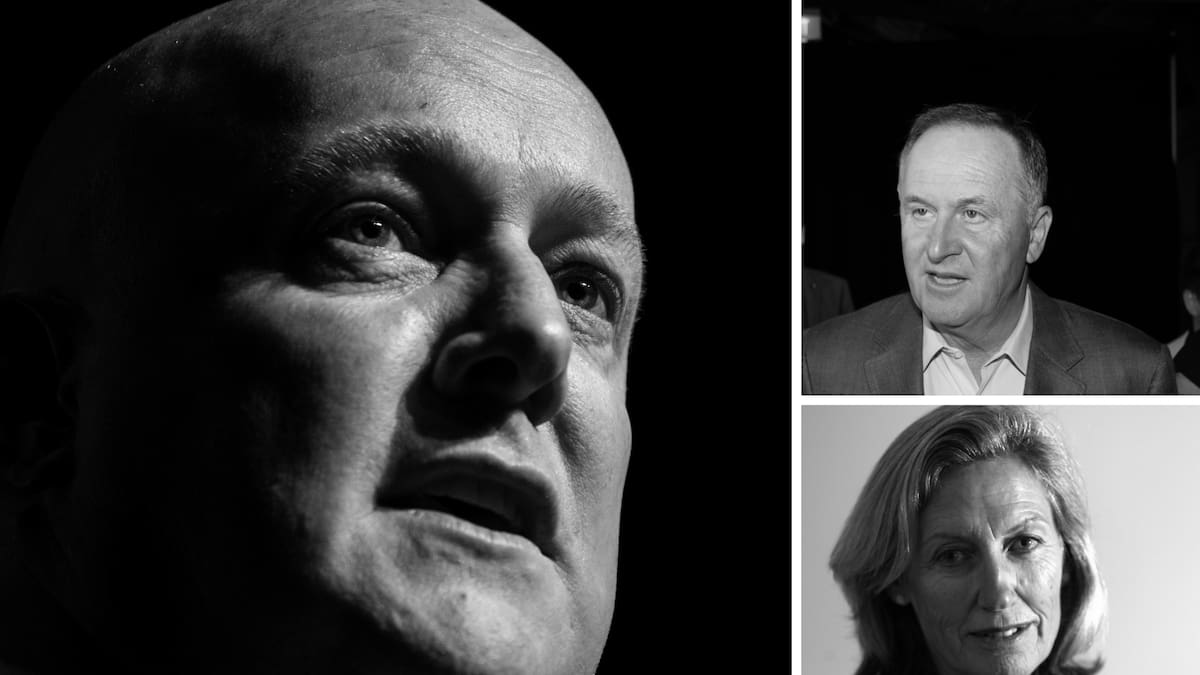
But Luxon’s transition from CEO to Prime Minister hasn’t been a smooth one, and what was initially seen as his great strength is often described now as his weakness.
Focus on his leadership is often negative, the result of falling support for National and/or preferred Prime Minister ratings, bad interviews or press conferences, his apparent inability to shake off his CEO language and style, or irritating sayings and habits.
His confirmation last night that National would not work with the Opportunity Party followed a press conference in which he would not commit one way or the other.
While there are clear signs of improvement in Luxon, you’ll hear a roll-call of Luxon’s offences in Auckland pubs or Wellington dinner parties.
“He always says ‘I say to you …’.”
“He’s too robotic.”
“He has no self-awareness.”
“He wears suits that are too small.”
“He buttons up his suit jacket.”
“Why does he keep saying he doesn’t need the job?”
“He sounds like a CEO, not a politician.”
Writer, publisher and former Act MP Deborah Coddington reflects on Luxon’s irritations.
“It’s like when your marriage starts going sour, you can’t even bear listening to them clean their teeth,” she tells the Herald.
When a politician is popular, she says, people don’t care about their little faults.
“When they’re not popular, those are the things that drive us insane. We can’t look at them.”
The story of Luxon’s polling popularity goes something like this: in the first year in office, both National and Luxon as preferred Prime Minister were ahead in most polls.
In the second year, he and National were fairly evenly matched with Labour and its leader Chris Hipkins, and in this, his third year, more often than not, he and National are lagging behind, even in polls that show the centre-right bloc ahead.
Luxon has also been copping it recently – not just from the Opposition – but from friends and supposed political allies.
When he gave an all-out effort to be an outstanding host to Indian Prime Minister Narendra Modi in Auckland this month, coalition partner Winston Peters referred on Herald NOW to Luxon’s “subservience and obsequious behaviour”, an astonishing thing for a Foreign Minister to say of a Prime Minister, and which he repeated again this week on Breakfast.
Two weeks ago, when broadcaster Paul Henry was announced as an Act candidate, he claimed not only that Luxon was “not clicking” with the public, but that he was not being his genuine self.
“I think Christopher has found it very hard to get a voice with ordinary people,” Henry said on Breakfast.
“He is not a John Key. I think he spent a lot of time trying to be a John Key. You’re better off concentrating on communicating yourself genuinely.”
Sir John Key says people should stop constantly wanting Christopher Luxon to change. Photo / Greg Bowker
It is a point that Key himself, a former Prime Minister, and a good friend of Luxon and Henry, strongly disputes.
“He’s 100% genuine,” says Key in a conversation from Scotland, hours before the Nash incident.
“The amount of time he puts into people, the genuine concern he has, I sit back and think ‘Wow, he’s doing such a better job than I did when I was Prime Minister’.
“I think we need to stop constantly saying Christopher needs to change and realise he’ll have a certain style.
“It might be a bit different to other people. But does that mean it’s wrong? No. And does that mean he needs to work on crisper, clearer communication? Yes. But a lot of what he is doing is really good.”
Key did point, however, to Luxon’s early communication problems, which he characterised as him not embracing the media right from the formation of the Government.
“He said: ‘Right, we’re not going to communicate, we’re just going to get on with it’.
“But what actually happens is you leave a void, and that void has to get filled, and it got filled by others.”
Key said the Opposition did a good job of saying that Luxon was “very corporate” and presented an image that was “uncaring”.
“Of course, he’s had a lifetime of living in that world and communicating in that style, but that doesn’t mean that’s the way he actually addressed things.”
And if Luxon tried to change his communication style to something more like Key’s, people would say he was fake; “that’s not who this guy is”.
“When you try to do something you’re not, but it’s just no longer authentic, people see through that as well.”
Luxon came to politics in 2020 after 26 years as a corporate leader, 18 years at Unilever and eight at Air New Zealand.
His appointment as Air New Zealand chief executive in 2012 gave him instant profile in New Zealand.
Christopher Luxon at his post-Cabinet press conference in the Beehive on Monday. Photo / Mark Mitchell
When he resigned in 2019 and made it clear he was interested in politics, he had no problem finding a home in the seat that former disgraced National MP Jami-Lee Ross had held.
But it was his 18 years at consumer-goods giant Unilever that allowed him to exercise management and branding skills at an international level, as former National MP Katherine Rich pointed out in a column on Newstalk ZB during the coalition negotiations in 2023.
It was shortly before she became chief executive of Business New Zealand, but she had worked with the likes of Unilever for more than a decade as the CEO of New Zealand’s Food and Grocery Council.
“You don’t become President of Unilever Canada by winning the job in a raffle,” she wrote.
And she believed his “Unilever DNA” would be a powerful asset for political management and success.
They were among the companies that were “the best in the world for training talent in every facet of management and leadership through a career”.
Rich identified several aspects of “the Unilever Way” she believed would influence his leadership, including being purpose-driven, having skills in negotiation, strategic planning, performance, marketing, branding and communications.
“The values, management training and leadership needed to succeed globally in Unilever are valuable skills for leading a small country, particularly one that needs what the Prime Minister-elect described as a ‘turn-around job’.”
She also pointed to the skill of “staying on message” acquired during two decades of consumer goods marketing but acknowledged it came across as “bland” during the campaign.
Much of what Rich predicted has come to pass, not necessarily in a positive way, but she declined to comment for this article.
Luxon’s ability to “stay on message” has been interpreted as him being too robotic or unable to answer straight questions, such as the famous interview last year with Mike Hosking in which he wouldn’t say if he would have sacked Andrew Bayly as a minister if he hadn’t resigned.
But he is driven by performance and outcomes, not least because National campaigned strongly against what it described as the previous Government’s lack of delivery.
Christopher Luxon at a public meeting in Feilding last week. Photo / Adam Pearse
The Government has set public service targets across health, education, housing, welfare, justice and environment and set up a delivery unit with the Department of the Prime Minister and Cabinet to monitor them.
Of course, the fact that Luxon had to do a deal with two experienced and colourful party leaders, in Peters from New Zealand First and Act’s David Seymour, has likely accentuated his image as a bland centrist.
Coddington is cutting about Luxon: “I think he is just shallow”.
“He’s not populist. He’s not authoritarian … he’s very blancmange really. He’s just vanilla.
“I can’t figure out what he really wants to be. Does he just want to please everyone? You know, you just can’t please everyone because you end up pleasing nobody.”
It was similar to comments by Paul Henry. He said he was enormously disappointed with National.
“What happens if you run a party that wants everyone to vote for them, is you end up doing nothing.”
Luxon is often compared to Key, as Henry did in suggesting Luxon was trying to be him. Others point to the fact that the conditions and numbers within the current Government arrangements are quite different from the previous National-led Government.
Key was seen as a statesman for inviting the Māori Party into Government in 2008, despite having enough support from Act and United Future to not need the Māori Party.
Key himself points to Luxon’s early challenges as Prime Minister, in having to deal not only with a coalition of three parties, each of which has a veto over the others, but with Act’s Treaty Principles Bill.
“His challenges have been made so much greater because he had to manage a coalition with two strong and experienced politicians,” says Key.
Agreeing to support the Treaty Principles Bill to select committee but no further was a compromise after Act had campaigned vigorously to hold a referendum on its bill.
It was finally voted down nearly halfway through the term of the Government.
“So sometimes the Government follows a policy which would not be one of the National Party’s making,” says Key.
“Even though people understand MMP superficially, they don’t realise that you can’t bully a coalition partner.
“If you push hard enough, the coalition by definition breaks apart, so it’s not an easy task.”
There is evidence this year that Luxon is working on some of the things that irritate people and is trying to change. He still uses corporate buzz words such as optionality and additionality, but fewer of them.
When he last appeared on TVNZ’s Q and A, in 2024, the Spinoff critiqued his performance, and noted he had said “what I say to you …” or variations of it, no fewer than 26 times.
Speaking at his public meeting in Feilding last week, he said it just once.
He has brought experienced broadcaster Rachel Smalley on to his staff as an adviser. He is using senior adviser Joe Ashcroft to help craft some better speeches. He appears more at ease in giving political answers, not just defensive ones, or answers that suggest he knows it all.
He appears to be caring less about offending coalition partners, NZ First in particular, in counteracting some of the party’s apparent anti-immigration positioning.
He has been impassioned in defending immigrants to New Zealand being used as political fodder by politicians akin to Pauline Hanson in Australia and Nigel Farage in Britain.
In his response to the Stuart Nash furore last Wednesday, he did not hesitate to say he would rather have his own MPs around the Cabinet table than “numpties” from other parties.
Key has noticed a change in Luxon as well, but at closer quarters.
“I actually think he is getting better and better,” he says.
“While you don’t see all of it, and it’s not obvious to people who aren’t close to him all the time, I think he has dramatically changed,” says Key.
Christopher Luxon is 100% genuine, says John Key. Photo / Sylvie Whinray
The pair spent a couple of hours together a few weeks ago.
“And it’s just obvious to me, the way he was talking, the way he was considering issues, his mindset has changed dramatically from what it would have been three years earlier.”
Key made particular reference to Luxon’s actions in April when he decided to shut down talk about his leadership by putting it to a caucus vote.
“I think when there was some talk about a leadership change, I suspect he had a good look at himself and said ‘if I really want this, I’ll have to fight for it’.
“And you’ve seen quite a different Christopher Luxon as Prime Minister in the last three months, in my view.”
When you come into the job with an economic focus, Key said, the aim was to get the books in better shape because once that had happened, you could afford the policies that the public wanted.
“But now he is starting to think a lot more about those social issues and about the fact that it’s not really just always about money.
“It’s not that he doesn’t want to be popular. I think he does. And it’s not that he doesn’t realise [he needs] to drop a few of the things that are a corporate way of speaking. He does.
“I’m just saying he is changing and it’s hard for people to see that change because they often come with a preconceived view.”
Key says Luxon should largely continue what he’s doing, which is to do the very best you can to get the job done “because there’s no question that the economy is turning”.
It is easy to find fault with people, he says, but the question is whether there is anyone who would be better to lead National in Government today.
“And the simple answer is not a person and not a chance.”